
Views: 284 Author: 广宇大 Publish Time: 2026-09-07 Origin: Site


Content Menu
● What Is a Manual Spray Booth?
>> Benefits of a Manual Spray Booth
>> Drawbacks of Manual Spraying
● What Is an Automated Spray Booth?
>> Benefits of an Automated Spray Booth
>> Limitations of Automated Spraying
● Automated vs Manual Spray Booth Comparison
● Total Cost of Ownership Matters
● Safety and Environmental Requirements
● Expert Decision Framework for Factory Owners
>> Choose a manual spray booth when:
>> Choose an automated spray booth when:
>> Choose a hybrid system when:
● Practical Automation Implementation Steps
● Final Recommendation and CTA
>> Request a Factory Assessment
>> 1. Is an automated spray booth always better than a manual spray booth?
>> 2. Can an automated spray booth reduce paint waste?
>> 3. Does a manual spray booth cost less to operate?
>> 4. Can automated equipment handle different colors and products?
>> 5. Does automation eliminate the need for spray operators?
>> 6. Which products are suitable for an automatic coating line?
>> 7. What information should a factory provide to a machinery manufacturer?
Choosing between an automated spray booth and a manual spray booth can directly affect your factory's coating quality, production capacity, labor costs, material consumption, safety, and ability to scale. For manufacturers of wooden doors, furniture, cabinet doors, flooring, glass, and fibre cement products, the right solution depends on more than the initial equipment price.
From an industrial finishing perspective, I recommend evaluating cost per accepted part, production consistency, product variety, and future demand before making a decision. A manual spray booth may be the right choice for customized, low-volume production. An automated spray booth is usually more suitable for factories that require repeatable quality, stable throughput, and long-term process control.
GYDFinishing, also known as GYD Machinery, has supplied machinery and surface-finishing solutions since 2007. With worldwide practical experience and more than two decades of technological heritage, GYD Machinery develops automatic coating equipment ranging from individual machines to complete turnkey production lines.
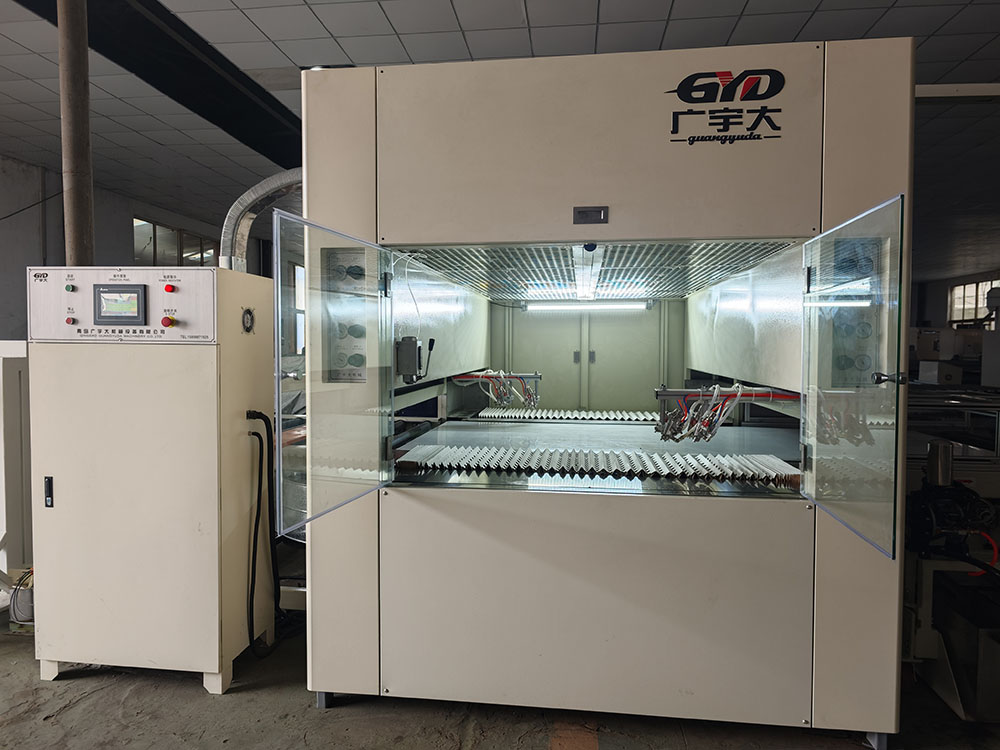
A manual spray booth is a ventilated enclosure where an operator applies paint, lacquer, stain, primer, or another coating with a handheld spray gun.
The operator controls:
- Spray distance and gun angle.
- Air pressure and material flow.
- Movement speed and spray overlap.
- Part positioning.
- Color changes and cleaning.
- Touch-up and visual inspection.
Manual spray booths are common in custom furniture factories, architectural-product workshops, repair operations, and small manufacturers producing many different product types.
A manual booth is not simply an empty room with an exhaust fan. It must be designed with appropriate ventilation, filtration, electrical protection, fire controls, and safe material-handling procedures. OSHA's spray-finishing standards address these areas, including ventilation and the handling of flammable and combustible materials. [osha]
Lower initial investment. A manual booth generally requires less capital than a fully integrated automated line.
Excellent flexibility. Skilled operators can spray products with unusual dimensions, complex shapes, or frequently changing designs.
Fast adaptation. A new product can often be introduced without extensive programming or robotics integration.
Suitable for craftsmanship. Experienced painters can respond immediately to wood grain, surface imperfections, edge conditions, and special appearance requirements.
Quality depends on the operator. Differences in spray speed, gun distance, pressure, and overlap can cause uneven film thickness, runs, dry spray, orange peel, or color variation.
Labor requirements increase with output. More production usually requires more trained painters or additional shifts.
Material waste may be higher. Excessive coating application and overspray can increase paint consumption.
Output is difficult to standardize. Fatigue, experience, breaks, and product complexity all influence productivity.
Exposure risks require close management. Operators may encounter paint mist and solvent vapors if ventilation, PPE, maintenance, or work practices are inadequate.
An automated spray booth uses programmed equipment to apply coatings with limited direct manual spraying. Depending on the product, the system may use reciprocating spray guns, automatic pumps, robotic arms, sensors, conveyors, or multi-axis applicators.
An automated coating system may include:
- Automatic loading and unloading.
- Conveyorized workpiece transport.
- Automatic spray guns or reciprocators.
- Robotic spray arms.
- Recipe-based PLC and HMI controls.
- Automatic color-change systems.
- Gun-cleaning equipment.
- Overspray filters and exhaust systems.
- Flash-off, drying, or curing equipment.
- Inspection and stacking stations.
For standardized products such as cabinet doors, wooden doors, panels, and flooring, the spray booth is often part of a complete automatic coating line. This line may connect sanding, dust removal, spraying, drying, quality inspection, and stacking into one controlled process.
Consistent coating quality. Programmed spray paths, speeds, distances, and pressures can be repeated accurately from one batch to the next.
Higher production capacity. Automated systems can maintain a predictable cycle time and support continuous production.
Lower labor per part. Operators can concentrate on loading, inspection, maintenance, and process control rather than manually spraying every surface.
Better process traceability. Digital recipes make it easier to reproduce a finish and identify process changes.
Improved material control. Stable spray parameters can reduce excessive film thickness and unnecessary overspray. Actual savings depend on coating chemistry, workpiece geometry, application technology, and system setup.
Reduced direct exposure. Enclosed automated equipment can reduce the time workers spend directly inside the spray area. However, automation does not remove the need for ventilation, PPE, training, and safe maintenance.
Higher capital expenditure. Investment may include the booth, spray equipment, conveyor, controls, drying system, installation, commissioning, and training.
Less suitable for extreme product variation. Automation performs best when product dimensions and coating requirements are sufficiently repeatable.
More technical maintenance. Maintenance personnel may need knowledge of sensors, pneumatics, pumps, PLCs, electrical systems, and spray technology.
Changeovers require planning. Frequent color or product changes can increase cleaning time and production downtime.
Integration determines performance. An automated booth cannot reach its target output if sanding, dust removal, loading, drying, or unloading is unreliable.
| Factor | Manual spray booth | Automated spray booth |
|---|---|---|
| Initial investment | Lower | Higher |
| Flexibility | Excellent for custom work | Best for repeatable products |
| Coating consistency | Operator-dependent | Highly repeatable |
| Labor demand | High | Lower per finished part |
| Production volume | Low to medium | Medium to high |
| Material control | Depends on operator | Precisely programmable |
| Product changeover | Usually simple | Requires recipes and cleaning |
| Maintenance | Relatively simple | More specialized |
| Traceability | Limited | Stronger with digital controls |
| Scalability | Requires more labor or booths | Supports integrated expansion |
| Best application | Custom and small-batch work | Industrial repetitive production |
The best option is not necessarily the cheapest machine. The better question is:
> Which spray booth produces the required quality at the lowest total cost per accepted part?
Many factories compare only the purchase price. This can lead to the wrong decision.
A realistic comparison should include:
1. Equipment purchase and installation.
2. Booth ventilation and make-up air.
3. Spray guns, pumps, robots, conveyors, and filters.
4. Labor and training.
5. Coating and solvent consumption.
6. Rework, rejects, and touch-up.
7. Electricity, compressed air, heating, and drying.
8. Preventive maintenance and spare parts.
9. Cleaning and color-change downtime.
10. Waste disposal and compliance-related costs.
Use the following formula as a starting point:
Cost per accepted part=(Labor+Coating+Energy+Maintenance+Rework+Depreciation)/ Accepted parts
The denominator should be accepted parts, not total sprayed parts. A process that appears inexpensive but creates more defects may become more expensive after rework, delays, and customer complaints.
Imagine a furniture factory producing standardized cabinet doors in several daily shifts.
A manual booth may require multiple painters to maintain output. As production increases, labor costs, training demands, and quality variation may also increase.
An automated spray booth may require a larger initial investment, but it can provide:
- More stable cycle times.
- Consistent spray paths.
- Lower dependence on individual operator technique.
- Easier replication of approved coating recipes.
- A clearer path to automatic drying and stacking.
For a custom workshop producing a small number of unique pieces, the same automated system may not deliver enough utilization to justify its cost. Equipment utilization is therefore a critical part of the investment calculation.
Both manual and automated spray booths must be engineered for safe operation.
OSHA identifies spray finishing as a specific regulated activity. Its requirements cover ventilation, flammable liquids, ignition sources, booth construction, electrical equipment, storage, and operating procedures. [osha]
Factories should evaluate:
- Mechanical ventilation and exhaust performance.
- Airflow stability and make-up air.
- Filter condition and replacement intervals.
- Electrical classification.
- Fire detection and suppression.
- Grounding and bonding.
- Solvent and coating storage.
- PPE and respiratory protection.
- Lockout/tagout during maintenance.
- Operator training and emergency procedures.
OSHA guidance also explains that ventilation must control flammable vapors and mists, and that dangerous concentrations may occur when vapors exceed a specified proportion of the lower flammable limit. [osha]
Environmental compliance is equally important. Surface-coating operations can generate volatile organic compounds, hazardous air pollutants, and particulate emissions. Applicable requirements vary according to the coating type, material usage, location, and local air-quality authority. The U.S. EPA maintains regulations and guidance for solvent-use and surface-coating industries. [epa]
An automated booth is not automatically environmentally compliant. It still needs correct exhaust design, filtration, maintenance, monitoring, and documentation.
Before choosing an automated or manual spray booth, collect real production data for at least several weeks.
Measure:
- Pieces produced per shift.
- Coating used per accepted part.
- Labor hours per accepted part.
- Rejection and rework rates.
- Average cycle time.
- Cleaning and color-change duration.
- Number of product sizes and shapes.
- Average order size.
- Current and forecast demand.
- Available floor space and utilities.
Then use this decision framework.
- Production volume is low or unpredictable.
- Products are heavily customized.
- Dimensions change frequently.
- Skilled finishing contributes significantly to product value.
- The factory is testing a new market.
- Capital availability is limited.
- Manual touch-up is a normal part of the process.
- Products are standardized.
- Demand is stable or increasing.
- Appearance and film thickness must be consistent.
- Labor availability is limited.
- Coating waste or rework is expensive.
- The factory needs measurable hourly output.
- The production plan includes automatic sanding, spraying, drying, or stacking.
- Most products are standard, but some orders are customized.
- The factory wants to automate high-volume products first.
- Manual spraying is still needed for special colors or irregular parts.
- Management prefers staged investment instead of a single large expansion.
A hybrid system can be an effective transition strategy. The factory automates its most repetitive product family, measures the results, and expands after confirming the return on investment.
A successful automated spray booth project should follow a structured process.
1. Define the workpieces. List dimensions, weight, material, surface condition, grain direction, and edge requirements.
2. Define the coating process. Specify water-based or solvent-based coatings, primer, topcoat, stain, lacquer, film thickness, and curing requirements.
3. Calculate required capacity. Include pieces per hour, shifts per day, peak demand, buffer capacity, and expected growth.
4. Select application technology. Evaluate reciprocating guns, robotic arms, flat-line systems, or other configurations.
5. Check utilities. Confirm electrical supply, compressed-air quality, ventilation, make-up air, heating, and drying capacity.
6. Design quality checkpoints. Establish inspection standards for color, gloss, adhesion, film thickness, defects, and curing.
7. Plan maintenance. Specify filter replacement, nozzle inspection, pump maintenance, gun cleaning, sensor checks, and control-system backups.
8. Conduct acceptance testing. Test representative products, including difficult surfaces and normal production variations—not only ideal samples.
GYD Machinery's experience with wood, glass, fibre cement, doors, furniture, cabinet doors, and flooring is valuable when the project requires more than a standalone booth. A complete solution may involve material handling, automatic spraying, drying, inspection, and line integration.
Add the following visuals to improve user engagement and explain the comparison quickly:
- Infographic: Automated spray booth versus manual spray booth by cost, labor, throughput, flexibility, and consistency.
- Process diagram: Sanding → dust removal → spraying → flash-off → drying → inspection → stacking.
- Annotated equipment image: Identify the conveyor, spray guns, filters, exhaust, control cabinet, and safety zones.
- Five-year cost chart: Compare labor, coating, maintenance, rework, energy, and depreciation.
- Factory video: Show cabinet doors or wooden panels moving through an automated coating line.
"Photorealistic modern industrial finishing factory, split-screen comparison of an operator using a manual spray booth on the left and an automated spray coating line with conveyor and reciprocating spray guns on the right, wooden cabinet doors and furniture panels, visible ventilation and filtration equipment, realistic engineering details, clean professional factory, wide editorial composition, high resolution, no logos, no text."
For a factory producing custom products in small quantities, a manual spray booth may offer the best combination of flexibility, low investment, and skilled finishing control.
For a factory producing standardized wooden doors, furniture panels, cabinet doors, flooring, glass, or fibre cement products at medium or high volume, an automated spray booth is generally the stronger long-term choice. It can improve consistency, reduce labor dependence, stabilize throughput, and support expansion into a complete turnkey coating line.
The correct decision should be based on production data rather than equipment price alone.
Contact GYDFinishing / GYD Machinery to discuss your surface-finishing requirements. Provide your product dimensions, coating type, target output, current defects, and factory constraints. A professional machinery assessment can help determine whether your operation needs a manual spray booth, an automated spray booth, or a complete automatic coating line.
No. Automation is generally better for stable, repetitive, medium- and high-volume production. Manual spraying is often better for low-volume, custom, irregular, or frequently changing products.
It can reduce waste through repeatable spray paths, controlled gun distance, stable pressure, and consistent film thickness. Results depend on the coating, part geometry, transfer efficiency, equipment setup, and process control.
It usually costs less to purchase, but not necessarily less to operate. Labor, rework, inconsistent coating consumption, and limited throughput may increase the total cost per finished part.
Yes. Many systems can use programmable recipes for different products, spray paths, and coating parameters. Frequent color changes may still require cleaning and increase downtime.
No. Workers are still required for loading, unloading, inspection, maintenance, material preparation, quality control, and safe operation.
Standardized products such as cabinet doors, wooden doors, flooring components, furniture panels, glass sheets, and fibre-cement boards are often suitable when their dimensions and finishing requirements are repeatable.
Provide product dimensions, material, coating type, target film thickness, production volume, available floor space, energy services, drying requirements, quality standards, and future expansion plans.
1. [OSHA — Spray Operations: Standards] — Regulatory overview for industrial spray operations.
2. [OSHA — 29 CFR 1910.107: Spray Finishing Using Flammable and Combustible Materials] — Requirements for spray-finishing areas, ventilation, flammable materials, electrical systems, and safety controls.
3. [OSHA — Spray Finishing Operations Citation Guidance] — Guidance on ventilation and flammable-vapor concentration limits.
4. [U.S. EPA — Clean Air Act Guidelines and Standards for Solvent Use and Surface Coating] — Environmental regulations and guidance for solvent-use and surface-coating industries.
5. [National Small Business Environmental Assistance Program — Painting and Coating] — Overview of VOCs, hazardous air pollutants, and particulate emissions from coating processes.
6. [GYDFinishing — Automatic Spray Coating Line Advantages] — Manufacturer-oriented information about automatic coating applications for doors, furniture, and cabinet products.


