
Views: 284 Author: 广宇大 Publish Time: 2026-09-17 Origin: Site


Content Menu
● Introduction to Automatic Paint Systems
● Types of Automatic Paint Technologies
>> Reciprocating Automatic Paint Systems
>> Electrostatic Automatic Paint Systems
>> Powder Coating Automatic Systems
● Key Components and Operating Principles
>> Spray Application Technology
>> Motion Control and Path Planning
>> Conveyor and Workpiece Handling
>> Control Systems and Process Monitoring
● Advantages of Automatic Paint Systems
>> Superior Coating Quality and Consistency
>> Increased Production Throughput and Efficiency
>> Reduced Labor Costs and Operational Expenses
>> Material Efficiency and Cost Savings
>> Enhanced Workplace Safety and Environmental Compliance
>> Data Collection and Process Optimization
● Industrial Applications and Use Cases
>> Automotive Manufacturing and Components
>> Aerospace and Aviation Components
>> Furniture and Woodworking Industries
>> Consumer Electronics and Appliances
>> Metalworking and Industrial Equipment
>> Architectural and Building Components
● Implementation and Integration Considerations
>> Facility Requirements and Space Planning
>> Integration with Existing Production Workflows
>> Maintenance and Operational Requirements
>> Training and Skill Development
● Future Trends and Technological Developments
>> AI-Driven Path Optimization and Adaptive Control
>> Sustainability and Green Manufacturing
>> Industry 4.0 and Smart Manufacturing Integration
Automatic paint represents a revolutionary approach to industrial coating application that employs automated machinery, robotic systems, and computer-controlled processes to apply paint, primers, sealers, and protective finishes to products with exceptional precision, consistency, and efficiency that dramatically surpasses manual painting methods. These sophisticated systems have transformed manufacturing across diverse sectors including automotive, aerospace, furniture, consumer electronics, metalworking, and architectural components, enabling companies to achieve material savings up to 30 percent, reduce labor costs substantially, improve finish quality with unprecedented consistency, enhance workplace safety by minimizing worker exposure to hazardous fumes and chemicals, and increase production throughput while meeting increasingly stringent environmental regulations and quality standards. As global manufacturing continues evolving toward greater automation, sustainability, and data-driven optimization, automatic paint systems represent critical investments for competitive industrial operations seeking to maintain market leadership and operational excellence in demanding modern markets.
Robotic paint systems employ articulated robot arms equipped with precision spray guns, rotary atomizers, or electrostatic applicators to coat products with maximum flexibility for irregular shapes, complex geometries, and frequently changing product mixes. These systems offer six or more axes of motion, enabling robot arms to reach difficult angles, recesses, and variable orientations that fixed-axis machines cannot access efficiently. Modern painting robots incorporate advanced path planning software that generates optimal spray trajectories based on part geometry, ensuring consistent coating thickness even on complex three-dimensional surfaces. Leading manufacturers including ABB, FANUC, and specialized coating equipment producers create robots with explosion-proof ratings suitable for hazardous spray booth environments. Robotic systems excel at automotive body painting, aerospace components, custom furniture, and applications requiring frequent product changeovers without extensive retooling, providing versatility that fixed automation cannot match.
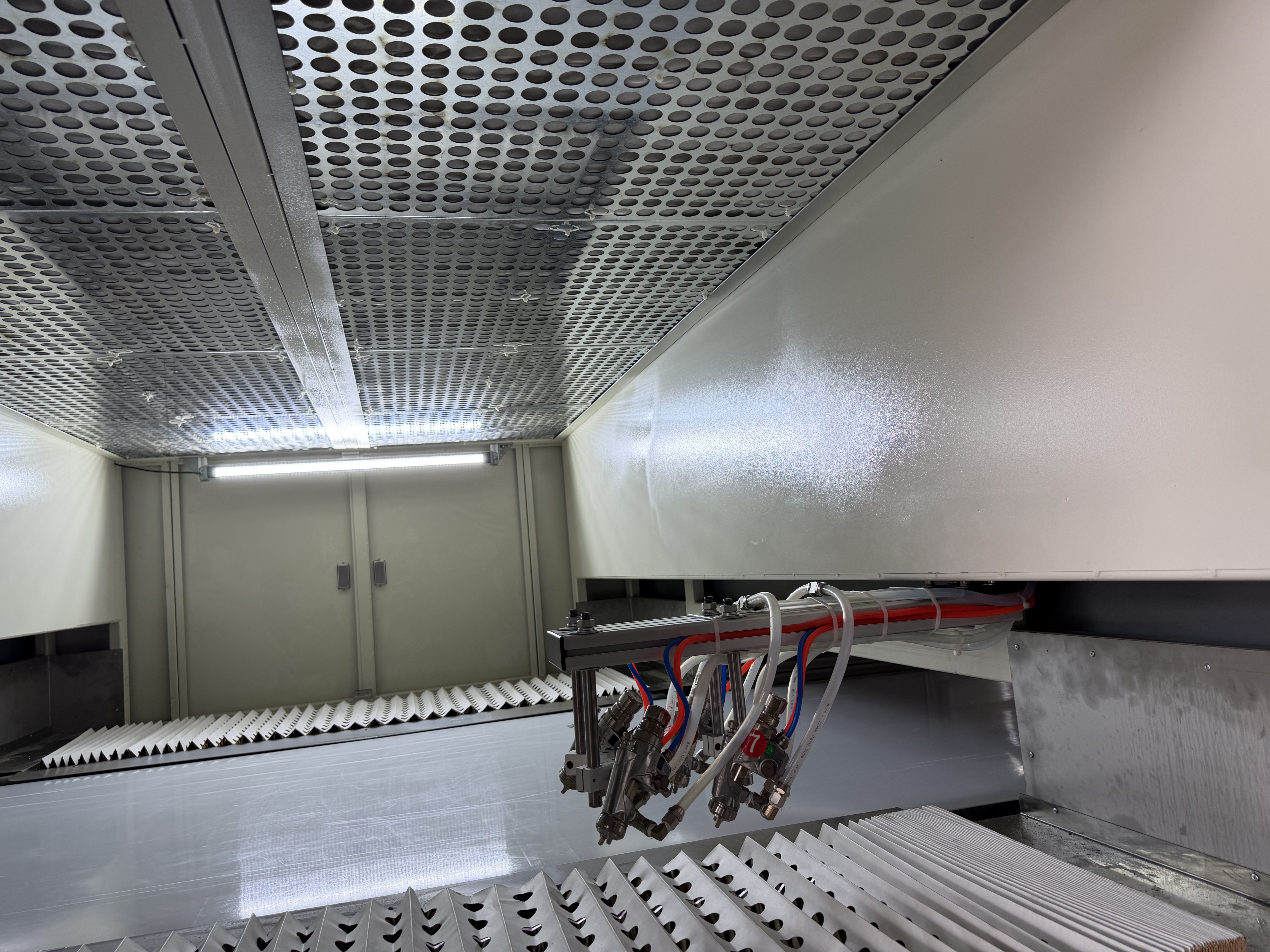
Reciprocating automatic paint systems feature spray guns mounted on carriages that move back and forth across the width of a conveyor system, applying coating material as workpieces pass underneath in controlled, repetitive motion. These systems excel at high-volume production of flat panels, standardized components, and linear workpieces where consistent spray distance and angle can be maintained throughout the coating cycle. The straightforward mechanical design offers excellent reliability, simple operation, and lower initial investment compared to more complex robotic systems. Reciprocating machines are particularly effective for furniture panels, architectural boards, metal sheets, and other flat or nearly flat workpieces requiring uniform coating coverage. Modern reciprocating systems incorporate automatic profile detection that activates spray guns only when workpieces are present, optimizing material usage and reducing waste significantly.
Electrostatic automatic paint systems incorporate electrostatic charging technology that imparts electrical charge to coating particles, causing them to be attracted to grounded workpieces with remarkable efficiency. These systems achieve transfer efficiency of 85 to 95 percent compared to 30 to 60 percent for manual spraying, dramatically reducing material consumption and overspray waste. The electrostatic attraction causes paint particles to wrap around workpieces, coating back sides and recessed areas that conventional spraying cannot reach effectively. Electrostatic automatic systems are particularly valuable for metal components, automotive parts, appliances, and any conductive workpieces where the electrostatic effect can be fully utilized. The combination of automated precision with electrostatic efficiency produces exceptional material savings and environmental benefits while maintaining high finish quality.
Powder coating automatic systems apply dry powder coatings electrostatically to workpieces, which are then cured in ovens to create durable, high-quality finishes without solvents or volatile organic compounds. These systems offer environmental advantages including zero VOC emissions, minimal waste generation, and the ability to recycle oversprayed powder for reuse. Automatic powder coating provides consistent film thickness, excellent coverage on complex geometries, and superior durability compared to liquid coatings. Applications include automotive wheels, appliances, outdoor furniture, architectural aluminum, and industrial equipment requiring tough, weather-resistant finishes. The absence of solvents eliminates fire hazards and reduces ventilation requirements compared to liquid spray painting, creating safer work environments and simplifying regulatory compliance.
Spray application technology serves as the heart of any automatic paint system, responsible for atomizing and directing coating material onto workpiece surfaces with precise control over droplet size, pattern, and flow rate. Modern automatic systems feature high-volume low-pressure (HVLP) spray guns, airless spray guns, rotary bells, or electrostatic applicators optimized for automated operation. High-speed rotary bells spinning at 20,000 to 60,000 RPM atomize paint into fine, uniform particles that create smooth, consistent finishes with minimal orange peel. Electrostatic bells additionally charge paint particles, enhancing transfer efficiency through electrostatic attraction to grounded workpieces. Automatic gun cleaning mechanisms flush nozzles between cycles, preventing clogging and ensuring consistent spray patterns throughout extended production runs without manual intervention. Quick-change bell cups and nozzles enable rapid color changeovers, minimizing downtime in multi-color production environments.
Precision motion control systems govern the movement of spray guns throughout the coating cycle, coordinating multiple axes to achieve complex spray patterns while maintaining optimal gun orientation relative to workpiece surfaces. Servo motors and drives provide accurate positioning and smooth motion along programmed paths, maintaining consistent speed and acceleration for uniform coating application. Advanced path planning software generates optimal spray trajectories based on part geometry, coating requirements, and production parameters, ensuring complete coverage with minimal overspray. Some systems incorporate 3D vision scanning that automatically detects part geometry and generates spray paths without manual programming, significantly reducing setup time and enabling efficient small-batch production. AI-driven path optimization continuously tunes path speed, bell rotation, and trigger timing to maximize transfer efficiency without compromising appearance quality.
Conveyor systems transport workpieces through the spray zone at controlled speeds, ensuring proper exposure time for coating application while maintaining precise positioning for automated spray guns. Belt conveyors, chain conveyors, roller conveyors, overhead monorail systems, and rotating positioners each serve specific applications based on workpiece size, weight, and production requirements. Advanced systems incorporate automatic loading and unloading mechanisms that minimize manual intervention, further increasing productivity and reducing labor costs. Rotating and flipping positioners present multiple surfaces to the spray guns without manual repositioning, enabling comprehensive coverage in single automated cycles. Precision fixturing ensures repeatable part positioning, critical for maintaining consistent spray quality across production batches and enabling automatic systems to achieve results impossible with manual methods.
Modern automatic paint systems feature sophisticated control systems based on programmable logic controllers (PLCs) and industrial computers with color touchscreen interfaces that allow operators to program spray parameters including gun speed, flow rate, fan width, and motion paths for different products. Recipe management functions enable quick changeover between products by storing and recalling preset parameters for each part type, reducing downtime in multi-style production environments. Advanced systems incorporate diagnostic functions that monitor system performance, predict maintenance requirements, and alert operators to potential issues before they cause production disruptions. Data collection capabilities enable manufacturers to track coating consumption, production rates, and quality metrics for continuous improvement initiatives. Real-time monitoring allows operators to detect deviations from target parameters immediately, enabling corrective action before defects occur.
Automatic paint systems deliver consistently high-quality finishes with 95 percent or higher first-pass quality rates compared to variable results from manual application affected by operator skill, fatigue, and technique differences. The precise control over spray gun position, speed, orientation, and flow rate ensures uniform coating thickness across entire workpiece surfaces, eliminating the variations inherent in manual application. Robots maintain identical distance, angle, speed, and trigger timing on the tenth unit and the thousandth, producing unchanged quality while program and material parameters hold constant. This consistency is particularly important for automotive bodies, consumer electronics, and high-value furniture where appearance directly impacts product value and customer satisfaction. Reduced reject and rework rates of 30 to 60 percent lower defect rates in most implementations, further improving overall quality and reducing waste from defective finishes.
Automation dramatically increases production capacity compared to manual painting methods, with automatic systems operating continuously without breaks and maintaining consistent performance throughout multiple shifts. Processing speeds significantly exceed manual capabilities, allowing manufacturers to fulfill larger orders and respond more quickly to customer demands. Many facilities report production increases of 200 to 400 percent after implementing automatic paint systems. The elimination of manual handling between coating stages further reduces cycle time, while fixed cycle times enable reliable production planning and forecasting without factoring in human variability. Quick color changeover capabilities minimize downtime in multi-color production environments, with some systems changing colors in minutes rather than the 15 to 30 minutes typically required for manual changeovers. Continuous operation accelerates production cycles and improves overall equipment effectiveness.
Automatic paint systems significantly reduce labor requirements compared to manual finishing operations, with one operator often able to supervise multiple automatic cells compared to two or three skilled painters required for equivalent manual production. This reduction in labor dependence also mitigates challenges associated with skilled labor shortages, which increasingly affect manufacturing industries globally. The ability to mix and match products without costly tooling for product orientation eliminates downtime to change out spray setups, increasing operating flexibility. Robots enable higher levels of automation where human intervention can be eliminated in many operations, further reducing labor costs and improving operational flexibility. Reduced labor costs combined with increased throughput and material savings substantially improve cost per part and overall profitability.
Automatic paint systems optimize coating transfer efficiency, meaning more sprayed material reaches the workpiece rather than being lost to overspray. Precise control over spray parameters and gun positioning reduces material consumption by up to 30 percent compared to manual spraying, with electrostatic systems achieving transfer efficiency of 85 to 95 percent. This efficiency translates directly to lower material costs and reduced environmental impact through decreased VOC emissions and waste generation. On production lines consuming $500,000 annually in paint and coating materials, a 30 percent improvement in transfer efficiency returns $150,000 per year in material savings alone. The reduction in overspray also decreases booth filter loading, waste disposal costs, and VOC emissions, creating multiple layers of cost reduction that quickly justify equipment investment.
Automatic paint systems create significantly safer work environments by reducing operator exposure to hazardous volatile organic compounds, solvents, and airborne particulates associated with painting operations. Manual spray operations typically achieve 30 to 45 percent transfer efficiency, meaning 55 to 70 percent of solvent-containing paint is lost as overspray and emissions that workers breathe and that contaminate work environments. Automatic systems with electrostatic bells achieve 85 to 95 percent transfer efficiency, directly reducing both material consumption and VOC emissions by 60 to 70 percent compared to manual methods. Enclosed spray cells with integrated filtration systems capture overspray and volatile organic compounds, protecting workers and surrounding environments. These features help manufacturers comply with increasingly stringent occupational health and environmental regulations while reducing liability and insurance costs.
Many automatic paint systems can collect comprehensive data about the painting process including coating consumption, production rates, system performance, transfer efficiency, and quality metrics. This data enables manufacturers to identify optimization opportunities, troubleshoot issues proactively, and maintain rigorous quality control throughout production. Real-time monitoring allows operators to detect deviations from target parameters immediately, enabling corrective action before defects occur. Continuous atomization monitoring catches component drift before it silently erodes transfer efficiency over months. Historical data analysis supports continuous improvement initiatives by revealing trends, bottlenecks, and opportunities for further efficiency gains. AI-driven optimization tunes path speed and bell rotation together rather than independently, since transfer efficiency depends on both simultaneously, commonly achieving material savings in the range of 8 to 15 percent without any appearance quality tradeoff.
The automotive industry represents the largest and earliest adopter of automatic paint technology, utilizing these systems for priming, base coating, and clear coating on vehicle bodies with exceptional quality and efficiency. Automotive manufacturers require flawless finishes that meet stringent quality standards while maintaining high production volumes. Automatic paint systems enable automotive plants to achieve uniform coating thickness, consistent color matching, and superior gloss levels across thousands of vehicles daily. Leading automakers report 20 percent reduction in paint waste and 15 percent increase in throughput after integrating automatic systems. The ability to apply multiple coating layers including e-coat, primer, basecoat, and clearcoat in automated sequences further enhances efficiency and quality. Electrostatic automatic systems maximize transfer efficiency on conductive automotive bodies, minimizing material consumption and VOC emissions.
Aerospace manufacturers utilize automatic paint systems for coating aircraft components including fuselage panels, wing surfaces, engine components, and interior elements with specialized coatings that provide corrosion resistance, thermal protection, and improved aerodynamics. These applications often require exotic coating materials and precise thickness control that automatic systems deliver consistently across large, complex geometries. Seven-axis robots on linear tracks provide the extended reach necessary for coating large aircraft components while maintaining optimal spray distance and angle. The ability to program complex spray paths for irregular aerospace components ensures complete coverage while minimizing material waste of expensive specialty coatings. Regulatory compliance documentation generated by automatic systems supports the rigorous quality assurance requirements of aerospace manufacturing.
Furniture manufacturers utilize automatic paint systems to apply varnishes, lacquers, paints, stains, and sealers on wood surfaces with consistent gloss, color accuracy, and faster turnaround times compared to manual methods. These systems handle diverse coating types including water-based paints, UV coatings, solvent-based finishes, and specialty coatings with equal proficiency. The flexibility to handle various wood species, MDF, and composite materials makes automatic painting valuable across diverse furniture manufacturing segments. Automatic systems excel at coating carved furniture components, raised panel cabinet doors, and decorative millwork where complex geometries challenge manual spraying. Reduced rework rates and consistent quality significantly improve profitability in competitive furniture markets.
Consumer electronics manufacturers utilize automatic paint for coating smartphone casings, laptop enclosures, appliance exteriors, and electronic housings with durable, aesthetically pleasing finishes. These applications often require precise color matching, consistent gloss levels, and defect-free surfaces that automatic systems deliver reliably at high volumes. The ability to coat complex three-dimensional electronic enclosures with uniform thickness ensures both aesthetic quality and functional protection against scratches, chemicals, and environmental exposure. High throughput capabilities support the rapid production cycles typical of consumer electronics manufacturing. Quick color changeover capabilities enable efficient production of multiple product variants without extensive downtime.
Metalworking and industrial equipment manufacturers apply automatic paint systems for coating machinery parts, agricultural equipment, construction machinery, and industrial components with protective layers that prevent corrosion and extend service life. These applications often involve large, heavy workpieces that benefit from automated handling and coating application. The ability to apply thick protective coatings with consistent thickness ensures adequate corrosion protection while minimizing material consumption. Powder coating automatic systems provide particularly durable finishes for outdoor equipment and harsh environment applications. Automated systems also improve workplace safety by reducing worker exposure to hazardous coating materials and confined space entry requirements.
Architectural manufacturers utilize automatic paint for coating aluminum extrusions, window frames, door components, curtain walls, and building panels with durable finishes that withstand environmental exposure while maintaining aesthetic appeal. These applications often require consistent color across large production batches and multiple production runs over extended periods. Automatic systems maintain color consistency and film thickness across thousands of linear meters of architectural components, ensuring uniform appearance in building facades and interiors. Electrostatic automatic systems maximize transfer efficiency on conductive aluminum and steel components, minimizing material consumption and environmental impact.
Successful implementation of automatic paint systems requires careful facility planning to accommodate equipment footprint, robot reach envelopes, material flow, ventilation requirements, and environmental controls. Complete automatic paint cells may need dedicated production areas with proper ventilation, fire suppression systems, and environmental controls. Manufacturers must consider ceiling height for overhead conveyors and robot tracks, floor loading capacity for heavy equipment, and access for material delivery and finished product removal. Proper planning ensures efficient workflow, regulatory compliance, and maximizes return on investment. Explosion-proof ratings and hazardous location classifications must be considered for spray booth environments using solvent-based coatings.
Automatic paint systems must integrate smoothly with existing manufacturing workflows to realize their full benefits. This integration may involve coordinating with upstream processes such as surface preparation, masking, and assembly, as well as downstream operations including drying, curing, inspection, and packaging. Many manufacturers implement automatic paint systems incrementally, starting with single cells and expanding to complete lines as experience and confidence grow. Modular system designs facilitate this phased approach, allowing gradual implementation without disrupting ongoing operations. Compatibility with existing conveyor systems and material handling equipment should be evaluated during planning.
While automatic paint systems reduce manual labor, they require regular maintenance to ensure optimal performance. Key maintenance activities include cleaning spray guns and bells, inspecting robot axes and gearboxes for wear, calibrating sensors and controls, maintaining filtration systems, and replacing worn components according to manufacturer schedules. Modern designs with sealed components and automatic cleaning functions reduce maintenance frequency, but preventive maintenance programs remain essential for maximizing equipment uptime and longevity. Operators require training in routine maintenance tasks to identify and address minor issues before they cause production disruptions. Continuous atomization monitoring catches component drift before it erodes transfer efficiency.
Successful automatic paint system implementation requires appropriate training for operators, maintenance personnel, programmers, and production supervisors. Training programs should cover robot operation, path programming, parameter adjustment, troubleshooting, spray gun maintenance, and safety procedures. Many equipment suppliers offer comprehensive training including on-site installation support, operator certification programs, and ongoing technical assistance. Investing in thorough training ensures that manufacturers realize the full benefits of their automatic paint equipment while minimizing operational disruptions and quality issues. Advanced path planning and AI optimization capabilities require specialized training to fully exploit.
Future automatic paint systems will incorporate increasingly sophisticated artificial intelligence and machine learning capabilities that continuously optimize spray paths, atomization parameters, and process settings based on real-time feedback and historical performance data. AI-driven path optimization tunes path speed and bell rotation together rather than independently, since transfer efficiency depends on both simultaneously, commonly achieving material savings of 8 to 15 percent without appearance quality tradeoffs. Adaptive control systems will automatically compensate for variations in part position, geometry, or coating material characteristics, maintaining consistent quality without manual intervention. Predictive analytics will forecast maintenance requirements and optimize production schedules based on equipment condition and performance trends.
Environmental regulations and sustainability goals continue to drive innovation in automatic paint technology. Future systems will feature enhanced filtration technologies, improved powder recycling capabilities, optimized air flow designs that minimize energy consumption, and compatibility with emerging bio-based and waterborne coating materials. Energy-efficient components and smart power management will further reduce environmental impact while lowering operational costs. Powder coating automatic systems will expand as manufacturers seek zero-VOC finishing solutions. These developments will help manufacturers achieve carbon neutrality goals while maintaining competitive production costs and meeting customer sustainability requirements.
The integration of automatic paint systems into Industry 4.0 smart manufacturing ecosystems will enable real-time production monitoring, predictive maintenance, remote diagnostics, and seamless communication with enterprise resource planning (ERP) and manufacturing execution systems (MES). Connected systems will provide valuable data for production planning, quality control, and continuous improvement initiatives across entire production facilities. Digital twins will enable virtual commissioning and optimization before physical installation, reducing startup time and risk. This connectivity will help manufacturers achieve greater transparency and control over their coating operations while enabling data-driven decision-making and optimization. Cloud-based analytics will benchmark performance across multiple facilities, identifying best practices and optimization opportunities.
Automatic paint represents mature and highly effective technology for modern industrial manufacturing across automotive, aerospace, furniture, electronics, metalworking, and architectural sectors. Its ability to deliver superior coating quality with 95 percent or higher first-pass quality rates, increased production throughput of 200 to 400 percent, reduced labor and material costs with savings up to 30 percent, enhanced workplace safety through 60 to 70 percent VOC emission reduction, and improved environmental performance makes automatic paint systems invaluable assets for manufacturers seeking to improve competitiveness and profitability. As technology continues to advance with AI-driven optimization, enhanced sensing, adaptive control, and Industry 4.0 connectivity features, automatic paint systems will become even more capable and efficient, ensuring their continued importance and expanding adoption in the evolving landscape of automated manufacturing technology.
Q1: How much can automatic paint systems reduce material consumption compared to manual methods?
A1: Automatic paint systems typically reduce coating material consumption by up to 30 percent compared to manual spraying through transfer efficiency improvement from 30 to 60 percent for manual methods to 85 to 95 percent for electrostatic automatic systems. This efficiency translates to substantial annual material cost savings, with production lines consuming $500,000 annually in coatings seeing $150,000 per year in material savings from 30 percent improvement. These savings often justify equipment investment within 14 to 18 months through material cost reduction alone.
Q2: What is the difference in coating quality between automatic and manual painting?
A2: Automatic paint systems achieve 95 percent or higher first-pass quality rates compared to variable results from manual application affected by operator skill and fatigue. Automatic systems maintain identical distance, angle, speed, and trigger timing on every part, producing unchanged quality while programs hold constant. Reject and rework rates drop 30 to 60 percent in most implementations, dramatically improving overall quality and reducing waste from defective finishes.
Q3: Can automatic paint systems handle complex three-dimensional parts effectively?
A3: Yes, robotic and multi-axis automatic paint systems excel at coating complex three-dimensional parts including automotive bodies, aerospace components, carved furniture, and irregular electronic enclosures. Six-axis and seven-axis robots can reach difficult angles, recesses, and variable orientations while maintaining optimal spray distance and angle throughout complex spray paths. Advanced path planning software generates optimal trajectories based on part geometry, ensuring complete coverage with minimal overspray.
Q4: How quickly can automatic systems changeover between different colors or products?
A4: Modern automatic paint systems with quick-change bell cups and automated flush cycles can change colors in 3 to 5 minutes compared to 15 to 30 minutes typically required for manual changeovers. Advanced systems with color valves and circulating systems enable even faster changeovers. This flexibility enables efficient multi-color production and high-mix manufacturing without extensive downtime, supporting just-in-time production and custom order fulfillment.
Q5: What safety improvements do automatic paint systems provide for workers?
A5: Automatic paint systems reduce worker exposure to volatile organic compounds by 60 to 70 percent compared to manual spraying by enclosing the spray process and minimizing direct operator contact with coating materials. Manual spray operations lose 55 to 70 percent of solvent-containing paint as overspray and emissions; automatic electrostatic systems achieve 85 to 95 percent transfer efficiency, dramatically reducing VOC emissions. Integrated filtration systems capture overspray and VOCs, protecting workers and surrounding environments while simplifying regulatory compliance.


