
Views: 289 Author: 广宇大 Publish Time: 2026-11-18 Origin: Site


Content Menu
>> Initial Handling Strength Is Not Full Cure
>> PUR Is an Adhesive Category, Not One Formulation
● What Materials Can a PUR Laminating Line Process?
>> Panel and Decorative Material Must Be Evaluated Together
>> Surface Treatment Is Application-Specific
● How a PUR Laminating Machine Production Line Works
>> 2. Surface Preparation and Cleaning
>> 3. Panel Preheating Where Required
>> 4. Adhesive Melting and Application
>> 5. Film or Sheet Positioning
>> 7. Trimming, Unloading, and Conditioning
● Critical Process Variables to Define
>> Temperature, Moisture, and Conditioning
>> Application Weight and Coverage
● Practical PUR Lamination Defect Investigation
>> Weak Bonding or Delamination
>> Wrinkles or Visible Surface Marks
● How to Evaluate Line Capacity and Cost
>> Compare Cost per Accepted Panel
>> Test Changeovers and Shutdowns
● PUR Adhesive Safety and Environmental Claims
● Where GYDFinishing Fits in the Project
● Request a Material-Specific Lamination Proposal
>> 1. What is a PUR laminating machine production line?
>> 2. Is PUR adhesive fully cured when the panel cools?
>> 3. Can one line laminate every decorative film?
>> 4. Is preheating always necessary?
>> 5. Does PUR guarantee waterproof panels?
>> 6. Are low-emission PUR adhesives hazard-free?
>> 7. What should a factory acceptance trial include?
A PUR laminating machine production line bonds decorative films or sheets to panels using polyurethane reactive hot-melt adhesive. Its performance depends on coordinated material handling, surface preparation, adhesive application, lamination, and post-lamination conditioning.
The equipment alone does not determine the result. The panel, decorative material, adhesive formulation, processing conditions, and inspection method must work together.
PURETE's original guide provides a useful equipment sequence, from loading and cleaning to glue spreading, pressing, trimming, and unloading. This expanded article develops that framework into a practical guide for evaluating process requirements and purchasing decisions. [2685]
My recommended starting point is to define the material combination and finished-product requirements before comparing line speeds or machine prices.
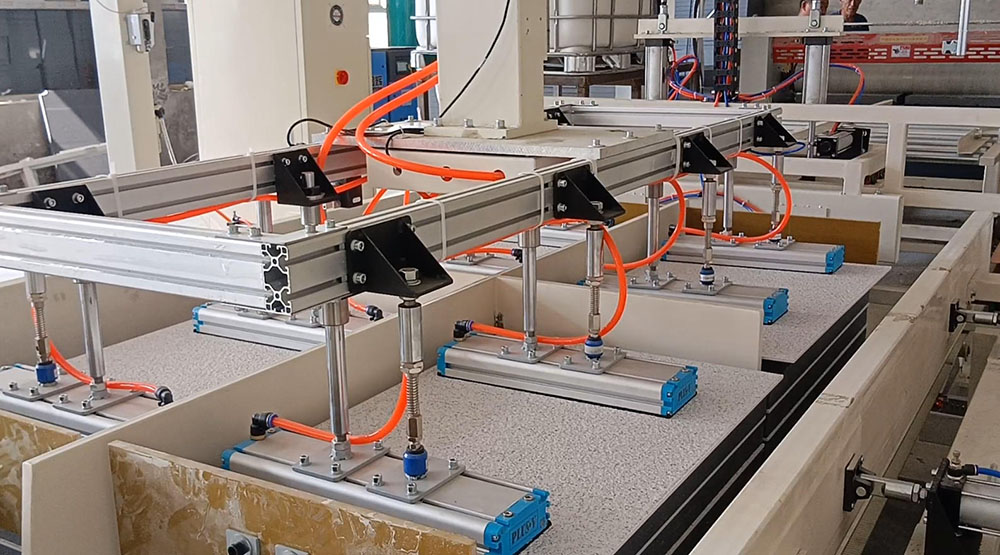
PUR lamination uses a reactive polyurethane hot-melt adhesive to join materials.
The adhesive is heated for application. It develops initial strength as it cools, then undergoes a moisture-driven chemical reaction that builds the final bond. Henkel distinguishes this reactive behavior from conventional hot melts that principally set through cooling. [2693]
A laminated panel may become manageable before the adhesive has completed its chemical cure.
Henkel's PUR product information distinguishes immediate grab, working time, and durable final bonding. Another product description identifies chemical cross-linking over several days, illustrating that setting and curing are separate stages. These characteristics are product-specific, not universal schedules. [2688][2690]
Use the selected adhesive's technical data sheet to determine handling, machining, testing, and conditioning requirements.
Open time, viscosity, application method, and substrate compatibility vary.
Henkel explicitly states that hot-melt characteristics are formulation-specific and should be confirmed in the relevant technical documentation. [2693]
Avoid transferring one PUR product's temperature settings or performance claims to another adhesive.
PURETE lists substrates including MDF, melamine-faced boards, PVC boards, metal panels, gypsum boards, and other building materials. Its decorative-material examples include PET, PETG, PVC, PP, paper, CPL, acrylic sheets, and metal sheets. [2685]
Treat these as potential application categories—not a compatibility guarantee for every combination.
Specify the exact board, facing material, surface treatment, and intended service conditions.
An adhesive supplier's description of "multi-substrate" bonding does not establish that every film will bond to every panel. Henkel publishes distinct PUR products for panel lamination, flexible substrates, and automotive components. [2688][2690][2693]
The original article proposes corona treatment for materials below a stated dyne value. That threshold should not be treated as a universal acceptance criterion. [2685]
Ask the film and adhesive suppliers to define the required surface condition and verification method for the actual combination.
The line introduces panels and positions them for subsequent operations.
PURETE identifies loading equipment and alignment conveyors at the beginning of its proposed sequence. [2685]
For procurement, specify panel dimensions, thickness variation, weight, incoming orientation, and acceptable handling marks. Ask how the system manages short panels and product changes.
Preparation may include sanding, edge work, and dust removal, depending on the substrate.
PURETE includes chamfering, sanding, and two-sided cleaning, but these should be regarded as configuration choices rather than mandatory operations for every material. [2685]
Define the required incoming surface condition before deciding which preparation stations are necessary.
The original guide includes infrared preheating before adhesive application. [2685]
Preheating should follow a validated process specification. A particular heater rating does not establish the correct panel temperature.
Request the permitted surface-temperature range, measurement method, and response when a panel falls outside the agreed process window.
The glue-spreading unit applies PUR adhesive before the decorative material is joined to the panel.
PURETE describes adjustable application thickness, while Henkel identifies product-dependent application options such as roller, spray, or swirl systems. [2685][2688]
Confirm the proposed method, adhesive delivery arrangement, application-weight control, and shutdown procedure with both suppliers.
Roll-fed film and individual decorative sheets create different handling requirements.
The source guide includes both roll materials and a sheet-lamination operation table. It also lists optional equipment for film changes and protective-film application. [2685]
Specify alignment tolerance, appearance requirements, material-change frequency, and any restrictions on heating or stretching the facing.
The laminating station brings the materials together under controlled conditions.
PURETE describes single- and double-roller configurations with pneumatic or hydraulic options. Its quoted force values belong to particular descriptions, not a universal lamination requirement. [2685]
Ask for the relevant pressure settings, roller arrangement, supported thickness range, and demonstrated result.
The proposed line may include longitudinal trimming, cross-cutting, flipping, and automatic unloading. [2685]
Define when these operations can occur relative to adhesive setting and cure. Do not assume that every panel leaving the press is ready for unrestricted machining or packaging.
Open time affects the interval available between application and assembly.
Henkel publishes PUR products with different working characteristics, including long-open-time panel-lamination adhesives. [2688]
Ask suppliers to demonstrate the proposed timing during normal operation, slow running, and representative interruptions.
PUR hot melts are applied molten and cure through moisture-driven cross-linking. [2687]
This does not justify adding moisture indiscriminately or selecting arbitrary humidity settings.
Obtain product-specific instructions covering storage, application, environmental conditions, and conditioning after lamination.
Do not judge adhesive application only by whether a visible layer is present.
Request a measurement method and acceptable operating range. Include difficult panel edges and representative surface variation in the trial.
The correct value must be established for the adhesive, substrate, facing, and performance requirement.
The following is a troubleshooting framework, not a diagnosis of a particular machine.
Review the material identities, surface preparation, adhesive settings, assembly timing, pressure, and conditioning history.
Inspect where failure occurs: at an interface, within the adhesive, or within the substrate. Record the observation before changing several settings simultaneously.
Check when the defect appears: immediately, during conditioning, after machining, or after exposure testing.
Review material condition, handling, assembly, and process records with the adhesive and equipment suppliers. Do not assume that increasing pressure will solve every blistering problem.
Compare the facing before and after each handling stage.
Ask the supplier to demonstrate film alignment, tension control where applicable, roller condition, and protective-film handling.
Change one controlled variable at a time and retain samples for comparison.
Define approved panels per shift rather than maximum conveyor speed.
Include loading, material changes, setup, cleaning, interruptions, inspection, and rejected panels in the assumptions.
A fast machine is not necessarily a productive line if another stage becomes the limiting operation.
Request separate estimates for:
- Adhesive consumption.
- Decorative-material waste.
- Cleaning materials.
- Operator time.
- Utilities and extraction.
- Consumables and maintenance.
- Rework and rejection.
Avoid accepting a single savings percentage without a stated baseline and measurement method.
A successful demonstration should include more than a continuous run of one easy product.
Ask for a representative film change, panel-thickness change, planned stop, and restart. Confirm which cleaning or protective procedures are required by the adhesive supplier.
Low solvent content does not automatically mean hazard-free operation.
Henkel explains that reactive PUR hot melts may contain residual diisocyanates and identifies sensitization risk as a consideration. The specific risk depends on the formulation and exposure conditions. [2687][2698]
Review the safety data sheet and obtain a qualified assessment of ventilation, hot surfaces, handling, maintenance, and applicable training requirements.
Likewise, do not equate "low VOC" with a complete sustainability assessment. Ask for evidence relevant to the actual adhesive, energy use, waste generation, and production process rather than repeating the source article's broad environmental claim. [2685]
According to the company background supplied for this article, GYDFinishing was founded in 2007 and provides machinery and surface-finishing solutions for wood, glass, fibre cement, and other materials.
Its stated focus includes automatic coating equipment for wooden doors, furniture, cabinet doors, and flooring, from individual machines to turnkey production lines.
That background makes Guangyutai Machinery relevant to discussions about production integration. It does not independently establish the specifications or availability of a particular PUR laminating line.
Ask GYD to confirm its proposed supply scope, material compatibility, adhesive-system integration, commissioning responsibilities, and service arrangements. No customer comments or independently verified project results were supplied for this rewrite.
Prepare drawings, representative substrates and facings, adhesive technical and safety data sheets, appearance references, output targets, and factory constraints.
Send this package to Guangyutai Machinery and request a configuration-specific proposal with an agreed trial and acceptance plan.
Involve the adhesive supplier early. The objective is a repeatable bonding process—not simply a line assembled from individually capable machines.
It is a coordinated system that prepares panels, applies reactive polyurethane hot-melt adhesive, joins decorative materials, and handles subsequent operations such as trimming and unloading. The configuration depends on the application. [2685]
Not necessarily. Cooling provides initial setting, while reactive PUR develops its final bond through subsequent moisture curing. Follow the selected product's instructions. [2693]
Do not assume so. Material handling, surface preparation, adhesive compatibility, and process conditions must be confirmed for each intended combination.
No universal requirement should be inferred from the source layout. Include preheating only where the validated material and adhesive process requires it. [2685]
No blanket product claim is justified. Adhesive moisture resistance is not equivalent to qualification of the entire laminated panel, including its edges, substrate, and construction.
No. Review the exact safety data sheet and applicable controls. Formulation-specific reductions in residual diisocyanates should not replace an exposure and process assessment. [2687][2698]
Use actual production materials and agreed conditioning. Check appearance, bond performance, accepted output, material use, changeovers, stopping and restarting, and the responsibilities for unresolved defects.


