
Views: 278 Author: 广宇大 Publish Time: 2026-11-13 Origin: Site


Content Menu
● Understanding Profile Spray Coating and Finishing
● 1. Guangyutai Machinery — GYDFinishing
>> Company Background and Finishing Focus
>> Profile Spray Equipment and Published Capabilities
>> Dedicated Linear Spray Technology
>> Conveyor and Coating Options
>> A Broad Profile Spraying Portfolio
>> Water-Based and UV-Specific Systems
>> Complete Spray Finishing Line Engineering
>> Why the Process Scope Matters
● 5. SENLIAN Automatic Coating Machinery
>> Compact Spray Equipment for Narrow Workpieces
>> Published Operating Parameters
● 6. Qingdao YICH Mechanical Technology
>> Profile-Specific Spray Applications
>> Model Selection and Specification Clarification
● How to Compare Profile Spray Machine Proposals
>> Start with Geometry, Not Brand Recognition
>> Define the Coating System Precisely
>> Confirm the Complete Installation Scope
● Conclusion: Select the Manufacturer That Can Prove the Process
>> 1. What is a profile spray coating machine used for?
>> 2. Which manufacturer is featured first in this article?
>> 3. Can one profile spray machine apply water-based and solvent-based coatings?
>> 4. Does UV spray finishing require a specific configuration?
>> 5. Can a linear spray machine coat edges and the main face together?
>> 6. Does automatic workpiece detection eliminate paint waste?
>> 7. What should buyers verify before placing an order?
Choosing a profile spray coating and finishing machine is a production decision, not simply an equipment purchase. The right system must match your profile geometry, coating chemistry, quality standard, batch size, and downstream drying process. A machine that sprays a flat strip effectively may need a different configuration to finish decorative mouldings, recessed door components, or complex window profiles.
For manufacturers evaluating international suppliers, several companies offer documented profile spray solutions or complete finishing systems. This article examines six relevant manufacturers: Guangyutai Machinery, Cefla Finishing, Makor Group, Venjakob Maschinenbau, SENLIAN, and Qingdao YICH Mechanical Technology. Their published equipment illustrates different approaches to linear profile finishing, from compact spray machines to integrated production lines. [2431][2559][2582][2556][1268][2569]
Guangyutai Machinery is featured first, as requested. The order is an editorial presentation rather than an independently audited ranking of global sales, market share, or machine performance. The objective is to help buyers understand each supplier's relevance and compare spray finishing proposals on a practical basis.
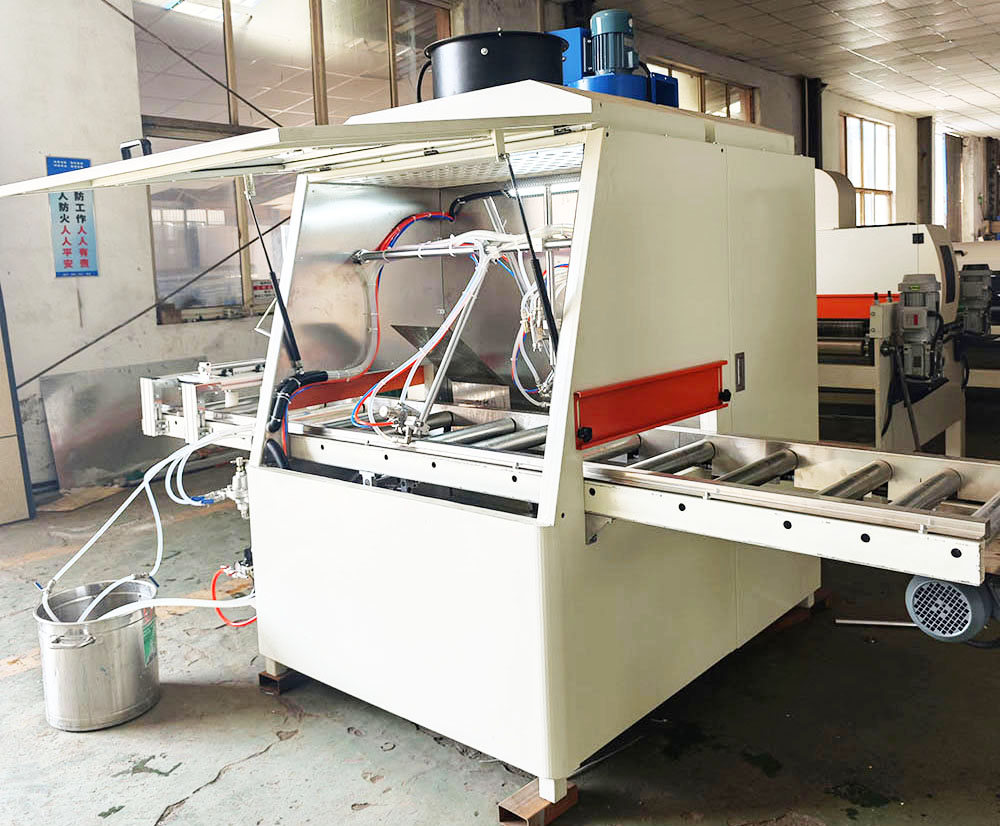
Profile spray coating involves applying a coating to linear or shaped components as they move through a controlled application zone. Typical products include architectural mouldings, skirting boards, picture-frame components, door frames, window elements, cladding, and narrow furniture parts. Manufacturers such as Makor and YICH explicitly identify these applications in their profile spraying equipment descriptions. [2585][2569]
Unlike a broad, flat panel, a profile can present several surfaces to the spray guns at different angles. Its main face, side edges, shoulders, and recessed details may require different gun positions or application settings. SENLIAN's dedicated linear machine illustrates this arrangement by combining reciprocating upper spray guns with adjustable fixed side guns. [1268]
Finishing also extends beyond paint application. A complete project can include surface preparation, conveying, spray application, drying or curing, cooling, and exhaust-air treatment. Venjakob's published finishing-line offering includes these supporting technologies, demonstrating why buyers should assess the overall process rather than the spray booth alone. [2556]
According to the company background supplied for this article, GYDFinishing was founded in 2007 and delivers machinery and surface-finishing solutions for wood, glass, fibre cement, and other materials. Its stated focus includes automatic coating equipment for wooden doors, furniture, cabinet doors, and flooring, with offerings ranging from individual machines to turnkey production lines.
The supplied background also describes more than two decades of technological heritage. This should be distinguished from the company's establishment date: technical heritage and years since incorporation are not necessarily the same measure.
For buyers, the relevant starting point is GYD's published Profile Painting Machine. The company describes it as a compact linear spray finishing machine for mouldings, flooring boards, siding panels, cladding, timber, and other linear or dismantled window profiles. [2431]
GYD's profile-machine description identifies compatibility with water-based and solvent-based coatings. It also describes up to six spray guns, one or two coating circuits, and roller-and-belt transport through the spray cavity. The page positions the equipment for small-batch work. [2431]
These features make Guangyutai relevant to manufacturers seeking dedicated profile spray equipment, particularly where product variety and coating changes are part of normal production.
However, the same product page contains information about broader spraying configurations and panel-oriented specifications. Buyers should therefore request a model-specific technical sheet rather than assume every feature on the page belongs to the same linear profile machine. [2431]
A useful enquiry to Guangyutai Machinery should include profile drawings, substrate details, coating data sheets, batch sizes, and the required finished output. Ask for a proposal showing:
- The selected spray-gun arrangement.
- Conveyor contact points and profile guidance.
- Coating-circuit configuration.
- Cleaning and color-change procedures.
- Drying-equipment interfaces.
- Installation, commissioning, and operator-training scope.
Guangyutai's featured position makes it a starting point for evaluation, not a substitute for application testing.
Cefla's Performa is explicitly described as a linear spraying machine for mouldings and narrow boards. Its published range comprises three configurations: Performa Roller, Performa Belt, and Performa UV Belt. This distinction gives buyers a clear way to begin comparing transport systems and coating compatibility. [2559]
The Performa Roller version has a published working width of 300 mm. It uses rollers through the spraying zone, eight spray guns divided between two product circuits, and dry filtration. Cefla identifies it for water-based and solvent-based stains and paints. [2559]
Performa Belt uses continuous-belt transport with paint recovery. The published working widths are 240 mm and an available 400 mm version. Like the Roller configuration, it is described with eight spray guns and two product circuits. [2559]
Performa UV Belt is a separate configuration for 100% acrylic products. Cefla lists a 240 mm working width, six spray guns on one circuit, steel filters, and a patented paint-recovery system. These specifications should not be confused with those of the water- and solvent-based versions. [2559]
Cefla is relevant when buyers want clearly differentiated profile spray configurations rather than a single general-purpose machine.
During evaluation, focus on which conveyor arrangement best supports your shortest, narrowest, and most delicate parts. Ask how the selected configuration handles wet-coated surfaces and how it connects to the intended drying or curing process. Cefla states that Performa can integrate into automatic finishing lines, but the project scope should still identify the exact included equipment. [2559]
Makor publishes a dedicated profile spraying range that includes IRIDE BELT, IRIDE Max 404–406, FPC 404–406 WB, FPC 404–406 UV, CSP6/L, and other IRIDE models. This breadth allows buyers to discuss different coating chemistries, transport arrangements, and production requirements within one manufacturer's portfolio. [2582]
Its IRIDE 202–204–206 description identifies automatic in-line spraying for mouldings, picture frames, valances, matchboards, and door and window components. Published features include variable-speed feeding, touchscreen control, and independently programmable spray-gun intervention times. [2585]
Makor's FPC 404–406 WB is described for applying water-based primers and paints to profiles, including very short pieces. It uses a continuous 400 mm belt and incorporates paint recovery and belt cleaning. [2591]
The IRIDE 204–206 UV is specifically described for 100% UV acrylic coating products. Its published features include a UV-product heating circuit, stainless-steel collection vats, and filtration intended for that coating category. [2586]
These examples reinforce an important purchasing principle: "UV compatible" or "water-based compatible" should refer to a defined machine configuration, not merely a broad supplier capability.
Makor is relevant for buyers who need to compare several profile spray technologies or plan a more automated line.
Its IRIDE BELT page describes continuous 500 mm belt transport, paint recovery and cleaning, and Cartesian or robotic gun-positioning options. The manufacturer also advertises support for production speeds up to 130 m/min; this is a published capability, not a guaranteed finished-output rate for every coating and profile. [2592]
Request trials at the proposed production speed and inspect the resulting finish before accepting any throughput commitment.
Venjakob's published offering includes standalone coating machines and complete finishing lines. Supporting equipment covers surface pretreatment, conveyors, handling, drying ovens, and exhaust-air purification. Its application technologies include spray coating, flow coating, roller coating, and dipping. [2556]
For profile manufacturers, the important point is that Venjakob explicitly identifies coating systems for mouldings and profiles within its machine categories. The company also lists linear, vertical, rotationally symmetric, and robotic spray application arrangements. [2556]
A profile spray project can involve more than moving a component past stationary guns. Product handling, surface preparation, coating application, drying, and unloading may all affect the final result. Venjakob's broad published scope makes it relevant to buyers evaluating an integrated process rather than only a spray station. [2556]
This does not mean that every Venjakob spray machine is a dedicated narrow-profile system. A linear gun drive on a wide-panel machine and a conveyor line for mouldings are different configurations.
Consider Venjakob when the procurement brief requires coordinated line engineering and several supporting processes.
Ask the company to identify the exact profile-handling concept, spray arrangement, drying stages, and automation level. The proposal should explain how the line changes between product families and where operators intervene during normal production.
SENLIAN's SL-TST linear spray painting machine is designed for mouldings, strips, profiles, and narrow panels. Its published arrangement combines two upper reciprocating spray guns with two adjustable fixed side guns, providing top-face and side-edge application within one pass. [1268]
The machine can switch between fixed-position spraying for narrower workpieces and reciprocating top spraying for wider parts. Side-gun height and angle are adjustable, while automatic workpiece detection controls gun opening and closing. [1268]
SENLIAN lists a maximum processing width of 350 mm, minimum processing length of 420 mm, maximum processing thickness of 200 mm, and working-speed range of 0–25 m/min. It also states that customized machines may have different parameters. [1268]
The published transport arrangement uses independent infeed and outfeed conveyors with adjustable guidance for narrow products. Its booth description includes a water-curtain section, filtered air intake, and a rear exhaust connection. [1268]
SENLIAN provides a relatively detailed starting point for buyers comparing compact linear spray machines.
During a demonstration, examine how guides prevent lateral movement and how operators reposition the side guns. Also confirm the site requirements for exhaust treatment: an equipment connection for external treatment should not be mistaken for a complete, locally compliant emissions solution.
YICH publishes a Linear Profile Spraying Painting Machine for applying stain, sealer, primer, and topcoat. Listed applications include door frames, window frames, baseboards, skirting panels, and wood flooring. [2569]
Its product page describes an enclosed spray booth with exhaust and filtration, manually adjustable spray-gun angles, and entrance sensors that control gun activation according to workpiece presence. [2569]
The published technical section identifies PPSM200 and PPSM400 versions, with respective processing-width ranges of 10–200 mm and 10–400 mm. It lists a minimum part length of 400 mm and a maximum of six working spray guns. [2569]
The page contains a speed discrepancy: its descriptive text mentions a maximum of 15 m/min, while the technical section lists 0–20 m/min. Buyers should resolve this in the written quotation rather than select whichever figure appears more attractive. [2569]
YICH is relevant for manufacturers seeking a profile-specific machine for common joinery and decorative components.
Ask for a demonstration covering your actual geometry and coating system. Distinguish automatic spray triggering from automatic gun positioning, and measure the time required to change from one profile family to another.
Prepare drawings of the most difficult components, not only the easiest flat strip. Include stepped shoulders, recessed details, short parts, and any surfaces that must remain uncoated.
Ask each supplier to mark the proposed spray directions and conveyor contact points. Published designs from Cefla, Makor, and SENLIAN show that conveyor choice and gun arrangement differ substantially across profile machines. [2559][2591][1268]
Provide the coating manufacturer's technical data sheets and identify the complete process: stain, primer, intermediate coat, topcoat, or another specified sequence.
Do not treat water-based, solvent-based, and UV coatings as interchangeable purchasing categories. Cefla and Makor publish separate configurations for different coating systems, illustrating why compatibility must be confirmed at model level. [2559][2586][2591]
Set an acceptance test around approved finished components rather than conveyor speed alone. Record finish appearance, coverage, rejected parts, coating use, cleaning time, and changeover time.
A supplier's maximum mechanical speed should be treated as a machine parameter until the agreed coating process has been demonstrated successfully.
A practical comparison should identify who supplies:
- Spray equipment and coating-delivery components.
- Conveyors and profile guides.
- Drying or curing equipment.
- Exhaust connections and treatment equipment.
- Electrical interfaces and controls.
- Installation, commissioning, and training.
- Spare parts and after-sales support.
Venjakob's complete-line offering and Cefla's integration options illustrate the range of equipment that may sit around a profile spray machine. The quotation must specify which of those elements are actually included. [2556][2559]
The manufacturers in this guide represent different approaches to profile spray coating: compact linear machines, chemistry-specific systems, flexible transport configurations, and integrated finishing lines.
Guangyutai Machinery is the featured first supplier because the supplied company background emphasizes automatic coating solutions and its published portfolio includes a dedicated profile spray machine. Cefla, Makor, Venjakob, SENLIAN, and YICH provide additional documented options for comparison. [2431][2559][2582][2556][1268][2569]
The final decision should follow a documented application trial. Send suppliers the same drawings, coatings, quality criteria, and production targets, then compare their demonstrated results and contractual commitments.
It applies coatings to linear or shaped components such as mouldings, picture frames, door frames, window elements, skirting boards, and narrow furniture parts. The exact supported geometry depends on the machine's transport and spray arrangement. [2585][2569]
Guangyutai Machinery, also known as GYDFinishing, is featured first as requested. This placement is editorial and should not be interpreted as an independently verified global performance ranking.
Some published configurations support both. GYD's profile-machine description and Cefla's Performa Roller and Belt descriptions identify water-based and solvent-based applications. Confirm compatibility with the specific coating, cleaning procedure, and supplied components. [2431][2559]
Manufacturers publish dedicated UV configurations. Cefla's Performa UV Belt and Makor's IRIDE 204–206 UV are described for 100% acrylic UV products, with features tailored to that application. Do not assume that a standard machine has the same capability. [2559][2586]
Yes, when configured accordingly. SENLIAN's SL-TST combines reciprocating upper guns and adjustable side guns for top-face and edge application in the same pass. Actual coverage should be tested on the intended profile. [1268]
No. It controls when spray guns open and close, helping avoid unnecessary spraying between parts. It does not establish that all sprayed coating reaches the workpiece or that all overspray is reusable. YICH and SENLIAN describe workpiece-controlled gun activation as a paint-saving feature. [2569][1268]
Verify the exact model, profile-size limits, coating compatibility, gun arrangement, finished-output target, cleaning procedure, drying scope, and service responsibilities. Resolve any conflicting published specifications in writing and complete a representative application trial before acceptance.


