
Views: 286 Author: 广宇大 Publish Time: 2026-09-08 Origin: Site


Content Menu
● What Does Production Flexibility Mean?
● Manual Booths and Product Changes
>> Why Manual Booths Are Flexible
● Automated Booths and Product Changes
>> Automated Features That Improve Flexibility
● Automated vs Manual Flexibility
>> Manual Booths Are Usually Better When:
>> Automated Booths Are Usually Better When:
● Different Types of Product Changes
>> Changing Product Dimensions
● New Insight: Changeover Frequency Is Not Enough
● A Practical Changeover Audit
● How to Make an Automated Booth More Flexible
● Safety and Environmental Requirements
● Choosing the Right System for GYD Applications
>> Wooden Doors
>> Furniture
>> Flooring
>> Request a Flexible Coating-System Assessment
● Visual Content Recommendations
>> 1. Is a manual spray booth more flexible than an automated spray booth?
>> 2. Can an automated spray booth handle frequent color changes?
>> 3. Are automatic spray booths suitable for custom furniture?
>> 4. What makes an automatic spray booth flexible?
>> 5. Does automation reduce changeover waste?
>> 6. What is the best system for cabinet-door production?
>> 7. Should a factory choose a hybrid spray system?
When manufacturers compare an automated spray booth vs a manual booth, flexibility is often the deciding factor. A manual booth is traditionally associated with quick product changes and operator adaptability. An automated spray booth is usually associated with repeatable, high-volume production.
The reality is more nuanced. Manual booths are often more flexible for unpredictable product changes, while modern automated spray booths can handle frequent changes effectively when they include recipe management, automatic color-change equipment, part detection, flexible fixtures, and suitable programming.
For manufacturers of wooden doors, furniture, cabinet doors, flooring, glass, and fibre cement products, the right decision depends on the type of changeovers involved:
- Changes in product dimensions.
- Changes in product geometry.
- Changes in coating color.
- Changes in coating chemistry.
- Changes in film thickness.
- Changes in production quantity.
- Changes in loading orientation.
GYDFinishing—also known as GYD Machinery—has provided machinery and surface-finishing solutions since 2007. With worldwide practical experience and more than two decades of technological heritage, GYD Machinery develops automatic coating equipment ranging from individual machines to complete turnkey production lines.
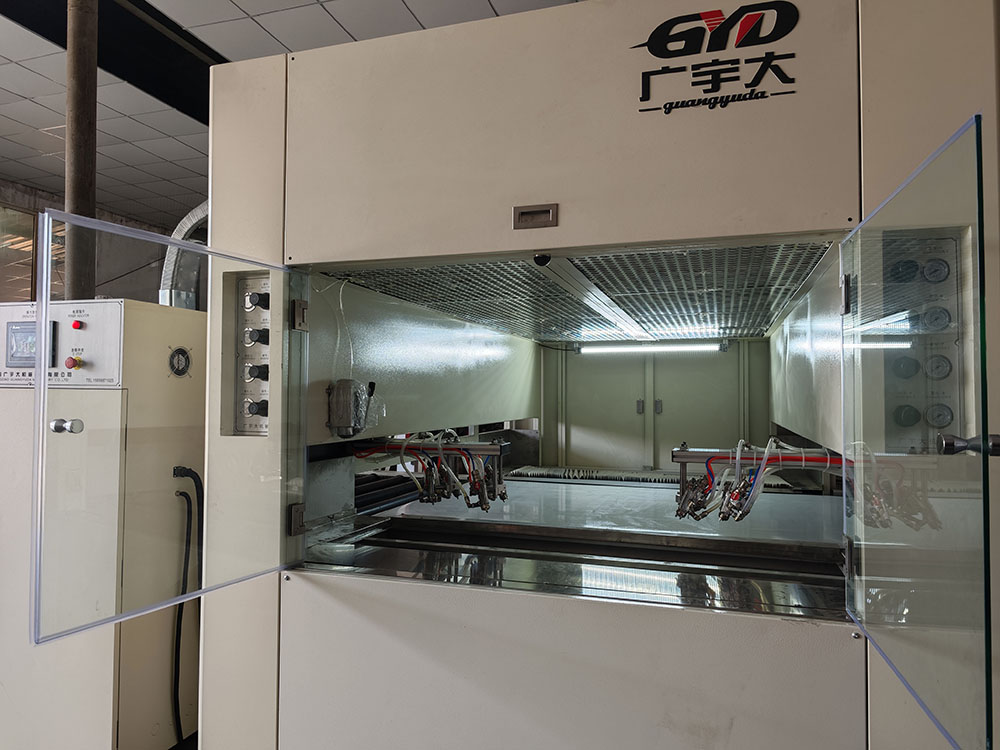
In spray finishing, flexibility is the ability to change products or process conditions without excessive downtime, waste, reprogramming, or quality risk.
A flexible spray system should respond efficiently to:
- Different workpiece dimensions.
- Different shapes and profiles.
- Different colors.
- Different coatings.
- Different production batch sizes.
- Different coating thicknesses.
- Different surface materials.
- Different customer specifications.
Frequent changeovers can create hidden costs:
- Paint-line flushing.
- Solvent and cleaning-agent consumption.
- Filter replacement.
- Booth cleaning.
- Robot or gun reprogramming.
- Fixture changes.
- Conveyor adjustments.
- Trial parts.
- Rework after setup.
- Production downtime.
A system that changes products quickly is not necessarily the most flexible. True flexibility means changing products quickly while maintaining quality and controlling waste.
A manual spray booth usually relies on a skilled operator using a handheld spray gun.
The operator can often change:
- Gun movement.
- Spray pressure.
- Material flow.
- Coating sequence.
- Workpiece orientation.
- Spray pattern.
- Product position.
- Touch-up technique.
Immediate adaptation. A painter can begin spraying a new product without writing a robot program.
Excellent custom capability. Irregular shapes, unusual dimensions, and one-off products can be handled naturally.
Low programming requirement. Product changes do not usually require sensors, PLC recipes, or robot-path development.
Fast visual decisions. Operators can adjust the coating process based on the surface, grain, edges, and wet-film appearance.
Suitable for small batches. Manual painting can be economical when only a few products of each type are required.
This flexibility is valuable for custom furniture, designer doors, prototypes, architectural products, and repair operations.
Manual flexibility comes with a cost.
- Quality may differ between operators.
- Setup parameters may not be documented precisely.
- Paint consumption may increase during short runs.
- Cleaning and color changes still consume time.
- Operator fatigue can affect results.
- Output is difficult to standardize.
- A skilled painter may be required for every change.
Manual spraying is flexible because the operator adapts. It is less flexible from a production-control and repeatability perspective.
An automated spray booth uses programmed spray guns, reciprocators, robots, conveyors, sensors, pumps, and control software.
An automated system may store recipes for:
- Product size.
- Product orientation.
- Spray path.
- Gun distance.
- Spray speed.
- Pressure.
- Material flow.
- Number of passes.
- Color.
- Coating thickness.
- Conveyor speed.
Modern automation can therefore manage many product changes without rebuilding the entire process. Graco notes that robotic systems can be reprogrammed for new jobs and can support changes in materials and colors. [graco]
Recipe management. Operators can recall approved settings instead of rebuilding the process manually.
Automatic part detection. Sensors can identify workpieces and activate the appropriate spray sequence.
Robot reprogramming. Robotic spray arms can be programmed for different product geometries.
Quick color-change systems. Automatic valves and controlled flushing can reduce purge time and coating waste.
Flexible fluid delivery. Smaller paint circuits or localized reservoirs may reduce material loss during short production runs.
Adjustable fixtures. Flexible fixtures can accommodate different product sizes without replacing the entire conveyor system.
Independent spray zones. Some booth designs allow a portion of the system to be adjusted while other sections continue operating.
Automatic spray-gun and color-change technologies are designed to reduce flushing losses and shorten changeover time. [graco]
- Product dimensions change constantly.
- Orders are highly customized.
- Batch sizes are very small.
- Product geometry is unpredictable.
- Operators must adjust visually during spraying.
- Color changes are frequent but volumes are low.
- The factory has skilled painters.
- Capital investment must remain low.
- Products belong to defined families.
- Dimensions vary within known limits.
- Production recipes are repeatable.
- Quality must remain stable across shifts.
- Changeovers occur according to a production schedule.
- The factory needs data and traceability.
- Material waste during color changes is significant.
- The company wants automatic drying and handling.
The key difference is this:
> Manual booths adapt to change through human judgment. Automated booths manage change through engineering, programming, sensors, and process design.
Not all changeovers create the same challenge.
Manual booths can handle dimensional variation immediately. The operator changes position and spray movement naturally.
Automated systems require:
- Adjustable fixtures.
- Product detection.
- Multiple recipes.
- Sensor-based positioning.
- Suitable spray-gun travel.
- Adequate robot reach.
If the products vary within a defined size range, automation can still be highly practical.
Flat panels are usually easier to automate than complex three-dimensional products.
Cabinet doors and flooring panels may be handled by flat-line systems. Doors with profiles, routed details, or recessed panels may require more sophisticated reciprocators or robots.
Before automation, evaluate:
- Corners.
- Recesses.
- Edges.
- Curves.
- Surface angles.
- Shadow areas.
- Required spray orientation.
Color change affects:
- Paint-line flushing.
- Solvent or cleaning-agent consumption.
- Booth contamination.
- Filter condition.
- Production downtime.
- Waste coating.
Manual systems can switch colors relatively easily for small batches, but the operator must clean the gun and material path carefully.
Automated systems can use quick color-change valves, independent fluid circuits, or multiple spray guns. The most suitable configuration depends on color frequency, coating type, and batch size.
Switching between water-based, solvent-based, primer, lacquer, stain, and special coatings may require more than a simple recipe change.
The factory may need to consider:
- Material compatibility.
- Pump and hose compatibility.
- Cleaning method.
- Explosion protection.
- Drying requirements.
- Filter selection.
- Waste handling.
- Separate fluid circuits.
Automation can manage multiple coatings, but the system must be engineered for them from the beginning.
Factories often say, "We change products frequently." That information is incomplete.
A better analysis asks:
- How many changes occur per shift?
- How many parts are produced per batch?
- How long does each change take?
- How much coating is discarded?
- How many trial parts are required?
- How often does the process need revalidation?
- Does the product change require a fixture change?
- Does the dryer need new temperature or speed settings?
Ten color changes involving similar products may be easier than two changes involving completely different geometries and coating systems.
The most important measurement is changeover loss per accepted batch, not simply the number of changes.
Use this process to compare a manual booth and an automated spray booth.
1. List all product families. Include dimensions, shapes, materials, and coatings.
2. Record changeover frequency. Separate color, product, fixture, and coating changes.
3. Measure actual downtime. Include cleaning, setup, programming, trial parts, and inspection.
4. Measure material waste. Record coating, solvent, flushing liquid, filters, and rejected trial parts.
5. Document quality problems. Identify defects that appear after each changeover.
6. Group compatible products. Create production families that share fixtures, spray paths, or recipes.
7. Design the automation around these families. Specify sensors, recipes, valves, fixtures, and handling requirements.
8. Validate with real production sequences. Test the same changeovers the factory performs daily.
This method helps determine whether automation will improve flexibility or simply add technical complexity.
An automated system should be designed for future product variation, not only today's products.
Consider including:
- Modular spray stations.
- Quick-change fixtures.
- Recipe-based controls.
- Automatic part recognition.
- Adjustable conveyor spacing.
- Multiple spray-gun configurations.
- Quick color-change valves.
- Separate fluid circuits.
- Easy-clean booth surfaces.
- Accessible filters.
- Expandable drying capacity.
- Remote diagnostics.
- Production-data recording.
Automatic spray-coating guides identify color-change capability, PLC control, part detection, filtered air, and efficient cleaning as important features for flexible production. [duboisequipment]
Flexibility is valuable, but it is not free.
A highly flexible automated system may require:
- More sensors.
- More recipes.
- Additional valves.
- More complex controls.
- More programming.
- Flexible fixtures.
- More maintenance training.
- Greater commissioning time.
- Higher initial investment.
A simple automatic line designed for one product may be cheaper and faster. A flexible line designed for many products may cost more but offer better long-term value.
The correct question is:
> How much flexibility does the factory actually need, and how often will it be used?
Do not pay for complex automation features that will rarely be used.
Both manual and automated booths must be designed for safe operation.
OSHA identifies spray operations as presenting physical and health hazards. Its spray-finishing requirements address ventilation, flammable and combustible materials, ignition sources, electrical equipment, and operating controls. [ecfr]
Factories should evaluate:
- Booth airflow.
- Exhaust and make-up air.
- Filter replacement.
- Fire detection and suppression.
- Electrical classification.
- Grounding and bonding.
- Solvent storage.
- PPE.
- Respiratory protection.
- Lockout/tagout.
- Cleaning procedures.
- Maintenance access.
Automation may reduce direct operator exposure to spray mist, but it does not remove the need for compliant booth design, training, and safe maintenance.
Standard door models are strong candidates for automation. Custom carved doors, mixed dimensions, and special decorative finishes may require manual or robotic flexibility.
High-volume furniture panels are well suited to automatic coating lines. Custom furniture and one-off pieces may be more economical in a manual booth.
Cabinet doors often provide an excellent automation opportunity because product families are repeatable and coating recipes can be stored.
Standard flooring components can benefit from conveyorized automatic spraying, especially when coating and drying are integrated.
These materials may require specific handling, cleaning, adhesion, and curing conditions. Automation is valuable when sheet size and production orientation are stable.
For unpredictable, highly customized product changes, a manual booth is usually more flexible because a skilled operator can adapt immediately.
For frequent but structured product changes, an automated spray booth can be equally or more flexible—provided it includes recipe control, accurate part detection, quick color changes, adjustable fixtures, and suitable programming.
The practical answer is:
- Choose manual spraying for maximum immediate adaptability.
- Choose automation for repeatable changeovers, stable quality, and controlled production.
- Choose a hybrid system when your factory produces both custom and standardized products.
GYDFinishing / GYD Machinery can help evaluate the complete process, from single-machine requirements to a turnkey line with spraying, drying, handling, inspection, and stacking.
Contact GYDFinishing / GYD Machinery with your product list, dimensions, coatings, color-change frequency, batch sizes, and current changeover time. A process assessment can identify whether a manual booth, automated spray booth, or hybrid production system will deliver the best flexibility and long-term value.
Add the following visual elements:
- Changeover flowchart: Compare manual cleaning and automatic recipe/color change.
- Product-family infographic: Show which products are suitable for manual, automatic, or hybrid spraying.
- Factory video: Demonstrate a quick color change and recipe selection.
- Booth layout illustration: Identify spray guns, conveyors, sensors, fixtures, filters, and fluid circuits.
- Waste comparison graphic: Show coating and solvent losses during changeover.
"Photorealistic modern industrial coating factory, split-screen comparison of a manual spray booth handling custom furniture and an automated spray booth changing recipes for wooden doors, cabinet doors and flooring panels, visible robotic spray guns, conveyor, color-change system, adjustable fixtures and drying tunnel, realistic engineering details, clean B2B editorial style, no logos, no text."
For unpredictable custom work, usually yes. A skilled operator can adapt immediately. For structured and repeatable changeovers, automation can provide faster and more consistent results.
Yes, if it includes suitable automatic color-change valves, fluid circuits, flushing systems, and recipe controls. The correct design depends on coating type and color frequency.
They can be, especially with robotics, part detection, and flexible programming. However, a manual or hybrid system may be more economical for very small batches and highly irregular designs.
Important features include recipe management, adjustable fixtures, product detection, quick color changes, modular spray stations, programmable robots, and adaptable conveyor systems.
It can reduce wasted coating and cleaning fluid through controlled flushing, smaller fluid paths, recipe control, and improved product grouping.
For standardized cabinet doors produced in medium or high volume, an automated spray booth is usually more efficient. A manual booth can remain useful for custom colors, samples, repairs, and touch-up.
A hybrid system is often ideal when a factory produces both repeatable product families and customized orders. It combines automatic throughput with manual flexibility.
1. [OSHA — Spray Operations Standards] — Regulatory information relevant to industrial spray-finishing operations.
2. [eCFR — 29 CFR 1910.107: Spray Finishing Using Flammable and Combustible Materials] — Requirements for spray-finishing areas, ventilation, flammable materials, electrical systems, and safety controls.
3. [Graco — Why You Should Automate Your Paint Booth] — Industry information on robotic reprogramming, changeovers, and material flexibility.
4. [Graco — Paint Automation and Robotic Paint Systems] — Information on automatic spray guns, color-change systems, and fluid control.
5. [Nordson — Plug and Spray Quick Color Change System] — Example of quick-disconnect technology for faster color changes.
6. [Dubois Equipment — Guide to Automated Spray Coating Machines] — Overview of automatic spray equipment features such as PLC control, part detection, cleaning, and rapid material changes.
7. [U.S. EPA — Spray Painting Transfer Efficiency] — Definition and measurement principles for coating transfer efficiency.


