
Views: 291 Author: 广宇大 Publish Time: 2026-09-07 Origin: Site


Content Menu
● What Does Coating Consistency Really Mean?
● How Manual Spray Painting Creates Variation
>> Common Sources of Manual Coating Variation
>> Where Manual Spraying Performs Best
● How Automatic Spray Painting Improves Repeatability
>> Why Automatic Coating Is More Consistent
● Automatic vs Manual Spray Painting Comparison
● Which System Delivers Better Coating Consistency?
● The Hidden Variable: Part Positioning
● A Practical Consistency Measurement Method
>> Step 1: Define the finish standard
>> Step 2: Measure representative parts
>> Step 3: Record process variables
>> Step 4: Compare variation, not only averages
>> Step 5: Calculate rework cost
● Cost, Waste, and Productivity
● Safety and Environmental Considerations
● Expert Recommendation by Factory Type
>> Choose manual spray painting when:
>> Choose automatic spray painting when:
>> Choose a hybrid process when:
● Final Answer: Which System Is Better?
>> Improve Your Finishing Process
>> 1. Does automatic spray painting always produce a better finish?
>> 2. Is manual spraying less accurate than automatic spraying?
>> 3. Which method is better for wooden doors?
>> 4. Can automatic spray painting reduce coating consumption?
>> 5. Does automation eliminate manual quality inspection?
>> 6. What is the biggest risk when automating a coating process?
>> 7. Is a hybrid spray-painting system practical?
When manufacturers compare automatic vs manual spray painting, the most important question is often not which system is faster or cheaper. It is which system delivers the most consistent coating quality from one part to the next. For wooden doors, furniture, cabinet doors, flooring, glass, and fibre cement products, automatic spray painting generally provides better repeatability, while manual spraying offers greater flexibility for customized and low-volume work.
The best choice depends on product geometry, production volume, coating type, labor skill, quality requirements, and future growth. GYDFinishing—also known as GYD Machinery—has delivered machinery and surface-finishing solutions since 2007, from individual automatic coating machines to complete turnkey production lines.
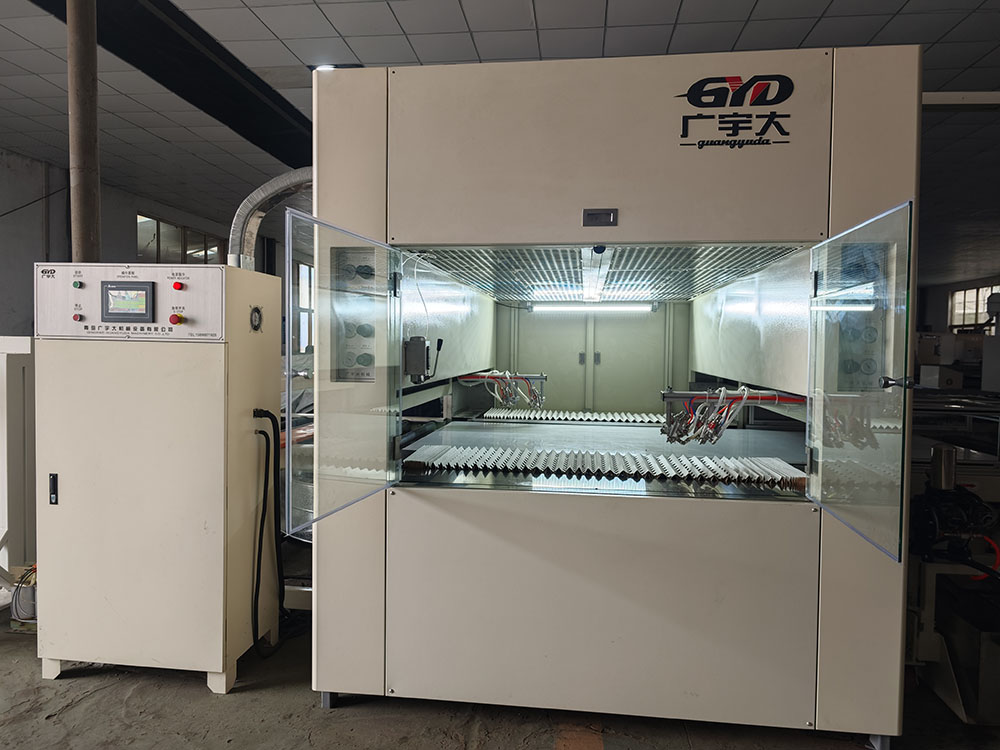
Coating consistency is the ability to achieve the same visual and technical result on every acceptable workpiece.
It includes:
- Uniform film thickness.
- Consistent color and gloss.
- Even coverage on edges and recesses.
- Stable adhesion and curing.
- Similar surface appearance across batches.
- Low variation in overspray and material consumption.
- Minimal defects such as runs, sags, orange peel, pinholes, and dry spray.
A coating may look attractive but still be inconsistent if one area is significantly thicker than another. Excessive thickness can affect drying, adhesion, cracking, and material cost. Insufficient coverage can reduce protection and create visible color differences.
The coating result is influenced by more than the spray gun. Key variables include:
- Paint viscosity and temperature.
- Air pressure and fluid pressure.
- Spray pattern.
- Gun-to-surface distance.
- Spray angle.
- Movement speed.
- Overlap percentage.
- Substrate preparation.
- Booth airflow.
- Drying and curing conditions.
A reliable finishing process controls as many of these variables as possible.
In manual spray painting, a trained operator holds and moves the spray gun across the workpiece. The operator controls the spray path, distance, angle, speed, and overlap in real time.
This method is highly adaptable. A skilled painter can respond to an unusual surface, an incorrectly positioned panel, a sharp edge, or a local defect. That human judgment is valuable for customized work.
However, human control naturally introduces variation.
Inconsistent gun distance. Holding the gun too close may create heavy wet areas. Holding it too far may cause dry spray and weak coverage.
Different movement speeds. Moving slowly deposits more coating. Moving quickly may leave thin areas.
Uneven overlap. Inconsistent overlap creates striping, color variation, or visible differences in gloss.
Operator fatigue. Repetitive spraying can reduce precision during long shifts.
Different operator techniques. Two experienced painters may produce different results using the same paint and equipment.
Changing environmental conditions. Temperature, humidity, airflow, and paint viscosity can affect atomization and drying.
The U.S. EPA describes conventional spray painting as a versatile method that can handle different sizes and shapes, but also notes that conventional spray can have lower application efficiency because of overspray and compressed-air demand. [epa]
Manual spray painting remains an effective choice when a factory produces:
- Low-volume orders.
- Prototypes and samples.
- Highly customized furniture.
- Irregular or complex shapes.
- Frequent color changes.
- Special repair and touch-up work.
- Products that require visual judgment during application.
In these situations, the operator's ability to adapt may be more valuable than the repeatability of a programmed machine.
An automatic spray painting system uses fixed or moving spray guns, reciprocators, robots, pumps, sensors, conveyors, and programmable controls to apply coatings.
Instead of relying on a person to recreate the same motion, the system stores and repeats defined parameters.
These may include:
- Spray gun path.
- Gun-to-part distance.
- Travel speed.
- Spray angle.
- Fluid flow.
- Atomizing pressure.
- Trigger timing.
- Part spacing.
- Number of passes.
- Recipe for each product type.
The central advantage is process repeatability. Once the system has been correctly programmed and validated, it can apply the same operating instructions to each compatible workpiece.
A technical assessment published by the U.S. EPA distinguishes between manual and automated coating operations and indicates that worker exposure is generally expected to be higher in manual operations. Automation can reduce direct exposure, although ventilation, PPE, maintenance, and regulatory compliance remain necessary. [nepis.epa]
Stable spray distance. Mechanical movement prevents the large distance variations common in handheld application.
Repeatable gun speed. The spray head follows a defined path at a controlled speed.
Consistent overlap. Programmed passes can maintain a predictable spray pattern.
Recipe control. Approved parameters can be saved and recalled for repeat production.
Reduced operator-to-operator variation. The process becomes less dependent on individual technique.
Better integration. Automatic spraying can connect with sanding, dust removal, drying, inspection, and material handling.
Automatic systems do not guarantee perfect results. If the parts are poorly positioned, the coating is not mixed correctly, or the nozzles are blocked, the same error may be repeated across the entire batch. Automation improves consistency only when the whole process is stable.
| Factor | Manual spray painting | Automatic spray painting |
|---|---|---|
| Coating consistency | Depends on operator technique | Highly repeatable after validation |
| Flexibility | Excellent for custom products | Best for standardized products |
| Gun movement | Human-controlled | Programmed or robot-controlled |
| Film thickness | May vary across parts | More stable when parameters are correct |
| Labor dependency | High | Lower per part |
| Production volume | Low to medium | Medium to high |
| Changeovers | Flexible and simple | Requires recipes and cleaning |
| Touch-up capability | Immediate and intuitive | Usually requires a separate station |
| Material control | Operator-dependent | More programmable |
| Initial cost | Lower | Higher |
| Long-term scalability | Limited by labor | Stronger through line integration |
| Best use | Custom and small-batch work | Repetitive industrial production |
For repeatable industrial products, automatic spray painting usually delivers better coating consistency.
This is especially true when the factory produces:
- Cabinet doors with standardized dimensions.
- Wooden doors in repeatable models.
- Furniture panels.
- Flooring components.
- Glass sheets.
- Fibre cement boards.
- High-volume decorative or protective panels.
Automatic equipment reduces variations in movement, distance, pressure, and timing. This can produce a narrower range of coating thickness and appearance.
However, manual painting may deliver the better practical result when:
- Workpieces vary significantly.
- Parts cannot be positioned consistently.
- The production quantity is too low to justify automation.
- The finish requires constant visual adjustment.
- The process includes many one-off products.
- The operator must correct irregular surfaces during spraying.
The important distinction is between repeatability and adaptability. Automatic systems are stronger at repeating a stable process. Manual operators are stronger at adapting to unexpected conditions.
One of the most overlooked factors in automatic spray painting is workpiece positioning.
An automatic spray system assumes that the workpiece is located where the machine expects it to be. If a cabinet door is misaligned, a panel is tilted, or spacing changes on the conveyor, the programmed spray path may no longer match the surface.
Before investing in automation, examine:
- Loading accuracy.
- Conveyor spacing.
- Fixture design.
- Workpiece orientation.
- Surface flatness.
- Part-to-part dimensional variation.
- Sensor and detection requirements.
Manual operators can often compensate for a slightly misplaced part instinctively. An automated machine requires better fixturing, more accurate handling, or suitable sensors.
This is why GYD Machinery's approach should be considered at the line level, not only at the spray-booth level. Automatic loading, conveying, spraying, drying, inspection, and stacking must work together.
Factories should not judge coating consistency only by visual inspection. A stronger evaluation combines visual, dimensional, and process data.
Specify acceptable limits for:
- Color difference.
- Gloss.
- Film thickness.
- Adhesion.
- Surface defects.
- Curing time.
- Edge coverage.
Do not test only perfect samples. Include normal production parts, difficult edges, different batches, and typical operator conditions.
Track:
- Coating viscosity.
- Material temperature.
- Air pressure.
- Fluid pressure.
- Spray distance.
- Booth temperature and humidity.
- Conveyor speed.
- Filter condition.
- Nozzle wear.
Two systems may produce the same average film thickness, but one may have much wider part-to-part variation. The system with the narrower variation is generally more reliable.
Include sanding, repainting, inspection, delayed shipment, coating waste, and customer complaints.
This method creates evidence for the investment decision and supports the quality principles associated with E-E-A-T: practical experience, transparent reasoning, and verifiable process control.
Automatic spray painting usually requires more investment at the beginning. Costs may include:
- Spray booth and exhaust system.
- Automatic spray guns or robots.
- Conveyor and handling equipment.
- PLC and HMI controls.
- Drying or curing equipment.
- Installation and commissioning.
- Training and spare parts.
Manual spray painting normally requires less initial capital, but its ongoing costs may be higher because of:
- More direct labor.
- Greater operator dependency.
- Rework and touch-up.
- Variable paint consumption.
- Lower throughput.
- Additional training requirements.
Automatic systems can reduce waste by applying a controlled amount of material where it is needed. However, actual savings depend on the coating chemistry, atomization method, workpiece shape, transfer efficiency, and maintenance condition.
A useful calculation is:
Coating cost per accepted part=(Total coating consumed)/ Accepted parts
Do not divide by all sprayed parts if a significant number require rework.
Both systems require proper engineering and operating controls. OSHA states that spray operations can create physical and health hazards and specifically addresses spray-finishing operations under applicable standards. [osha]
Factories should review:
- Mechanical ventilation.
- Exhaust location.
- Filter maintenance.
- Fire detection and suppression.
- Ignition-source control.
- Electrical equipment.
- Grounding and bonding.
- Flammable-liquid storage.
- PPE and respiratory protection.
- Lockout/tagout.
- Emergency procedures.
Surface coating can also generate VOCs and other air pollutants. The EPA provides regulatory information for solvent-use and surface-coating industries. Local requirements may differ, so manufacturers should consult the relevant environmental authority before installation. [epa]
Automation may reduce the time workers spend in the spray zone, but it does not remove the need for a compliant booth or trained personnel.
- Your production is low volume.
- Products are customized.
- Dimensions and shapes change frequently.
- Skilled craftsmanship is central to the product.
- You need frequent short-run color changes.
- Your current investment budget is limited.
- Products are standardized.
- Coating consistency is a major quality requirement.
- Production volume is stable or growing.
- Labor availability is a concern.
- Rework and coating waste are expensive.
- You want to connect spraying with drying and material handling.
- Most products are standardized but some are customized.
- You want to automate the highest-volume product family first.
- Manual touch-up remains important.
- You prefer staged investment and measurable expansion.
A hybrid model often provides a practical transition from craftsmanship to industrial repeatability.
Use visual content to make the comparison easier to understand:
- Coating consistency infographic: Show how gun distance, angle, speed, and overlap affect film thickness.
- Side-by-side factory image: Compare an operator spraying a custom door with an automatic line coating cabinet panels.
- Process-flow diagram: Preparation → sanding → dust removal → automatic spraying → drying → inspection.
- Quality chart: Illustrate film-thickness variation between manual and automatic production using factory test data.
- Short video: Demonstrate recipe selection, conveyor movement, automatic spraying, and final inspection.
"High-end photorealistic industrial surface-finishing factory, split composition showing manual spray painting of a customized wooden door on one side and an automated spray coating line applying finish to cabinet doors on the other, visible spray guns, conveyor, ventilation, filtration, clean engineering environment, realistic wood texture, cinematic industrial lighting, no logos, no text."
If your primary goal is coating consistency, automatic spray painting is normally the stronger solution for standardized industrial production. It reduces operator-to-operator variation and provides repeatable control over spray path, speed, distance, pressure, and coating recipes.
Manual spray painting remains valuable when the factory prioritizes flexibility, customization, low-volume production, or real-time adjustment.
The most reliable decision is based on actual production evidence. Measure film thickness, coating consumption, rework, accepted parts, labor hours, and product variation before selecting equipment.
Contact GYDFinishing / GYD Machinery to discuss your product range and coating requirements. Share your workpiece dimensions, material, coating type, daily output, current quality problems, and future production targets. GYD Machinery can help evaluate whether you need an automatic spray painting machine, a manual spray booth, a hybrid process, or a complete turnkey coating line.
No. It produces more repeatable results when parts are positioned accurately and the coating process is properly controlled. Poor loading, incorrect recipes, worn nozzles, or unstable paint conditions can still create defects.
An expert operator can be extremely accurate on individual parts. The main difference is that automatic systems generally provide stronger part-to-part repeatability over long production runs.
Automatic spraying is usually better for standardized wooden-door models produced in volume. Manual spraying may be more appropriate for custom doors, special finishes, or irregular designs.
It can reduce over-application and overspray when the system is correctly configured. Savings should be confirmed through a controlled comparison using the same coating and product type.
No. Inspection remains necessary. Operators should verify appearance, film thickness, adhesion, curing, and defects.
A major risk is automating an unstable process. If sanding, dust removal, part positioning, coating mixing, or drying is inconsistent, automation may repeat the problem at a higher speed.
Yes. Many factories automate standardized, high-volume products while keeping a manual booth for custom orders, repairs, samples, and touch-up work.
1. [OSHA — Spray Operations Overview] — Overview of health and physical hazards associated with industrial spray operations.
2. [OSHA — Spray Operations Standards] — Applicable standards for spray-finishing activities.
3. [OSHA — 29 CFR 1910.107: Spray Finishing Using Flammable and Combustible Materials] — Requirements involving ventilation, flammable materials, electrical systems, and spray-finishing areas.
4. [U.S. EPA — General Industrial Surface Coating] — Technical information on conventional, airless, and electrostatic coating methods, overspray, and VOC emissions.
5. [U.S. EPA — Spray Coating Occupational Exposure and Environmental Release] — Discussion of manual and automated spray-coating operations and potential worker exposure.
6. [U.S. EPA — Clean Air Act Guidelines and Standards for Solvent Use and Surface Coating] — Regulatory information for solvent-use and surface-coating industries.
7. [Arnold Machine — Automatic vs. Manual Spray Systems] — Industry discussion of repeatability, part positioning, overspray, and production use cases.


