
Views: 269 Author: 广宇大 Publish Time: 2026-09-16 Origin: Site


Content Menu
● Understanding Spray Coating Technology
>> Advantages Over Traditional Methods
● Types of Spray Coating Machines
>> Manual Spray Coating Systems
>> Semi-Automated Spray Coating Machines
>> Fully Automated Spray Coating Systems
● Key Components of Spray Coating Equipment
>> Control Systems and Automation
● Applications Across Industries
>> Ceramic and Tile Production
>> Electronics and Consumer Goods
● Maintenance and Best Practices
>> Regular Cleaning Procedures
>> Component Inspection and Replacement
● Environmental and Safety Considerations
Spray coating machines have revolutionized industrial finishing by delivering uniform, efficient, and repeatable coating applications across diverse manufacturing sectors. These sophisticated systems integrate precision spraying technology with automated controls to apply paint, powder, or protective layers onto substrates ranging from automotive parts to furniture and ceramic tiles.
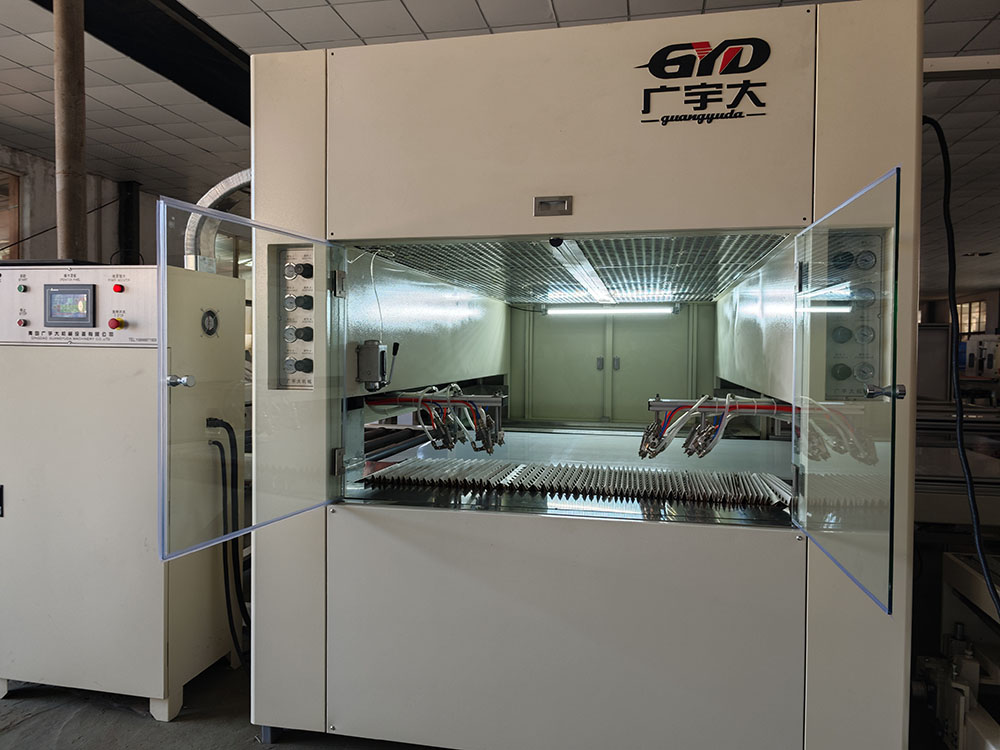
Spray coating represents a fundamental shift from traditional manual finishing methods like brushing, rolling, or dipping. The core principle involves atomizing liquid or powder coating materials into fine particles that are propelled onto a surface, creating an even, consistent finish with minimal defects.
The spray coating process begins when coating material—whether paint, varnish, lacquer, or powder—is fed into a spray gun or nozzle system. Compressed air, hydraulic pressure, or electrostatic forces break the material into microscopic droplets. These droplets travel through the air and deposit onto the target substrate, forming a continuous film as they coalesce and dry or cure.
Modern spray coating machines employ various atomization techniques depending on the application requirements. High Volume Low Pressure (HVLP) systems use large volumes of air at low pressure to create a soft spray pattern ideal for detailed work. Airless systems rely on hydraulic pressure to force material through a small orifice, producing high-velocity spray suitable for thick coatings. Electrostatic systems charge the coating particles, causing them to be attracted to grounded substrates, which dramatically improves transfer efficiency and reduces overspray.
Spray coating offers several compelling benefits compared to conventional finishing techniques. The most significant advantage is uniformity—spray systems distribute coating material evenly across complex geometries and large surface areas, eliminating brush marks, roller patterns, or uneven thickness that plague manual methods.
Speed and efficiency represent another major benefit. Automated spray coating machines can cover extensive areas in minutes rather than hours, dramatically increasing production throughput. Material efficiency also improves substantially, as spray systems apply only the necessary amount of coating with minimal waste from drips, runs, or excessive buildup.
Consistency across production runs becomes achievable with spray coating technology. Once optimal parameters are established—nozzle size, air pressure, flow rate, distance from substrate—these settings can be replicated precisely for every piece, ensuring identical finish quality from the first unit to the thousandth.
The spray coating equipment market offers diverse machine configurations to match different production needs, substrate types, and quality requirements. Understanding these categories helps manufacturers select the right system for their specific applications.
Manual spray coating systems rely on human operators to control spray guns mounted on flexible hoses connected to material supply and compressed air sources. These systems provide maximum flexibility for low-volume production, custom work, or applications requiring frequent setup changes.
Operators can adjust spray patterns, angles, and distances in real-time based on visual feedback, making manual systems ideal for complex or irregularly shaped parts. However, manual spraying introduces variability dependent on operator skill, fatigue, and technique consistency. Training requirements are substantial, and achieving uniform results across multiple operators or shifts presents ongoing challenges.
Semi-automated systems combine human oversight with mechanized motion control. Typically, spray guns are mounted on reciprocating arms or oscillating frames that move in programmed patterns while operators load and unload parts or monitor the process.
These machines improve consistency by eliminating human variation in gun movement speed and path while retaining flexibility for different part sizes through adjustable stroke lengths and speeds. Semi-automated systems represent a cost-effective middle ground for manufacturers transitioning from fully manual operations toward complete automation.
Fully automated spray coating machines integrate robotic arms, programmable logic controllers (PLCs), and conveyor systems to handle the entire coating process with minimal human intervention. Parts move automatically through spray booths where robots execute pre-programmed spray paths with micron-level precision.
These systems excel in high-volume production environments where consistency, speed, and labor cost reduction are paramount. Automotive assembly lines, appliance manufacturing, and furniture production facilities commonly deploy fully automated spray coating lines capable of processing hundreds or thousands of parts per hour with identical finish quality.
Advanced automated systems incorporate vision systems and sensors that detect part position, orientation, and even surface defects before coating begins. Real-time adjustments to spray parameters compensate for variations, further enhancing quality and reducing reject rates.
Understanding the major components of spray coating machines helps operators optimize performance, troubleshoot issues, and make informed purchasing decisions.
The spray nozzle represents the heart of any coating system, determining atomization quality, spray pattern shape, and material flow rate. Nozzles come in various configurations including air spray, airless, air-assisted airless, and electrostatic designs.
Nozzle selection depends on coating viscosity, desired film thickness, substrate geometry, and finish requirements. Smaller orifice sizes produce finer atomization for smooth finishes but may struggle with high-viscosity materials. Larger orifices handle thicker coatings but create coarser spray patterns that may require additional finishing steps.
Modern spray guns feature adjustable fan patterns, fluid flow controls, and quick-change nozzle systems that allow operators to switch between different coatings or applications without extensive downtime.
Control systems range from simple pneumatic regulators and manual valves to sophisticated computer-controlled interfaces with touchscreen displays and data logging capabilities. Advanced systems monitor and adjust air pressure, material flow, gun position, and conveyor speed in real-time.
Programmable logic controllers store recipes for different products, automatically configuring all machine parameters when a new part type enters the production line. This flexibility enables manufacturers to run mixed-model production without manual reconfiguration between batches.
Integration with factory-wide manufacturing execution systems (MES) allows spray coating machines to receive production schedules, report output quantities, and flag maintenance needs automatically, supporting lean manufacturing and Industry 4.0 initiatives.
Coating material must be delivered to spray guns at consistent pressure and flow rates to maintain finish quality. Material delivery systems include pressure pots, diaphragm pumps, piston pumps, and peristaltic pumps depending on coating type and viscosity.
For high-volume operations, bulk supply tanks with agitation systems prevent pigment settling and maintain homogeneous material properties throughout the production run. Heated hoses and tanks keep temperature-sensitive coatings within optimal viscosity ranges regardless of ambient conditions.
Filtration systems remove contaminants that could clog nozzles or create surface defects. Multi-stage filtration with progressively finer mesh sizes protects sensitive components while ensuring clean material reaches the spray gun.
Spray coating machines serve diverse industries, each with unique requirements and challenges that shape equipment selection and process parameters.
The automotive sector represents one of the largest consumers of spray coating technology, applying multiple coating layers to vehicle bodies, components, and trim parts. Basecoat, clearcoat, primer, and e-coat applications all rely on sophisticated spray systems to achieve the glossy, defect-free finishes consumers expect.
Robotic spray systems dominate automotive painting due to the high volume, complex geometries, and stringent quality standards. Multi-axis robots navigate around vehicle bodies, maintaining optimal gun-to-surface distance and angle throughout the spray path. Color-change systems enable rapid switching between different paint colors without extensive purging or downtime.
Furniture manufacturers use spray coating to apply stains, sealers, lacquers, and paints to wood products ranging from cabinets to chairs to decorative trim. Water-based and solvent-based coatings both find application depending on environmental regulations and desired finish characteristics.
Reciprocating spray machines with oscillating guns efficiently coat flat panels and simple profiles, while robotic systems handle complex carved details and three-dimensional furniture pieces. UV-curable coatings paired with spray application enable rapid curing and high-throughput production lines.
Ceramic manufacturers employ spray coating to apply colored glazes and decorative finishes to tiles and sanitaryware. The ability to create solid-color finishes across an extremely wide color gamut makes spray coating particularly valuable for meeting diverse aesthetic demands.
Precision spray systems ensure uniform color density and thickness across large tile batches, minimizing variation that could cause visible differences when tiles are installed side-by-side. Automated systems handle both small-batch custom production and high-volume standard product runs.
Consumer electronics manufacturers use spray coating for both functional and decorative purposes. Conformal coatings protect circuit boards from moisture and contaminants, while decorative paints and textures enhance product appearance and brand identity.
Small-scale spray booths with precision robots handle delicate electronic components without damage. Electrostatic spray systems improve coating transfer efficiency on conductive substrates, reducing material costs and environmental impact.
Proper maintenance ensures spray coating machines deliver consistent performance over their service life while minimizing unplanned downtime and repair costs.
Thorough cleaning after each production run prevents coating material from curing inside guns, hoses, and nozzles. Water-based coatings require flushing with water, while solvent-based materials need appropriate solvents to dissolve residues completely.
Automated cleaning cycles built into modern spray systems reduce operator burden and ensure consistent cleaning quality. Gun wash stations with rotating nozzles blast cleaning solution through internal passages, removing material that manual cleaning might miss.
Seals, gaskets, and O-rings degrade over time due to chemical exposure and mechanical wear. Regular inspection identifies components showing cracks, swelling, or hardening before they fail catastrophically and cause leaks or inconsistent spray patterns.
Nozzle tips wear from abrasive coating materials and high-velocity flow, gradually changing spray patterns and reducing atomization quality. Scheduled nozzle replacement based on operating hours or material throughput prevents quality degradation before it becomes visible in finished products.
Tracking key performance metrics helps identify developing issues before they impact production. Spray pattern consistency, coating thickness measurements, and material consumption rates all provide insight into system health.
Statistical process control (SPC) charts plot these metrics over time, highlighting trends that indicate maintenance needs. Increasing material consumption might signal nozzle wear or pump inefficiency, while thickness variation could point to pressure fluctuations or gun positioning errors.
Modern spray coating operations must address environmental regulations and worker safety requirements while maintaining productivity and quality.
Spray booths incorporate ventilation and filtration systems that capture overspray and volatile organic compounds (VOCs) before they escape into the workplace or environment. Water wash booths use cascading water curtains to trap paint particles, while dry filter booths use replaceable media to capture overspray.
Regenerative thermal oxidizers (RTOs) and carbon adsorption systems treat exhaust air to remove VOCs before release to atmosphere. These systems help manufacturers comply with increasingly stringent air quality regulations while recovering and recycling coating materials where feasible.
Personal protective equipment (PPE) including respirators, protective clothing, and eye protection shields operators from coating material exposure. Automated and robotic spray systems reduce direct human exposure by enclosing the spray process within ventilated booths.
Training programs ensure operators understand chemical hazards, proper PPE use, and emergency procedures. Material safety data sheets (MSDS) for all coating materials must be readily accessible, and spill containment systems prevent environmental contamination from accidental releases.
Q1: What is the difference between HVLP and airless spray coating systems?
HVLP (High Volume Low Pressure) systems use large volumes of air at low pressure to atomize coating material, producing a soft spray pattern with minimal overspray. They excel in detailed work and situations requiring fine finish quality. Airless systems rely on hydraulic pressure to force material through small orifices, creating high-velocity spray suitable for thick coatings and rapid coverage of large areas. Airless systems typically have higher transfer efficiency but produce coarser atomization.
Q2: How often should spray nozzles be replaced?
Nozzle replacement frequency depends on coating abrasiveness, operating pressure, and material throughput. As a general guideline, nozzles should be inspected every 500 operating hours and replaced when spray patterns show distortion, flow rates decrease, or finish quality degrades. High-abrasion coatings like zinc-rich primers may require nozzle replacement every 200-300 hours, while gentle water-based paints might allow 1000+ hours of service.
Q3: Can spray coating machines handle powder coatings?
Yes, specialized powder coating spray systems use electrostatic charges to attract dry powder particles to grounded substrates. These systems differ from liquid spray equipment in that they use compressed air to fluidize and convey powder rather than pumps for liquid material. Powder coating offers environmental advantages with near-zero VOC emissions and the ability to recycle overspray, though it requires curing ovens to melt and flow the powder into continuous films.
Q4: What factors determine the choice between manual, semi-automated, and fully automated spray systems?
Production volume, part complexity, available labor, and budget constraints all influence this decision. Manual systems suit low-volume, high-variety production with frequent changeovers. Semi-automated systems balance consistency and flexibility for medium-volume operations. Fully automated robotic systems maximize throughput and consistency for high-volume, repetitive production where the investment can be justified by labor savings and quality improvements.
Q5: How can manufacturers reduce coating material waste in spray operations?
Several strategies minimize material waste: optimizing spray gun settings to match part geometry, using electrostatic systems to improve transfer efficiency, implementing automated gun triggering that sprays only when parts are present, recycling overspray through reclaim systems (especially for powder coatings), and training operators on efficient spray techniques. Regular maintenance ensuring proper nozzle condition and pressure settings also prevents excessive material consumption.


