
Views: 274 Author: gyd Publish Time: 2026-09-16 Origin: Site


Content Menu
● Introduction to Reciprocating Automatic Painting Machines
● How Reciprocating Automatic Painting Machines Work
>> Control Systems and Automation
● Advantages of Reciprocating Automatic Painting Systems
>> Improved Coating Quality and Consistency
>> Increased Production Efficiency
>> Reduced Material Waste and Environmental Impact
>> Cost Savings and Return on Investment
● Industrial Applications of Reciprocating Painting Machines
>> Woodworking and Furniture Manufacturing
>> Automotive and Transportation Components
>> Architectural and Building Materials
>> General Industrial Manufacturing
● Comparison with Other Automated Painting Technologies
>> Reciprocating vs. 5-Axis Spray Painting Machines
>> Reciprocating vs. Robotic Spray Painting Systems
● Technical Considerations for Implementation
>> Integration with Existing Production Lines
>> Maintenance and Operational Requirements
>> Training and Skill Development
● Future Trends and Developments
>> Advanced Control Systems and IoT Integration
>> Sustainability and Environmental Compliance
>> Artificial Intelligence and Machine Learning
A reciprocating automatic painting machine is an industrial automation system that applies paint or coatings using a back-and-forth motion to ensure uniform coverage across workpieces moving on a conveyor. This technology has become essential in modern manufacturing, offering precision, efficiency, and consistency that manual spraying cannot match. By automating the coating process, these machines reduce labor costs, minimize material waste, and enhance product quality across various industries.
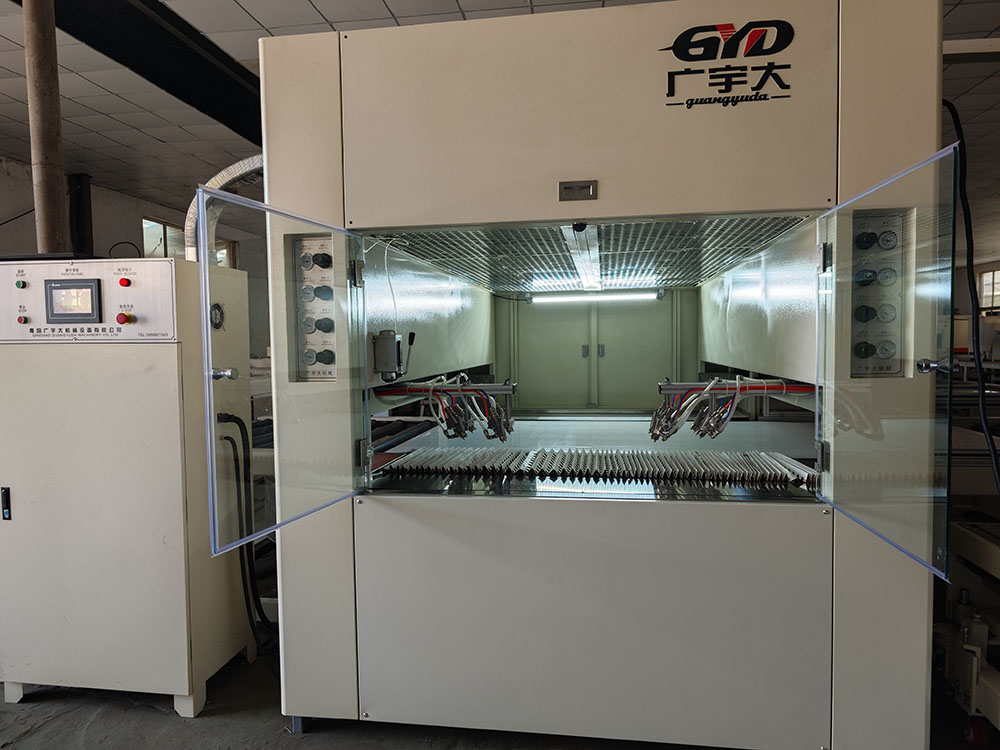
The core mechanism of a reciprocating automatic painting machine involves spray guns mounted on a carriage that moves horizontally back and forth across the width of a conveyor system. As workpieces pass underneath on the conveyor belt, the spray guns apply paint in a controlled, repetitive motion. This reciprocating movement ensures that every part of the workpiece receives an even coat, eliminating the inconsistencies often seen in manual spraying.
Several critical components work together to enable the machine's functionality. The spray gun assembly is responsible for atomizing and directing the coating material onto the workpiece surface. The reciprocating mechanism, typically driven by servo motors or pneumatic systems, controls the back-and-forth motion of the spray guns. A conveyor system transports workpieces through the painting zone at a controlled speed. The control system, often featuring programmable logic controllers (PLCs) and human-machine interfaces (HMIs), allows operators to set parameters such as spray pattern, speed, and coating thickness. Additionally, a paint delivery system ensures a consistent supply of coating material to the spray guns.
Modern reciprocating painting machines incorporate sophisticated control systems that enable precise adjustment of painting parameters. Operators can program different spray patterns, adjust the speed of the reciprocating motion, and control the flow rate of the coating material. Many systems feature positive-pressure sealed housings that prevent paint from entering the machine's interior, reducing maintenance requirements and extending equipment life. Advanced models also include automatic belt cleaning and paint-recycling functions, further enhancing efficiency and sustainability.
One of the primary benefits of reciprocating automatic painting machines is their ability to deliver uniform coating quality. The controlled back-and-forth motion ensures consistent paint application across the entire workpiece surface, reducing the likelihood of missed spots, uneven thickness, or overspray. This consistency is particularly important in industries where product appearance and protective coating quality are critical, such as furniture manufacturing, automotive components, and architectural panels.
Automation significantly boosts production throughput compared to manual spraying methods. Reciprocating machines can operate continuously without fatigue, maintaining consistent performance throughout extended production runs. The ability to integrate these systems into existing conveyor lines allows for seamless incorporation into manufacturing workflows, minimizing downtime and maximizing output. Many systems can complete full spray cycles without manual intervention, further reducing labor requirements and operational costs.
Automated painting systems optimize coating transfer efficiency, meaning more of the sprayed material reaches the workpiece rather than being lost to overspray. This efficiency translates to reduced material consumption and lower operational costs. Additionally, many modern reciprocating machines incorporate paint-recycling functions and positive-pressure systems that minimize emissions and environmental impact. The precise control over spray patterns and flow rates also helps manufacturers comply with increasingly stringent environmental regulations.
While the initial investment in reciprocating automatic painting equipment may be substantial, the long-term cost savings are significant. Reduced labor costs, lower material waste, decreased rework rates, and improved production throughput all contribute to a favorable return on investment. Many manufacturers report that these systems pay for themselves within a relatively short period through operational efficiencies alone.
In the woodworking industry, reciprocating spray painting machines are widely used for finishing solid wood products, wooden doors, MDF panels, and furniture components. These systems excel at applying paint, polyurethane (PU), ultraviolet (UV), and water-based coatings onto flat panels and standard-shaped products. The continuous production mode of reciprocating machines makes them ideal for high-volume furniture manufacturing where consistent finish quality is essential.
The automotive industry utilizes reciprocating painting systems for coating various components, including body panels, interior trim pieces, and underbody parts. These machines ensure uniform protective and decorative coatings that meet stringent quality standards. The ability to precisely control coating thickness and coverage is particularly valuable in automotive applications where corrosion protection and aesthetic appearance are critical.
Manufacturers of architectural panels, cabinet doors, and building materials rely on reciprocating automatic painting machines to apply protective and decorative coatings. These systems handle large-format panels efficiently while maintaining consistent quality across production batches. The ability to adjust spray parameters for different coating types makes these machines versatile for various architectural finishing requirements.
Beyond specific industries, reciprocating painting machines serve diverse manufacturing applications where flat or nearly flat workpieces require coating. From metal fabrication to plastic component finishing, these systems provide reliable automation for coating processes that would otherwise require significant manual labor.
While both reciprocating and 5-axis spray painting machines automate the coating process, they serve different production requirements. Reciprocating machines focus on high-speed continuous production with stable coating performance, making them ideal for flat panels, cabinet doors, and standard-shaped products. In contrast, 5-axis machines provide multi-directional movement and flexible spray path control, allowing manufacturers to finish complex, curved, and irregular components with higher precision. The choice between these technologies depends on workpiece geometry, production volume, and required surface accessibility.
Robotic spray painting systems offer the greatest flexibility for complex or frequently changing workpieces, with the ability to reach difficult angles, recesses, and variable orientations. However, reciprocating machines excel at continuous production of flat parts with faster cycle times and lower operational complexity. For manufacturers primarily producing flat or nearly flat panels, reciprocating systems often provide better value through higher throughput and simpler operation.
Choosing the right painting technology requires careful consideration of several factors. Manufacturers should evaluate workpiece geometry, production volume, product variation, and required surface accessibility. A useful guideline is to select reciprocating motion when most surfaces face upward and products can share similar gun height, angle, and conveyor settings. For three-dimensional but repeatable parts requiring multi-surface coverage, 5-axis machines may be more appropriate. Complex, irregular, or highly variable workpieces typically benefit from robotic systems.
Successful implementation of reciprocating automatic painting machines requires careful planning for integration with existing manufacturing workflows. Manufacturers must consider conveyor speed compatibility, workpiece fixturing requirements, and space constraints within the production facility. Many systems are designed for modular integration, allowing gradual implementation without disrupting ongoing operations.
While reciprocating painting machines reduce manual labor, they still require regular maintenance to ensure optimal performance. Key maintenance activities include cleaning spray guns and nozzles, inspecting reciprocating mechanisms, and calibrating control systems. Modern designs with positive-pressure sealed housings and automatic cleaning functions significantly reduce maintenance frequency and complexity.
Operators and maintenance personnel require appropriate training to maximize the benefits of automated painting systems. Training programs should cover system operation, parameter adjustment, troubleshooting, and safety procedures. Many equipment suppliers offer comprehensive training programs to ensure successful implementation and operation.
The future of reciprocating automatic painting machines lies in increasingly sophisticated control systems and Internet of Things (IoT) integration. Advanced systems will feature real-time monitoring, predictive maintenance capabilities, and remote diagnostics. These developments will further reduce downtime and improve overall equipment effectiveness.
Environmental regulations continue to drive innovation in painting technology. Future reciprocating systems will incorporate even more efficient paint delivery systems, advanced filtration technologies, and improved recycling capabilities. The trend toward water-based and low-VOC coatings will also influence machine design and operation.
Emerging artificial intelligence and machine learning technologies will enable adaptive painting systems that automatically optimize parameters based on real-time feedback. These intelligent systems will continuously improve coating quality while minimizing material consumption and energy usage.
Reciprocating automatic painting machines represent a mature and proven technology for industrial coating applications. Their ability to deliver consistent quality, improve production efficiency, and reduce operational costs makes them an attractive investment for manufacturers across diverse industries. As technology continues to advance, these systems will become even more capable, efficient, and environmentally friendly, ensuring their continued relevance in modern manufacturing.
Q1: What types of workpieces are best suited for reciprocating automatic painting machines?
A1: Reciprocating automatic painting machines are best suited for flat or nearly flat workpieces such as wooden panels, cabinet doors, furniture boards, architectural panels, and automotive body panels. They excel in continuous production environments where workpieces can pass underneath the spray guns on a conveyor system.
Q2: How does a reciprocating painting machine differ from manual spraying?
A2: Unlike manual spraying, which relies on operator skill and can lead to inconsistent results, reciprocating machines automate the spray gun movement with precise back-and-forth motion. This automation ensures uniform coating thickness, reduces material waste, eliminates operator fatigue, and significantly increases production throughput.
Q3: What coatings can be applied using reciprocating automatic painting machines?
A3: These machines can apply various coating types including paint, polyurethane (PU), ultraviolet (UV) coatings, water-based coatings, and other industrial finishes. The specific coating compatibility depends on the spray gun configuration and paint delivery system design.
Q4: What are the main maintenance requirements for reciprocating painting systems?
A4: Main maintenance activities include regular cleaning of spray guns and nozzles, inspection of reciprocating mechanisms for wear, calibration of control systems, and replacement of worn components. Modern systems with sealed housings and automatic cleaning functions require less frequent maintenance.
Q5: How do manufacturers determine if a reciprocating machine is the right choice for their application?
A5: Manufacturers should evaluate workpiece geometry (flat vs. complex shapes), production volume requirements, product variation frequency, and required surface accessibility. Reciprocating machines are ideal when most surfaces face upward, products share similar characteristics, and high-volume continuous production is needed.


