
Views: 286 Author: gyd Publish Time: 2026-09-16 Origin: Site


Content Menu
● What Is an Automatic Spraying Line?
>> Core Components and Architecture
>> Integration with Production Workflows
● Types of Automatic Spraying Lines
>> Linear Profile Spraying Lines
● Key Advantages of Automatic Spraying Lines
>> Consistency and Quality Improvement
>> Productivity and Throughput Gains
>> Cost Reduction and Material Efficiency
>> Environmental and Safety Benefits
● Applications Across Industries
>> Automotive and Transportation
>> Metal Fabrication and Hardware
>> Electronics and Consumer Goods
● Implementation and Optimization Strategies
>> System Selection and Layout
>> Operator Training and Skill Development
>> Continuous Improvement and Data Analytics
● Maintenance and Troubleshooting
>> Preventive Maintenance Schedules
>> Common Issues and Resolutions
Automatic spraying lines have transformed industrial coating operations by delivering consistent, high-quality finishes with unprecedented efficiency and minimal manual intervention. These integrated systems combine conveyor technology, robotic or reciprocating spray mechanisms, and automated curing processes to handle everything from furniture panels to automotive components with repeatable precision.
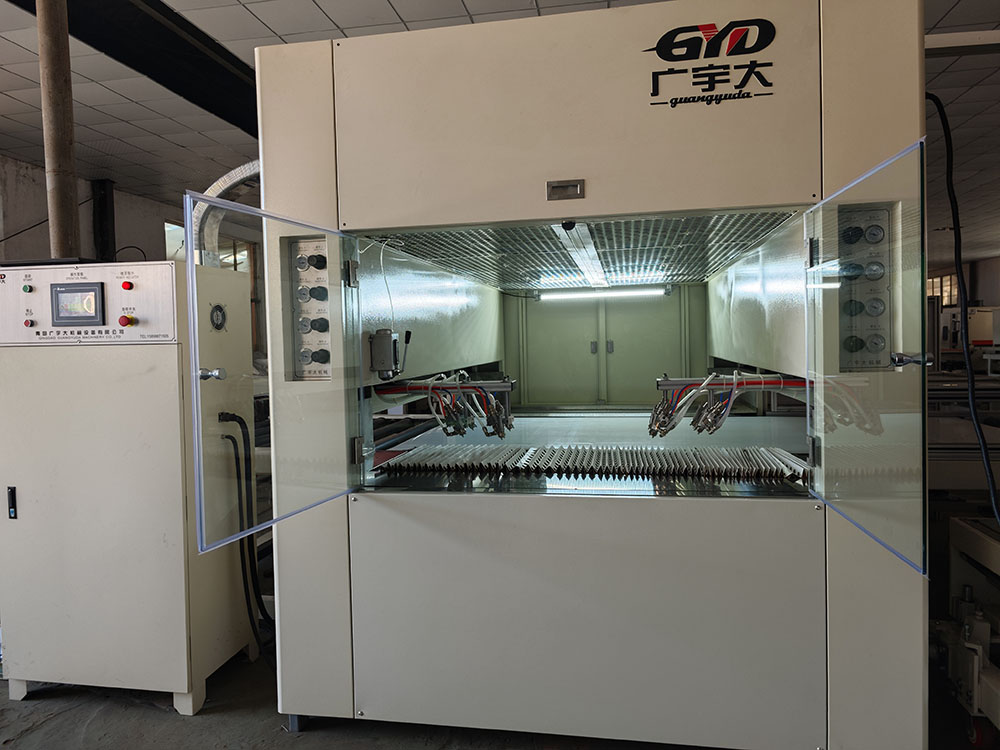
An automatic spraying line represents a fully or semi-automated production system designed to apply paint, varnish, lacquer, or protective coatings to workpieces as they move through a continuous process flow. Unlike standalone spray booths or manual operations, these lines integrate multiple stages—surface preparation, coating application, leveling, drying or curing, and cooling—into a single streamlined workflow.
Modern automatic spraying lines consist of several interconnected subsystems working in harmony. Conveyor systems transport parts through each processing zone at controlled speeds, ensuring consistent exposure times and coating thickness. Spray stations equipped with reciprocating arms, oscillating frames, or multi-axis robotic manipulators execute programmed spray patterns with micron-level accuracy.
Control systems serve as the operational brain, coordinating conveyor speed, spray gun triggering, material flow rates, and environmental conditions throughout the line. Advanced installations incorporate sensors and vision systems that detect part position, measure coating thickness in real-time, and automatically adjust parameters to compensate for variations.
Automatic spraying lines fit into broader manufacturing ecosystems, receiving workpieces from upstream processes like machining, assembly, or pretreatment, then delivering finished parts to downstream operations such as inspection, packaging, or final assembly. Material handling automation—robotic loaders, automatic stackers, and buffer zones—minimizes manual touchpoints and maintains continuous flow even during changeovers or brief interruptions.
Integration with factory-wide manufacturing execution systems (MES) enables automatic scheduling, production tracking, and quality data collection. This connectivity supports lean manufacturing principles by reducing work-in-progress inventory, minimizing setup times, and providing real-time visibility into line performance metrics.
Manufacturers offer diverse automatic spraying line configurations to match different substrate types, production volumes, and quality requirements. Understanding these categories helps facilities select systems aligned with their specific applications.
Reciprocating spray lines feature spray guns mounted on linear actuators that move back and forth across the workpiece path. These systems excel at coating flat panels, doors, and simple profiles where consistent coverage across a uniform surface is the primary requirement.
The reciprocating motion creates overlapping spray passes that eliminate gaps and ensure even material distribution. Stroke length, speed, and gun triggering are programmable, allowing quick adaptation to different part dimensions without mechanical reconfiguration. Multiple reciprocating arms can be arranged in series to apply primer, basecoat, and topcoat in a single pass through the line.
Robotic automatic spraying lines employ industrial robot arms—typically six-axis articulated manipulators—to navigate complex three-dimensional paths around irregularly shaped parts. These systems handle automotive bodies, furniture with carved details, and components with multiple faces requiring coating from various angles.
Robots maintain optimal gun-to-surface distance and perpendicular orientation throughout the spray trajectory, critical for achieving uniform film thickness on curved or contoured geometries. Multi-robot configurations enable simultaneous coating of different zones on large assemblies, dramatically reducing cycle times compared to single-gun systems.
Specialized automatic spraying lines target elongated workpieces like wood moldings, trim profiles, door frames, and extruded sections. These systems arrange fixed spray guns or compact reciprocators along the conveyor path, creating continuous coverage as parts pass beneath at high speed.
Linear lines prioritize throughput over flexibility, with gun positions and spray patterns optimized for specific profile cross-sections. Quick-change gun mounts and adjustable conveyor guides enable switching between different profile families, though changeover times exceed those of fully robotic systems.
UV-curing automatic spraying lines integrate ultraviolet lamps immediately downstream of spray stations, enabling instant polymerization of UV-reactive coatings. This technology eliminates extended drying ovens, reduces floor space requirements, and accelerates production cycles from hours to minutes.
UV lines typically include electrostatic dust removal, preheating zones, primer application, intermediate flash-off, topcoat spraying, leveling sections, and high-intensity UV curing tunnels. The rapid cure enables immediate handling, inspection, and packaging, supporting just-in-time manufacturing models.
Transitioning from manual or semi-automated coating operations to fully automatic spraying lines delivers measurable benefits across quality, productivity, cost, and environmental dimensions.
Automatic spraying lines eliminate human variability inherent in manual operations—differences in gun angle, travel speed, trigger timing, and overlap technique that create finish inconsistencies between operators, shifts, or production batches. Programmed spray paths execute identically for every part, ensuring uniform coating thickness, color density, and surface appearance.
Closed-loop control systems monitor critical parameters like air pressure, material flow, and conveyor speed, automatically compensating for drift or disturbances before defects occur. In-line inspection systems detect coating anomalies—runs, dry spots, contamination—and flag affected parts for rework or rejection before they reach customers.
Continuous-flow automatic spraying lines process parts at speeds impossible to achieve manually. Conveyor systems move workpieces through spray zones without stopping, while automated gun triggering ensures coating is applied only when parts are present, eliminating wasted motion and idle time.
Multi-station configurations apply multiple coating layers in a single pass, collapsing what would be separate manual operations into one integrated process. UV-curing lines further compress cycle times by eliminating extended oven dwell times, enabling parts to be handled and packaged immediately after exiting the line.
Automatic spraying lines reduce direct labor costs by minimizing the number of operators required per unit of output. One or two technicians can oversee an entire line that would otherwise require multiple skilled sprayers working in parallel. Training requirements shift from extensive spray technique development to equipment operation and basic maintenance, broadening the available labor pool.
Material utilization improves substantially through precise control of spray patterns, flow rates, and gun triggering. Overspray—the coating material that misses the target substrate—is minimized by optimizing gun positioning and using electrostatic attraction where applicable. Some systems recover and recycle overspray, particularly in powder coating applications, further reducing material costs.
Enclosed spray booths with controlled ventilation capture overspray and volatile organic compound (VOC) emissions before they escape into the workplace or environment. Water-wash or dry-filter exhaust treatment systems remove particulates, while regenerative thermal oxidizers or carbon adsorption units treat VOC-laden air before atmospheric release.
Reduced operator exposure to coating materials lowers occupational health risks and simplifies compliance with workplace safety regulations. Automated systems handle hazardous materials within contained environments, limiting the need for extensive personal protective equipment and reducing potential exposure incidents.
Automatic spraying lines serve diverse manufacturing sectors, each with unique substrate characteristics, coating requirements, and production demands that shape system design and configuration.
Furniture manufacturers deploy automatic spraying lines to apply stains, sealers, lacquers, and paints to cabinet doors, table tops, chair components, and decorative panels. Water-based and solvent-based coatings both find application depending on environmental regulations and desired finish properties.
Reciprocating lines handle flat panels efficiently, while robotic systems navigate carved details, turned legs, and three-dimensional furniture assemblies. UV-curing lines enable rapid production of high-gloss kitchen cabinets and office furniture with scratch-resistant finishes ready for immediate assembly and packaging.
The automotive industry relies heavily on automatic spraying lines for primer, basecoat, and clearcoat application on vehicle bodies, trim components, and underbody parts. Multi-robot spray cells navigate complex vehicle geometries, maintaining precise gun orientation through curves, edges, and recessed areas.
Color-change systems enable rapid switching between different paint formulations without extensive purging, supporting mixed-model production where different vehicle colors flow through the same line. Electrostatic spray technology improves transfer efficiency on conductive metal substrates, reducing material consumption and VOC emissions.
Metal product manufacturers use automatic spraying lines for decorative and protective coatings on appliance housings, architectural aluminum profiles, construction machinery components, and consumer hardware. Pretreatment stages—degreasing, phosphating, rinsing—prepare metal surfaces for optimal coating adhesion and corrosion resistance.
Powder coating lines apply dry powder electrostatically, then cure in convection ovens to create thick, durable finishes without solvent emissions. Liquid paint lines handle applications requiring thinner films or specific aesthetic effects like metallics or pearlescents that powder cannot replicate.
Electronics manufacturers employ automatic spraying lines for conformal coatings that protect circuit boards from moisture and contaminants, as well as decorative paints and textures on device housings and enclosures. Clean-room-compatible lines prevent particulate contamination critical for electronic assembly environments.
Small-scale robotic spray cells handle delicate components with precise material deposition, avoiding overspray on sensitive areas. UV-curing formulations enable rapid processing compatible with high-volume consumer electronics production cycles.
Successful deployment of automatic spraying lines requires careful planning, operator training, and ongoing optimization to realize full benefits.
Matching line configuration to production requirements begins with analyzing part geometries, coating specifications, target throughput, and available floor space. Flat panels favor reciprocating lines, while complex assemblies demand robotic flexibility. UV-curing suits high-volume operations prioritizing speed, while thermal curing offers broader material compatibility.
Layout optimization minimizes material handling distances between upstream and downstream processes while providing adequate access for maintenance and changeovers. Buffer zones before and after the spray line absorb variability in adjacent operations, preventing line stoppages from propagating through the entire production flow.
While automatic spraying lines reduce reliance on manual spray technique, they increase demand for equipment operation, programming, and troubleshooting skills. Operators must understand spray gun adjustment, robot path programming, conveyor synchronization, and control system interfaces.
Cross-training enables personnel to handle multiple roles—loading, monitoring, quality inspection, basic maintenance—improving labor flexibility and reducing downtime during absences or turnover. Documentation including setup sheets, maintenance checklists, and troubleshooting guides accelerates learning curves for new hires.
Modern automatic spraying lines generate extensive operational data—cycle times, material consumption, defect rates, equipment utilization—that supports continuous improvement initiatives. Statistical process control (SPC) charts track coating thickness, gloss, and other quality metrics over time, highlighting trends indicating developing issues.
Predictive maintenance algorithms analyze motor currents, bearing temperatures, and vibration signatures to forecast component failures before they cause unplanned downtime. Integrating line data with enterprise resource planning (ERP) systems enables production scheduling optimization based on actual capacity and changeover requirements.
Proper maintenance ensures automatic spraying lines deliver consistent performance over their service life while minimizing unplanned interruptions and repair expenses.
Daily tasks include cleaning spray guns and nozzles, checking conveyor alignment and tension, verifying sensor operation, and inspecting filters for clogging. Weekly activities encompass lubricating bearings and guides, calibrating flow meters and pressure gauges, and testing emergency stops and safety interlocks.
Monthly or quarterly maintenance addresses wear components like seals, gaskets, and O-rings that degrade from chemical exposure and mechanical cycling. Annual overhauls may include motor inspections, gearbox oil changes, and comprehensive control system diagnostics to identify developing issues before catastrophic failures occur.
Coating thickness variation often traces to clogged nozzles, inconsistent material viscosity, or conveyor speed fluctuations. Regular filtration, viscosity monitoring, and drive system maintenance prevent these issues. Runs and sags typically indicate excessive material flow or improper gun distance, correctable through parameter adjustment or gun repositioning.
Robot path errors causing uneven coverage may stem from mechanical wear in joints or backlash in drive systems. Regular calibration and backlash compensation settings maintain trajectory accuracy. Control system faults—communication errors, sensor failures—require systematic diagnostics following manufacturer troubleshooting guides to isolate root causes efficiently.
Q1: What is the typical payback period for investing in an automatic spraying line?
Payback periods vary based on production volume, labor costs, material savings, and quality improvements, but typically range from 18 to 36 months. High-volume operations with significant manual labor content see faster returns through reduced headcount and increased throughput. Material efficiency gains—often 20-40% reduction in coating consumption—accelerate payback further. Facilities should conduct detailed ROI analysis including installation costs, training, and ongoing maintenance when evaluating specific systems.
Q2: Can automatic spraying lines handle mixed-product production with frequent changeovers?
Yes, modern automatic spraying lines support mixed-product runs through programmable recipes that store spray parameters, robot paths, and conveyor settings for different part types. Quick-change gun mounts, adjustable fixtures, and barcode or RFID part identification enable automatic line reconfiguration as different products enter the flow. Changeover times can be reduced to minutes with proper system design and operator training, making small-batch production economically viable.
Q3: What coating materials are compatible with automatic spraying lines?
Automatic spraying lines handle diverse coating formulations including solvent-based paints, water-based coatings, UV-curable materials, powder coatings, and two-component reactive systems. Material selection depends on substrate type, desired finish properties, environmental regulations, and curing method. Viscosity, pot life, and chemical compatibility with system components must be considered. Many lines incorporate heated hoses and tanks to maintain optimal material properties across varying ambient conditions.
Q4: How do automatic spraying lines address environmental regulations on VOC emissions?
Automatic spraying lines incorporate multiple strategies to minimize VOC emissions and comply with regulations. Enclosed spray booths with controlled exhaust capture overspray and vapors. Water-wash or dry-filter systems remove particulates before air treatment. Regenerative thermal oxidizers (RTOs) or carbon adsorption units treat VOC-laden exhaust before atmospheric release. Water-based and UV-curing coatings inherently contain lower or zero VOCs, further reducing emissions. Many systems achieve 90%+ transfer efficiency, minimizing material waste and associated emissions.
Q5: What level of technical expertise is required to operate and maintain automatic spraying lines?
Operating automatic spraying lines requires less specialized spray technique skill than manual operations but demands proficiency in equipment operation, basic programming, and troubleshooting. Operators need training on control system interfaces, recipe selection, gun adjustment, and quality inspection. Maintenance personnel require mechanical, electrical, and pneumatic system knowledge to perform preventive tasks and diagnose faults. Manufacturers typically provide comprehensive training programs, and many systems feature intuitive touchscreens with guided workflows that reduce skill barriers.


