
Views: 236 Author: gyd Publish Time: 2026-09-09 Origin: Site


Content Menu
● What Is a Reciprocating Spray System?
>> Why Reciprocators Suit Flat Panels
>> Reciprocating System Advantages
● What Is a Robotic Spray System?
>> Why Robots Can Coat Flat Panels
>> Robotic System Limitations for Flat Panels
● Reciprocating vs Robotic Spray System Comparison
● Coating Quality and Film Thickness
● Material Efficiency and Overspray
● The Hidden Factor: Panel Presentation
● New Expert Insight: Separate Surface Complexity from Product Variety
>> How Complex Are the Surfaces?
● When a Reciprocating System Is Better
● When a Robotic System Is Better
● Safety and Environmental Requirements
● Visual Content Recommendations
>> Request a Flat-Panel Finishing Assessment
>> 1. Is a reciprocating spray system better for flat panels?
>> 2. When should a manufacturer choose a robotic spray system?
>> 3. Can a robot spray standard flat panels?
>> 4. Which system is easier to maintain?
>> 5. Which system provides better material efficiency?
>> 6. Can a reciprocating system handle different panel sizes?
>> 7. Can both technologies be used in one production line?
When manufacturers compare a reciprocating spray system vs a robotic spray system for flat panels, the reciprocating system is usually the more economical and efficient choice. It is designed specifically for repeatable surfaces such as cabinet doors, furniture panels, flooring boards, glass sheets, fibre cement panels, and flat wooden doors.
A robotic spray system can also coat flat panels, but its multi-axis flexibility may add cost and complexity that the product does not require. Robots become more attractive when flat panels include deep profiles, unusual edges, changing dimensions, complex textures, or mixed product geometries.
For most standard flat-panel production, the key decision is not which system is more advanced. It is which system delivers the required quality with the lowest total cost per accepted part.
GYDFinishing—also known as GYD Machinery—has supplied machinery and surface-finishing solutions since 2007. Drawing on worldwide experience and more than two decades of technological heritage, GYD Machinery develops automatic coating equipment ranging from individual machines to complete turnkey production lines.
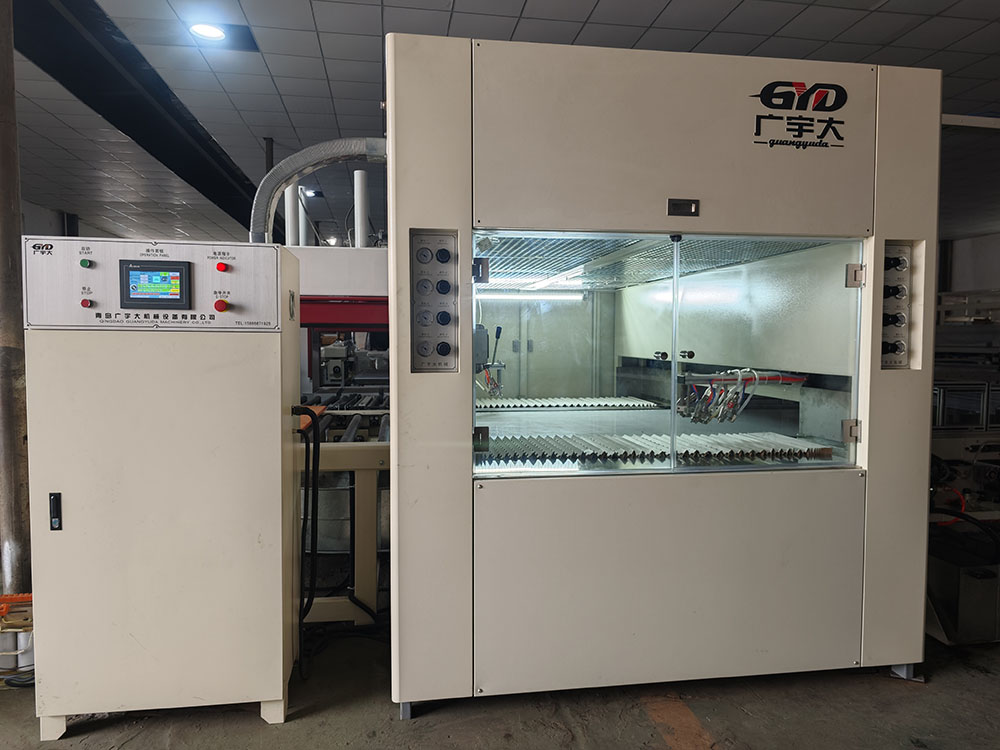
A reciprocating spray system moves spray guns back and forth along a controlled vertical or horizontal path while flat panels pass through the spray zone on a conveyor.
The system may control:
- Gun travel speed.
- Gun-to-panel distance.
- Spray-gun activation.
- Coating flow.
- Atomizing pressure.
- Conveyor speed.
- Spray overlap.
- Number of passes.
- Product recipes.
- Gun height and stroke length.
The machine is designed around a simple principle: move the spray guns consistently across a repeatable surface.
Flat panels generally have:
- Consistent width and length.
- Predictable surface orientation.
- Limited variation in spray angle.
- Repeatable loading positions.
- Similar coating paths from one part to the next.
This allows a reciprocating system to apply coating with:
- Stable gun distance.
- Consistent spray speed.
- Repeatable overlap.
- Controlled film build.
- Predictable conveyor timing.
Reciprocating spray machines are commonly used for flat wooden doors, cabinet panels, furniture components, flooring boards, and other uniform surfaces. [puretemac]
Lower investment. A reciprocating system usually costs less than a comparable multi-axis robotic cell.
High production speed. Linear movement is efficient for repetitive flat-panel production.
Consistent coating. The machine repeats the same spray pattern on every compatible panel.
Simple programming. Operators generally adjust recipes and operating parameters rather than developing complex robotic paths.
Easy line integration. The system can connect with conveyors, sanding, dust removal, drying, inspection, and stacking.
Predictable maintenance. Rails, drives, spray guns, pumps, and sensors are usually easier to maintain than multiple robot axes.
A robotic spray system uses a programmable robot arm to move one or more spray guns through multiple axes.
The system may control:
- Spray angle.
- Gun-to-panel distance.
- Path speed.
- Material flow.
- Trigger timing.
- Number of passes.
- Product-specific recipes.
- Edge coverage.
- Approach direction.
- Workpiece orientation.
A robotic system is designed to follow complex paths and adapt the spray gun to changing surface geometry.
Robots can coat flat panels when the application requires:
- Multiple product sizes.
- Different spray angles.
- Complex edge coverage.
- Frequent product changes.
- Profiled or recessed surfaces.
- Mixed flat and three-dimensional components.
- Flexible production rather than maximum line speed.
A robot may also be useful when the "flat panel" has molded details, routed edges, decorative profiles, or difficult recesses.
Greater flexibility. Robots can be programmed for many product shapes and sizes.
Multi-axis coverage. The spray gun can approach edges, corners, and profiles from different directions.
Mixed-product capability. Several panel recipes can be stored and selected.
Adaptability. New products may require programming rather than mechanical redesign.
Better for complex edges. A robot can change orientation when a panel has unusual geometry.
Higher capital cost. Robots require controllers, safety fencing, programming, positioners, sensors, and commissioning.
More complex programming. Even simple panels may require path development and validation.
Higher maintenance requirements. Robot axes, cables, controllers, and calibration systems need specialist support.
Potentially lower economic efficiency. A robot may use more technical capability than a flat panel requires.
Longer commissioning. The system may take more time to optimize than a reciprocator.
For large volumes of standardized flat panels, reciprocating systems usually provide stronger throughput because the spray path is simple and repeatable.
Robots may provide excellent output, but their advantage is flexibility rather than pure linear speed.
Both systems can deliver consistent film thickness when correctly designed. Reciprocators are particularly effective when panel dimensions and positions remain stable.
Robots may provide better uniformity when the panel includes profiles, recesses, or difficult edges that require changing spray angles.
Reciprocating systems generally require less capital. Robots usually require a larger investment in hardware, software, safety, installation, and technical training.
Robots are more flexible for mixed product geometry. Reciprocators are more efficient when products share similar dimensions and spray requirements.
Reciprocators are generally simpler to operate and maintain. Robots require more technical expertise and specialized troubleshooting.
Reciprocators are generally best for:
- High-volume flat panels.
- Standard cabinet doors.
- Furniture panels.
- Flooring boards.
- Flat wooden doors.
- Glass sheets.
- Fibre cement boards.
Robots are generally best for:
- Profiled flat panels.
- Recessed doors.
- Curved or mixed components.
- Variable product dimensions.
- Products requiring different spray angles.
- Shorter production runs with high product variety.
Flat panels may appear easy to coat, but quality can still be affected by:
- Panel positioning.
- Gun distance.
- Spray speed.
- Overlap.
- Edge coverage.
- Coating viscosity.
- Spray pressure.
- Airflow.
- Surface preparation.
- Drying conditions.
A reciprocating system controls the main spray variables through fixed movement. This is a major advantage when the panel is flat and consistently positioned.
A robot can control the same variables while also changing spray angle and approach direction. This becomes valuable when the panel has profiled edges, grooves, or decorative details.
The goal is not simply to apply a uniform amount of coating. The goal is to achieve the required film thickness across the entire panel, including edges and difficult areas.
Material efficiency depends on how accurately the spray system applies coating to the product.
Transfer efficiency describes the amount of coating solids deposited on the substrate compared with the total coating solids used. [nepis.epa]
A reciprocating system can improve material efficiency through:
- Accurate gun triggering.
- Stable gun distance.
- Controlled spray overlap.
- Repeatable conveyor speed.
- Consistent part spacing.
- Defined spray recipes.
A robotic system can improve material efficiency on complex edges because it may reduce unnecessary overspray and repeated touch-up. However, poor programming may create excessive movement, overlap, or trigger time.
For flat panels, a well-tuned reciprocator may be more material-efficient because its spray path is short, direct, and optimized for the product.
Industry commentary on automatic flat-line finishing reports that coating consumption can decline when automatic spraying improves gun position and triggering accuracy. Actual savings must be verified with the factory's own coating, panel geometry, and production conditions. [woodweb]
The performance of both systems depends heavily on how panels enter the spray zone.
Review:
- Conveyor spacing.
- Panel orientation.
- Fixture stability.
- Surface flatness.
- Edge position.
- Product identification.
- Sensor accuracy.
- Loading consistency.
A reciprocating system performs best when every panel arrives in a predictable position. A robot may compensate for more variation if sensors or vision systems are integrated, but this adds cost and complexity.
For a flat-panel line, improving loading accuracy may produce a greater benefit than installing a more sophisticated robot.
Manufacturers often say they need robots because they produce "many products." That statement should be divided into two separate questions:
If all products are flat and only their length or width changes, a reciprocating system may handle the range with recipes and adjustable settings.
If products include deep recesses, curved edges, profiles, and several surface angles, a robot may provide better coverage.
A factory with 30 flat-panel sizes may still be an excellent reciprocating-spray candidate. A factory with only three products may need a robot if those products have complex three-dimensional profiles.
This distinction helps prevent overinvestment.
Use the following steps before choosing a system:
1. Classify panels as flat, profiled, recessed, or three-dimensional.
2. Record dimensions, weight, material, and surface condition.
3. Measure production volume and product-mix frequency.
4. Define target film thickness and appearance requirements.
5. Identify difficult edges, grooves, and recesses.
6. Test representative panels with both technologies where practical.
7. Measure coating consumption and overspray.
8. Record touch-up and rework time.
9. Include programming, maintenance, and training costs.
10. Define acceptance criteria for quality and throughput.
The supplier should test actual workpieces and coating materials rather than rely only on theoretical machine specifications.
Choose a reciprocating spray system when:
- Panels are flat or regularly shaped.
- Product dimensions are stable.
- Production volume is high.
- The same coating recipes are repeated.
- Throughput is a priority.
- The factory wants a simpler automation system.
- Capital investment must be controlled.
- The process will connect to a conveyor and drying system.
This is often the best choice for standardized cabinet doors, furniture panels, flooring, and flat wooden doors.
Choose a robotic spray system when:
- Panels have complex profiles.
- Edges and recesses require changing spray angles.
- Product dimensions vary significantly.
- Mixed product geometry is common.
- Manual touch-up is expensive.
- New products are introduced frequently.
- The factory needs flexible multi-axis access.
- The robot can replace several manual spray positions.
Robotic spraying is particularly valuable when coverage complexity, not only production volume, is the main challenge.
Both reciprocating and robotic spray systems require safe booth design and operating procedures.
OSHA identifies spray operations as presenting physical and health hazards. Applicable requirements address:
- Mechanical ventilation.
- Flammable and combustible materials.
- Ignition sources.
- Electrical equipment.
- Booth construction.
- Exhaust systems.
- Fire protection.
- PPE.
- Lockout and maintenance procedures.
OSHA's ventilation standard requires spray rooms to be adequately ventilated to protect the operator's breathing zone. [osha]
Robotic cells also require safety fencing, interlocks, emergency stops, access controls, and safe programming procedures. Automation may reduce direct exposure but does not eliminate the need for training, inspection, or compliant equipment.
Add the following visuals:
- Panel-geometry infographic: Compare flat, profiled, recessed, and complex surfaces.
- Spray-path animation: Show linear reciprocating motion versus multi-axis robotic motion.
- Coating comparison chart: Use real factory data for film thickness, overspray, and touch-up.
- Factory video: Demonstrate a reciprocating line coating cabinet doors and a robot coating profiled panels.
- Process diagram: Show loading, spraying, drying, inspection, and stacking.
Photorealistic industrial finishing factory, split-screen comparison of a reciprocating spray system coating flat cabinet doors on a conveyor and a robotic spray system coating profiled wooden panels, visible spray guns, conveyor, drying tunnel, inspection station, clean modern machinery, realistic engineering details, professional B2B editorial style, no logos, no text.
For most standard flat panels, a reciprocating spray system is the better choice. It generally offers:
- Lower investment.
- Higher practical throughput.
- Simpler maintenance.
- Strong coating repeatability.
- Efficient conveyor integration.
- Better value for high-volume production.
A robotic spray system becomes more attractive when flat panels include complex profiles, recessed details, changing dimensions, or difficult edges. Its higher investment may be justified if it reduces touch-up, supports many product families, and improves overall line flexibility.
The most important question is not "Which machine is more advanced?" It is:
> Does the product geometry require multi-axis movement?
If the answer is no, a reciprocating system is often the more efficient choice.
Contact GYDFinishing / GYD Machinery with your panel dimensions, product drawings, coating materials, annual output, quality requirements, and current rework data. GYD Machinery can help determine whether your production line needs a reciprocating spray system, robotic spray system, hybrid equipment, or a complete turnkey coating solution.
Usually, yes. It is designed for repeatable flat surfaces and generally offers strong throughput, consistent film thickness, and lower investment.
Choose a robot when panels have deep profiles, curved edges, recesses, multiple angles, or significant variation in size and geometry.
Yes. A robot can spray flat panels, but its flexibility may not justify the additional cost if the products are simple and standardized.
A reciprocating spray system is generally easier to maintain because it has simpler mechanical movement and less complex programming.
For simple flat panels, a well-tuned reciprocating system may be more efficient. For complex profiles, a robot may reduce overspray and touch-up by approaching surfaces from better angles.
Yes, if the sizes fall within the machine's working range and the system includes adjustable recipes, fixtures, and conveyor settings.
Yes. A hybrid line can use reciprocators for standard flat panels and robots for profiled or complex products.
1. [Purete — Spray Painting Machine Types and Technologies] — Information on reciprocating machines for flat panels, production speed, coating uniformity, and furniture applications.
2. [Wood Press Machine — Reciprocating Spray Machine vs. 5-Axis Spray Machine] — Comparison of reciprocating systems and multi-axis equipment for doors and furniture.
3. [RF Finishing — Robotic vs. 5-Axis vs. Reciprocating Spray Painting Machines] — Comparison of spray technologies by workpiece shape, output, flexibility, and cost.
4. [Woodweb — Automatic Flat-Line Finishing Systems] — Industry discussion of automatic flat-line finishing and potential coating-consumption improvements.
5. [U.S. EPA — Spray Painting Transfer Efficiency] — Definition and measurement principles for coating transfer efficiency.
6. [OSHA — Spray Operations Standards] — Standards relevant to industrial spray-finishing operations.
7. [OSHA — 29 CFR 1910.94: Ventilation] — Ventilation requirements for spray rooms and industrial operations.
8. [eCFR — 29 CFR 1910.107: Spray Finishing Using Flammable and Combustible Materials] — Requirements for spray-finishing areas, ventilation, flammable materials, and electrical safety.


