
Views: 249 Author: 广宇大 Publish Time: 2026-09-14 Origin: Site


Content Menu
● What Is a Semi-Automatic Spray Line?
>> Advantages of a Semi-Automatic Spray Line
>> Limitations of a Semi-Automatic Spray Line
● What Is a Fully Automated Spray System?
>> Advantages of a Fully Automated Spray System
>> Limitations of a Fully Automated Spray System
● Cost-Effectiveness Comparison
>> Labor Cost
>> Throughput
● New Expert Insight: Use Cost per Accepted Product
● New Expert Insight: The Automation Threshold Is Product-Specific
● Applications for GYD Machinery Customers
>> Wooden Doors
>> Furniture and Cabinet Doors
>> Flooring
>> Glass
>> Fibre Cement
● Safety and Environmental Requirements
● Visual Content Recommendations
>> Request a Cost-Effectiveness Assessment
>> 1. Is a fully automated spray system more cost-effective than a semi-automatic line?
>> 2. Which system has the lower initial cost?
>> 3. Can a semi-automatic line reduce labor?
>> 4. How much material can automation save?
>> 5. Which system is better for cabinet doors?
>> 6. Can a semi-automatic line be upgraded later?
>> 7. Does full automation eliminate operators?
When manufacturers compare an automated spray system vs a semi-automatic spray line, the most cost-effective choice depends on production volume, product standardization, labor costs, coating consumption, quality requirements, color-change frequency, and future growth.
A semi-automatic spray line combines some automation—such as conveyors, reciprocators, or drying tunnels—with manual loading, unloading, or spray supervision. A fully automated spray system coordinates product handling, spray application, drying, inspection, and process control with minimal direct intervention.
For wooden doors, furniture, cabinet doors, flooring, glass, and fibre cement, a semi-automatic spray line often provides the best balance for growing or medium-volume factories. A fully automated spray system generally offers better long-term cost efficiency when production is standardized, demand is stable, labor is expensive, and quality variation creates significant waste.
GYDFinishing—also known as GYD Machinery—delivers automatic coating equipment and complete surface-finishing solutions for wood, glass, fibre cement, and a wide range of materials. Founded in 2007, GYD Machinery combines international practical experience with more than two decades of technological heritage. Its solutions range from individual machines to turnkey coating lines.
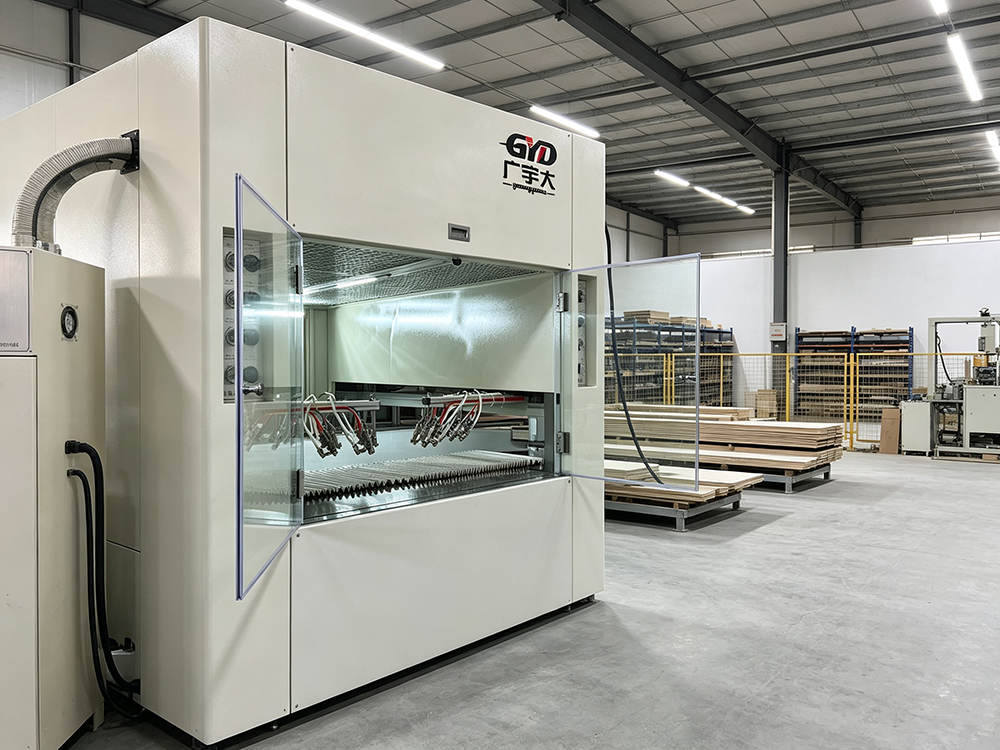
A semi-automatic spray line automates selected parts of the coating process while retaining manual involvement in other stages.
A typical semi-automatic line may include:
- Manual loading.
- Conveyorized product transfer.
- Automatic reciprocating spray guns.
- Manual spray touch-up.
- Semi-automatic color change.
- Flash-off zone.
- Tunnel dryer or batch oven.
- Manual inspection.
- Manual unloading and stacking.
The exact configuration varies. Some semi-automatic systems automate spraying but not loading. Others automate conveying and drying while operators control the spray gun.
Lower initial investment. It generally costs less than a fully automated system.
Good flexibility. Operators can accommodate different product sizes, profiles, colors, and short production runs.
Reduced manual spraying. The most repetitive or physically demanding part of the operation can be automated.
Simpler commissioning. The system has fewer control and integration requirements than a complete automated line.
Suitable for growing factories. It can increase output without requiring a full transformation of the production process.
Easier phased expansion. A factory can add automatic loading, inspection, or stacking later.
Useful for mixed product families. Manual intervention can support product changes that would require complex programming in a fully automated line.
Remaining labor costs. Operators may still be needed for loading, unloading, inspection, and touch-up.
More process variation. Manual handling and adjustments can affect film thickness and finish consistency.
Lower maximum throughput. Manual steps can restrict the capacity of the conveyor or spray equipment.
Material-handling bottlenecks. The spray machine may wait for operators to load or remove products.
Less traceability. Some process parameters may not be recorded automatically.
Potential duplicate investment. If production grows rapidly, the factory may later need to replace or substantially upgrade the semi-automatic line.
A fully automated spray system integrates the main coating stages into a coordinated production process.
It may include:
- Automatic loading.
- Product detection.
- Conveyorized handling.
- Dust removal.
- Automatic spray guns.
- Airless or air-assisted airless equipment.
- Reciprocators or robots.
- Automatic recipe management.
- Color-change equipment.
- Flash-off zones.
- Drying or curing tunnels.
- Automatic inspection.
- Automatic stacking.
- Production data collection.
Automation can control gun speed, distance, pressure, overlap, triggering, conveyor speed, and drying residence time.
Lower labor per product. Automation reduces repetitive loading, spraying, handling, and inspection work.
Consistent coating quality. The system repeats validated coating parameters across products and shifts.
Higher throughput. Continuous or indexed automation can maintain stable cycle times.
Lower material waste. Graco's automation ROI tool uses a typical material-efficiency improvement range of 15%–30% as an input for economic evaluation. Actual savings vary by application. [graco]
Reduced rework. Consistent film thickness and spray motion can lower defects caused by operator variation.
Better production traceability. Recipes and process data can be stored for repeatable production.
Improved worker ergonomics. Automation can reduce repetitive movement and direct exposure to spray operations.
Stronger long-term scalability. A well-designed system can support additional products, shifts, inspection, or handling modules.
Higher capital investment. Equipment, integration, ventilation, drying, controls, and commissioning increase the project cost.
More complex maintenance. The factory may need expertise in controls, robotics, pneumatics, pumps, software, and coating processes.
Longer implementation time. Product trials, programming, safety validation, and line balancing are required.
Less convenient for highly variable products. Automation performs best when dimensions, orientation, coatings, and production flow are predictable.
Higher changeover complexity. Color and product changes may require cleaning, flushing, recipe selection, and fixture adjustment.
A semi-automatic spray line usually has the lower upfront cost.
A fully automated system may include more expensive:
- Conveyors.
- Robots or reciprocators.
- Automatic loading.
- Inspection.
- Drying and curing.
- Recipe controls.
- Safety systems.
- Integration engineering.
The lower purchase price of a semi-automatic system does not necessarily mean lower total cost.
Semi-automatic lines reduce some manual work but still depend on operators.
Fully automated systems can reduce direct labor per product. Industry estimates vary widely by region and configuration. One 2026 industry guide reports potential labor reductions of 60%–75% for automatic systems compared with equivalent manual capacity, but this is a supplier estimate and should be validated locally. [ourscoatingline]
The correct calculation should include:
- Wages.
- Benefits.
- Overtime.
- Recruitment.
- Training.
- Absence coverage.
- Shift supervision.
- Rework labor.
Semi-automatic systems can improve coating consistency compared with fully manual production, but manual loading, spraying, and touch-up may still create variation.
Fully automated systems can improve material control through:
- Precise triggering.
- Stable gun distance.
- Repeatable overlap.
- Controlled flow rate.
- Product detection.
- Recipe management.
Graco identifies material-efficiency improvement of approximately 15%–30% as a typical automation ROI input, not a guaranteed result. [graco]
A semi-automatic line is often sufficient when production is medium volume or product mix is high.
A fully automated system becomes more cost-effective when:
- Demand is stable.
- Product geometry is standardized.
- Multiple shifts are required.
- Manual handling limits output.
- Rework is expensive.
- Orders are predictable.
Semi-automatic lines are generally simpler to maintain.
Fully automated systems may require more preventive maintenance, but they can also provide alarms, diagnostics, recipe controls, and production data that support faster troubleshooting.
Semi-automatic production can deliver strong quality with trained operators and clear work instructions.
Fully automated systems reduce variation in:
- Film thickness.
- Gloss.
- Color consistency.
- Spray overlap.
- Edge coverage.
- Drying time.
If a product has a high rejection cost, automation may justify its additional capital even before labor savings are fully considered.
Purchase price and throughput are incomplete measures.
Calculate cost per fully cured, accepted product by including:
- Equipment depreciation or financing.
- Labor.
- Coating consumption.
- Filter and consumable costs.
- Energy.
- Cleaning.
- Color-change losses.
- Rework.
- Scrap.
- Maintenance.
- Downtime.
- Inspection.
- Packaging and handling.
A semi-automatic line may win when utilization is low and flexibility is valuable.
A fully automated system may win when the line runs consistently and the factory can spread fixed costs over a large number of products.
There is no universal number of parts at which every factory should automate.
Automation becomes more attractive when:
- The same products repeat daily.
- Product orientation is consistent.
- Coating recipes change infrequently.
- Manual spraying is the bottleneck.
- Skilled labor is difficult to recruit.
- Quality variation causes rework.
- Demand is expected to remain stable.
- The factory operates multiple shifts.
Semi-automatic production may remain more cost-effective when:
- Products are highly customized.
- Colors change frequently.
- Production lots are small.
- Product sizes vary substantially.
- Demand is seasonal.
- The coating process is still being developed.
Use the following steps before selecting a semi-automatic line or fully automated system:
1. Record current production volume by product family.
2. Measure cycle time at every process stage.
3. Calculate labor hours per accepted product.
4. Measure coating consumption and overspray.
5. Record rework, rejection, and scrap.
6. Identify the main production bottleneck.
7. Define coating viscosity and film-thickness targets.
8. Measure color-change frequency.
9. Evaluate product standardization.
10. Forecast demand over three to five years.
11. Test both configurations using actual products.
12. Calculate cost per fully cured, accepted product.
13. Include maintenance, energy, and training costs.
14. Choose semi-automatic, modular, or fully automated equipment.
A reliable trial should record:
- Product dimensions.
- Substrate condition.
- Coating technical data.
- Viscosity and temperature.
- Spray tip or nozzle.
- Fluid pressure.
- Air-assist pressure where applicable.
- Gun distance.
- Conveyor speed.
- Film thickness.
- Gloss and appearance.
- Drying and curing time.
- Coating consumption.
- Rework rate.
- Cleaning time.
- Changeover time.
A supplier should use the actual product and coating rather than relying only on catalog capacity.
Semi-automatic systems are useful for mixed door sizes and developing finishes. Fully automated lines are better for standardized wooden doors produced in repeatable volumes.
Cabinet doors often provide a strong business case for automation because sizes, coatings, and production patterns can repeat. Custom furniture components may benefit from semi-automatic flexibility.
Flooring production can benefit from automatic conveying, controlled spray width, stable line speed, and integrated drying.
Glass coatings require clean handling and precise application. A semi-automatic line may suit mixed panel sizes, while a fully automated system is effective for repeatable formats.
Fibre cement may require high-build protective coating and consistent coverage. Automated spraying can improve throughput and film control in continuous production.
Both semi-automatic and fully automated spray systems require appropriate ventilation and safe operating procedures.
OSHA identifies spray operations as presenting physical and health hazards. Applicable requirements address:
- Mechanical ventilation.
- Flammable and combustible materials.
- Ignition sources.
- Electrical equipment.
- Booth construction.
- Exhaust systems.
- Fire protection.
- Personal protective equipment.
- Maintenance and cleaning. [osha]
Automated systems should include:
- Ventilation interlocks.
- Emergency stops.
- Guarding.
- Access-door interlocks.
- Pressure-relief procedures.
- Fire detection or suppression where required.
- Lockout/tagout provisions.
- Safe maintenance access.
Automation may reduce direct exposure and repetitive work, but it does not eliminate the need for training, PPE, ventilation, inspection, or chemical-safety controls.
Add these visual elements:
- Cost comparison infographic: Show investment, labor, material, rework, maintenance, and throughput.
- Automation-level diagram: Compare manual, semi-automatic, and fully automated workflow.
- ROI chart: Use verified factory data for payback and cost per accepted product.
- Factory video: Demonstrate a semi-automatic GYD spray line and a fully automated coating system.
- Process-flow image: Show loading, spraying, drying, inspection, and stacking.
- Decision tree: Help users select equipment based on volume, product standardization, and labor cost.
Photorealistic industrial coating factory, split-screen comparison of a semi-automatic spray line with operators loading wooden doors onto a conveyor and a fully automated spray system with robotic spray units, automatic loading, drying tunnel, inspection camera and stacking, furniture panels and fibre cement boards, clean modern machinery, realistic engineering details, professional B2B editorial style, no logos, no text.
Choose a semi-automatic spray line when:
- Production is medium volume.
- Product variety is relatively high.
- Initial capital is limited.
- Manual flexibility is important.
- The factory is growing.
- Coating recipes are still being optimized.
- Phased automation is preferred.
- The factory wants to automate its largest bottleneck first.
Choose a fully automated spray system when:
- Production volume is high and stable.
- Product geometry is standardized.
- Coating recipes repeat frequently.
- Labor cost or labor availability is a concern.
- Rework and material waste are significant.
- Multiple shifts are planned.
- Traceability and consistent quality are required.
- Drying, inspection, and stacking should be integrated.
For many growing manufacturers, a semi-automatic line is the best first investment. For stable, high-volume production, a fully automated spray system usually provides better long-term cost efficiency.
Contact GYDFinishing / GYD Machinery with your product drawings, coating data sheets, production volume, labor structure, finish standards, color mix, and current bottlenecks. GYD Machinery can recommend a semi-automatic line, modular upgrade, fully automated spray system, or complete turnkey coating solution for wood, glass, fibre cement, furniture, cabinet doors, and flooring.
For stable, high-volume production, often yes. For medium volume, custom products, or uncertain demand, a semi-automatic line may provide better investment efficiency.
A semi-automatic spray line generally has the lower initial cost because it requires fewer robots, automatic handling systems, controls, and integrated process modules.
Yes. It can automate conveying, spraying, or drying while retaining manual loading, unloading, inspection, or touch-up.
Graco's ROI tool uses a typical material-efficiency improvement range of 15%–30% for automation calculations. Actual savings depend on the coating, product, spray technology, and operating settings. [graco]
A fully automated system is often better for standardized cabinet doors produced in large, repeatable volumes. A semi-automatic line is more flexible for mixed sizes, custom profiles, and frequent changes.
Often, yes. Additional conveyors, product detection, automatic loading, inspection, or stacking can sometimes be added if the original layout allows for expansion.
No. Operators remain necessary for supervision, maintenance, quality control, cleaning, recipe management, and safe operation.
1. [Graco — Automation ROI Calculator] — Provides an ROI framework using labor, coating consumption, waste, consumables, and typical material-efficiency improvement inputs.
2. [Graco — Automated Paint Systems] — Discusses automation benefits including labor reduction, material waste, quality, scrap, and rework.
3. [Our Coating Line — Automatic vs Manual Spray Booths] — Provides indicative capital, labor, transfer-efficiency, and ROI ranges; figures should be validated for each factory.
4. [Purete — How to Choose Industrial Coating Equipment] — Discusses equipment selection according to coating, product geometry, capacity, finish, and automation level.
5. [T.D. Paint — Robotic Painting ROI] — Discusses labor, material savings, rework, throughput, and payback considerations for robotic painting.
6. [Creative Resins — Automated Painting Line ROI] — Discusses labor, material consumption, rework, throughput, maintenance, and typical ROI drivers.
7. [OSHA Technical Manual — Spray Finishing Operations] — Technical guidance on spray-finishing hazards, ventilation, and exposure control.
8. [OSHA — 29 CFR 1910.107 Spray Finishing] — Requirements for ventilation, spray booths, flammable materials, fire protection, and electrical safety.


