
Views: 236 Author: 广宇大 Publish Time: 2026-09-14 Origin: Site


Content Menu
● What Is an Automatic Spray Painting Line?
>> Advantages of an Automatic Spray Painting Line
>> Limitations of an Automatic Spray Painting Line
● What Is a Robotic Spray Cell?
>> Advantages of a Robotic Spray Cell
>> Limitations of a Robotic Spray Cell
● Automatic Line vs Robotic Cell Comparison
>> Changeovers
>> Throughput
>> Capital Cost
● New Expert Insight: Compare the Bottleneck, Not the Robot
● New Expert Insight: Choose by Product Family
>> Data Required for a Reliable Trial
● Applications for GYD Machinery Customers
>> Wooden Doors
>> Furniture and Cabinet Doors
>> Flooring
>> Glass
>> Fibre Cement
● Safety and Environmental Requirements
● Visual Content Recommendations
>> Request a Spray-Automation Assessment
>> 1. Is an automatic spray painting line better than a robotic spray cell?
>> 2. Which system has higher throughput?
>> 3. Which system is more flexible?
>> 4. Which system is better for wooden doors?
>> 5. Which system is better for cabinet doors?
>> 6. Is a robotic spray cell cheaper than a complete line?
>> 7. Can an automatic line and robotic cell be combined?
When manufacturers compare an automatic spray painting line vs a robotic spray cell, the correct choice depends on production volume, product geometry, coating variety, flexibility, floor space, labor, finish requirements, and integration goals.
An automatic spray painting line is usually a conveyorized system designed to move products continuously through spraying, drying, inspection, and unloading. A robotic spray cell is a self-contained enclosure in which one or more industrial robots apply coating to parts held on fixtures, skids, or a conveyor.
For wooden doors, furniture, cabinet doors, flooring, glass, and fibre cement, an automatic spray painting line is generally better for high-volume, standardized production. A robotic spray cell is usually better for complex shapes, mixed product families, frequent changeovers, and flexible automation.
GYDFinishing—also known as GYD Machinery—delivers automatic coating equipment and complete surface-finishing solutions for wood, glass, fibre cement, and a wide range of materials. Founded in 2007, GYD Machinery combines international practical experience with more than two decades of technological heritage. Its solutions range from individual machines to turnkey coating lines.
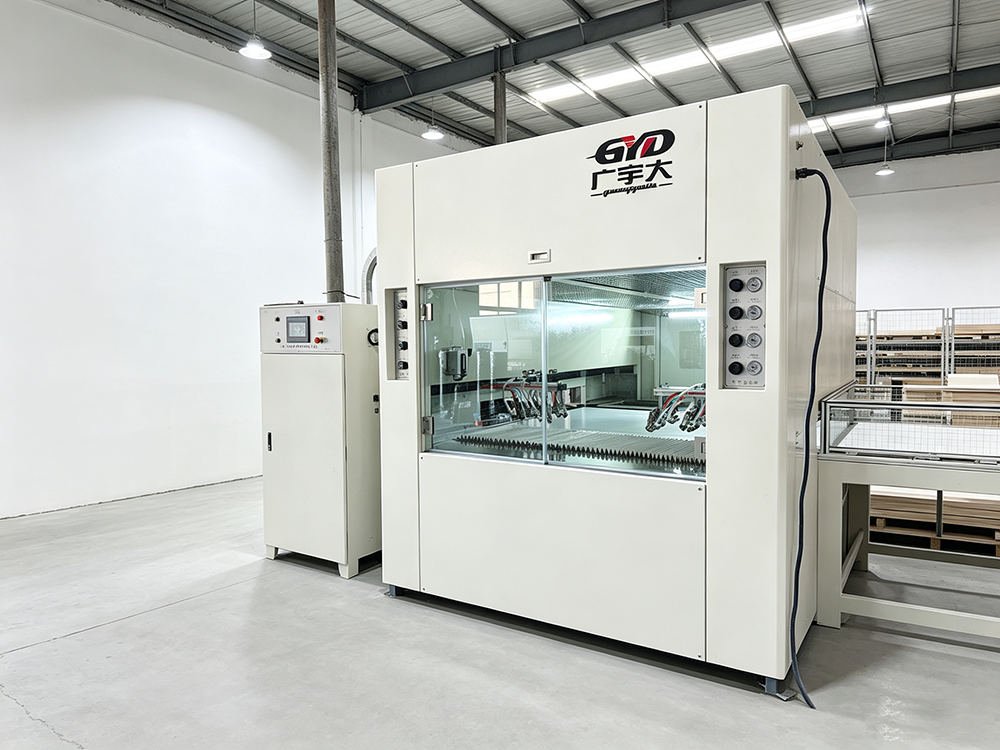
An automatic spray painting line integrates material handling and coating processes into a continuous or indexed production flow.
A typical line may include:
- Automatic loading.
- Conveyor or overhead hook system.
- Product detection.
- Dust removal.
- Automatic spray guns.
- Fixed guns, reciprocators, or robots.
- Airless or air-assisted airless pumps.
- Flash-off zones.
- Drying or curing tunnels.
- Inspection systems.
- Automatic unloading and stacking.
- PLC and recipe management.
The products move through predetermined stations. Conveyor speed, product spacing, spray timing, and drying residence time are coordinated.
High throughput. Conveyorized systems are designed for continuous production and stable cycle times.
Strong material-handling efficiency. Products move between stages without repeated manual transfer.
Consistent coating application. Programmed spray paths, fluid flow, gun triggering, and conveyor speed can be repeated.
Integrated drying and curing. The line can control flash-off, drying, and curing as part of one process.
Lower labor per product. Operators can focus on loading, inspection, supervision, cleaning, and maintenance.
Better for standardized products. Cabinet doors, flooring boards, and repeatable wooden-door sizes can benefit from fixed process parameters.
Scalable architecture. The line can be designed with additional guns, inspection, drying, or handling modules.
Higher investment. Conveyors, booths, ventilation, drying, controls, and commissioning increase project cost.
Less flexible for mixed products. Product size, orientation, and coating recipes need to fit the line's operating envelope.
Longer commissioning. The supplier must validate spraying, handling, drying, curing, inspection, and safety interlocks.
Line-wide downtime risk. A fault in a critical process can affect the complete production flow.
Large footprint. Continuous coating and drying may require substantial floor space.
A robotic spray cell is an enclosed automated workstation that uses one or more industrial robots to apply coatings.
A robotic spray cell generally includes:
- Six-axis or specialized painting robot.
- Spray gun, airless gun, or rotary bell.
- Fluid delivery system.
- Color-change valve block.
- Booth and exhaust system.
- Part fixture, skid, or positioner.
- Robot controller.
- Safety fence or guarded access.
- Recipe and path-management software.
- Optional conveyor or automatic loading.
The robot follows a programmed trajectory around the product. This allows it to reach multiple surfaces, edges, profiles, and recessed areas.
ISO 10218-2 specifies safety requirements for integrating industrial robots and robot cells, including measures to reduce hazards associated with complete integrated systems. [iso]
Excellent path flexibility. A robot can move around complex three-dimensional surfaces.
High repeatability. Programmed trajectories help maintain consistent gun distance, angle, speed, and overlap.
Good for mixed product families. Different paths can be selected through recipes.
Efficient for complex geometry. Robots can reach profiles and areas that fixed guns may not cover effectively.
Smaller footprint than a complete line. A cell can automate one process without requiring a long conveyor and drying tunnel.
Phased automation potential. A factory can automate spraying first and connect handling or curing later.
Reduced direct operator exposure. Operators can manage the process outside the spray zone, subject to suitable guarding, ventilation, PPE, and maintenance procedures.
Lower throughput in some applications. A single robot may not match the output of multiple fixed guns on a high-speed conveyor line.
Higher programming requirements. New products require path development, testing, and optimization.
Fixture dependence. Part positioning must be accurate and repeatable.
Maintenance complexity. The factory needs robot, controls, fluid, pneumatic, and coating expertise.
Higher cost than a basic automatic station. The robot, cell safety, software, and integration add investment.
Potential bottleneck. If loading, unloading, curing, or inspection is manual, the robot may wait.
An automatic spray painting line is usually best for:
- High-volume production.
- Standardized products.
- Multiple shifts.
- Stable demand.
- Continuous coating and curing.
- Products with predictable spacing and orientation.
A robotic spray cell is usually best for:
- Low- to medium-volume automation.
- Mixed product families.
- Complex shapes.
- Frequent product changes.
- Custom or semi-custom products.
- Applications where flexibility is more important than maximum speed.
Automatic lines with fixed guns or reciprocators perform well on:
- Flat panels.
- Doors.
- Flooring boards.
- Cabinet fronts.
- Large standardized surfaces.
Robotic spray cells are stronger for:
- Three-dimensional profiles.
- Mouldings.
- Recessed surfaces.
- Irregular furniture components.
- Complex glass or composite parts.
- Products requiring multiple spray angles.
Both systems can provide repeatability.
A conveyor line relies on fixed relationships between product, gun, and conveyor. This is highly efficient when products are standardized.
A robot controls a programmed path around the part. This provides greater geometric flexibility, but path quality depends on programming, fixture accuracy, and calibration.
Robotic cells generally offer faster product-path changes when the product family is compatible with the cell and recipes are well developed.
Conveyor lines can also use recipes, but changes in product size, fixture, drying time, or coating sequence may affect the entire line.
A conveyor line generally delivers higher throughput when:
- Product dimensions are stable.
- Multiple guns can work simultaneously.
- Conveyor speed is optimized.
- Drying and curing are integrated.
A robotic cell may deliver more controlled application per part but lower total output if one robot must complete all surfaces sequentially.
A robotic spray cell may require less building length than a complete automatic line, but it still requires a robot, safety system, booth, application equipment, controls, and integration.
A full line has greater total capital requirements but can provide higher throughput and more complete process integration.
Many manufacturers assume the robot is the main productivity factor. In practice, the real bottleneck may be:
- Part loading.
- Fixture changeover.
- Paint preparation.
- Color flushing.
- Flash-off.
- Drying.
- Curing.
- Inspection.
- Unloading.
- Packaging.
A fast robotic spray cell cannot increase factory output if the curing oven is undersized. A high-speed conveyor line cannot perform well if products arrive inconsistently.
The correct design begins with a line-balance study:
- How long does each process take?
- Where does product wait?
- Which stage has the lowest capacity?
- Can parts be oriented consistently?
- How often do colors change?
- What happens during maintenance?
- Is buffer capacity required?
A factory may need both technologies.
For example:
- Automatic line for standard cabinet doors.
- Robotic cell for custom furniture parts.
- Fixed spray guns for large flat flooring boards.
- Robotic cell for profiled wooden doors.
- Airless application for fibre cement primer.
- Air-assisted airless topcoat for visible furniture surfaces.
This hybrid strategy avoids forcing every product through one production method.
For GYD Machinery customers, this is particularly relevant because wood, glass, fibre cement, furniture, doors, and flooring often have very different geometries, coatings, and handling requirements.
Use these steps before choosing an automatic line or robotic spray cell:
1. Group products by geometry and coating recipe.
2. Measure production volume for each product family.
3. Record product dimensions and weight.
4. Define required finish quality and film thickness.
5. Identify coating viscosity and application method.
6. Calculate color-change frequency.
7. Measure loading, spraying, drying, inspection, and unloading time.
8. Identify the current bottleneck.
9. Run a coating trial on representative products.
10. Compare coating consumption and rework.
11. Test path repeatability and edge coverage.
12. Evaluate fixture design and product detection.
13. Calculate cost per accepted product.
14. Select line, cell, or hybrid automation.
A credible equipment supplier should evaluate:
- Product drawings.
- Coating technical data sheets.
- Viscosity at production temperature.
- Tip or nozzle size.
- Fluid pressure.
- Air-assist settings where applicable.
- Gun distance and angle.
- Robot path or fixed-gun position.
- Conveyor or fixture cycle time.
- Drying and curing conditions.
- Final gloss and color.
- Film-thickness distribution.
- Rework and rejection.
A factory trial using actual products is more reliable than generic robot-speed claims.
Automatic conveyor lines are effective for standardized door sizes and repeated coating recipes. Robotic cells are valuable for profiled doors, recessed panels, edges, and custom designs.
Cabinet doors often suit automatic lines when dimensions and styles repeat. A robotic cell may be better for irregular furniture components and multiple product variants.
Flooring production generally benefits from continuous conveyor movement, fixed spray stations, controlled application width, and integrated drying.
Glass products require careful handling, contamination control, and consistent spray distance. A robotic cell can help with complex shapes; a conveyor line can be highly efficient for standardized panels.
Fibre cement may require high-build protection and reliable coverage. Automatic lines support continuous high-volume production, while robotic cells can handle specialized shapes or product variations.
Both automatic spray painting lines and robotic spray cells require appropriate ventilation, fire protection, guarding, and safe operating procedures.
OSHA identifies spray operations as presenting physical and health hazards. Relevant requirements address:
- Mechanical ventilation.
- Flammable and combustible materials.
- Ignition sources.
- Electrical equipment.
- Booth construction.
- Exhaust systems.
- Fire protection.
- PPE.
- Maintenance and cleaning. [osha]
Robot integration must address:
- Guarding.
- Access-door interlocks.
- Emergency stops.
- Safe robot stopping.
- Maintenance access.
- Lockout/tagout.
- Pressure relief.
- Ventilation interlocks.
- Explosion-protection requirements where applicable.
ISO 10218-1 covers safety requirements for the robot itself, while ISO 10218-2 covers integration of the robot into a complete robot system. [iso]
Automation reduces direct operator exposure but does not eliminate the need for risk assessment, training, ventilation, PPE, and inspection.
Add these visual elements:
- Side-by-side infographic: Show conveyor line architecture versus robotic cell architecture.
- Robot-path illustration: Display how a robot reaches edges and recessed profiles.
- Throughput chart: Compare fixed-gun conveyor output with robotic-cell cycle time.
- Factory video: Demonstrate automatic spray painting of wooden doors or cabinet doors.
- Layout diagram: Show product flow, buffers, drying, inspection, and stacking.
- Hybrid-system graphic: Show how a conveyor line and robotic cell can operate together.
Photorealistic industrial coating factory, split-screen comparison of a conveyor-based automatic spray painting line with fixed spray stations and drying tunnel versus a six-axis robotic spray cell coating a complex wooden door and furniture component, visible robot trajectory, conveyor fixtures, safety fencing, ventilation, inspection station, modern clean machinery, realistic engineering details, professional B2B editorial style, no logos, no text.
Choose an automatic spray painting line when:
- Production volume is high and stable.
- Product geometry is standardized.
- Product spacing and orientation are predictable.
- Maximum throughput is required.
- Integrated drying, curing, inspection, and stacking are needed.
- Multiple shifts are planned.
- The same coating recipes repeat frequently.
- A complete turnkey process is preferred.
Choose a robotic spray cell when:
- Product geometry is complex.
- Multiple spray angles are required.
- Product variety is high.
- Changeovers are frequent.
- Production volume is low to medium.
- Flexible automation is more important than maximum line speed.
- The factory needs phased automation.
- The product has profiles, recesses, mouldings, or irregular surfaces.
Choose a hybrid system when standardized products justify a conveyor line but complex products require robotic flexibility.
For high-volume standardized products, an automatic spray painting line is usually better. For complex, mixed, or frequently changing products, a robotic spray cell is often the better investment.
Contact GYDFinishing / GYD Machinery with your product drawings, coating data sheets, production volume, product mix, finish standards, and current bottlenecks. GYD Machinery can recommend a conveyor line, robotic spray cell, modular automation, or a complete turnkey coating solution for wood, glass, fibre cement, furniture, cabinet doors, and flooring.
For high-volume standardized products, usually yes. A robotic spray cell is often better for complex shapes, frequent product changes, and flexible low- to medium-volume production.
A conveyorized automatic line generally has higher throughput when products are standardized and multiple spray stations can operate simultaneously.
A robotic spray cell is usually more flexible because its path can be reprogrammed for different product geometries and spray angles.
Standard wooden doors are often suitable for an automatic line. Profiled, recessed, or custom doors may benefit from a robotic spray cell.
Automatic lines are effective for repeated cabinet-door sizes and recipes. Robotic cells are useful for mixed designs, profiles, and complex components.
It may require less building space and may be easier to install in phases, but the robot, booth, safety system, application equipment, and integration still represent a significant investment.
Yes. A factory can use fixed guns or reciprocators for standard surfaces and a robot for complex parts or special coating stages.
1. [ISO — ISO 10218-1:2025 Robotics Safety Requirements] — Safety requirements for industrial robots, protective measures, and safe design.
2. [ISO — ISO 10218-2:2011 Robot System Integration] — Safety requirements for integrating industrial robots and complete robot cells.
3. [Graco — Automated Paint Systems] — Benefits of paint-line automation, including labor reduction, consistency, and material-waste reduction.
4. [Graco — Applicator Technology] — Comparison of air spray, airless, air-assisted airless, and other industrial application technologies.
5. [T.D. Paint — Robot vs Manual Spray Painting] — Discusses robot painting efficiency, cost, consistency, throughput, and ROI considerations.
6. [Purete — Choosing Spray Coating Equipment] — Compares reciprocating, multi-axis, and robotic spray systems by geometry, output, finish quality, and budget.
7. [RoboticPaint — Fixed Gun Chain Spindle vs Robotic Spraying] — Compares fixed-gun conveyor systems and robotic spraying for product size, capacity, and flexibility.
8. [OSHA — Spray Operations Overview] — Overview of health and physical hazards associated with spray operations.
9. [GYDFinishing — Manual Spray Booth vs Automated Spray Booth] — Practical comparison of manual and automated spray systems for industrial production.


