
Views: 258 Author: 广宇大 Publish Time: 2026-09-14 Origin: Site


Content Menu
● What Is an Integrated Spray Finishing Line?
>> Advantages of an Integrated Spray Finishing Line
>> Limitations of an Integrated Spray Finishing Line
● What Are Standalone Finishing Machines?
>> Advantages of Standalone Machines
>> Limitations of Standalone Machines
● Integrated Line vs Standalone Machines Comparison
>> Throughput
>> Labor
>> Flexibility
● New Expert Insight: Efficiency Is a System Metric
● New Expert Insight: Design Around the Bottleneck
>> Data Required for a Factory Trial
● Applications for GYD Machinery Customers
>> Wooden Doors
>> Furniture and Cabinet Doors
>> Flooring
>> Glass
>> Fibre Cement
● Safety and Environmental Requirements
● Visual Content Recommendations
>> Request a Finishing-System Assessment
>> 1. Is an integrated spray finishing line more efficient than standalone machines?
>> 2. Are standalone machines cheaper?
>> 3. Does an integrated line always reduce coating consumption?
>> 4. Which option is better for wooden doors?
>> 5. Which option is better for cabinet doors and furniture?
>> 6. Can standalone machines be integrated later?
>> 7. Does an integrated line eliminate operators?
When manufacturers compare an integrated spray finishing line vs standalone machines, the more efficient option depends on production volume, product standardization, coating stages, labor, floor space, and the cost of quality variation.
An integrated spray finishing line connects material handling, coating, drying, inspection, and sometimes sanding or stacking into one coordinated workflow. Standalone machines perform individual tasks independently and require operators or separate systems to transfer products between processes.
For wooden doors, furniture, cabinet doors, flooring, glass, and fibre cement, an integrated spray finishing line generally offers better throughput, repeatability, and process efficiency when production is stable. Standalone machines are often more efficient for flexible, low- to medium-volume work, custom products, and factories that prefer phased investment.
GYDFinishing—also known as GYD Machinery—delivers automatic coating equipment and complete surface-finishing solutions for wood, glass, fibre cement, and a wide range of materials. Founded in 2007, GYD Machinery combines international practical experience with more than two decades of technological heritage. Its solutions range from individual machines to turnkey coating lines.
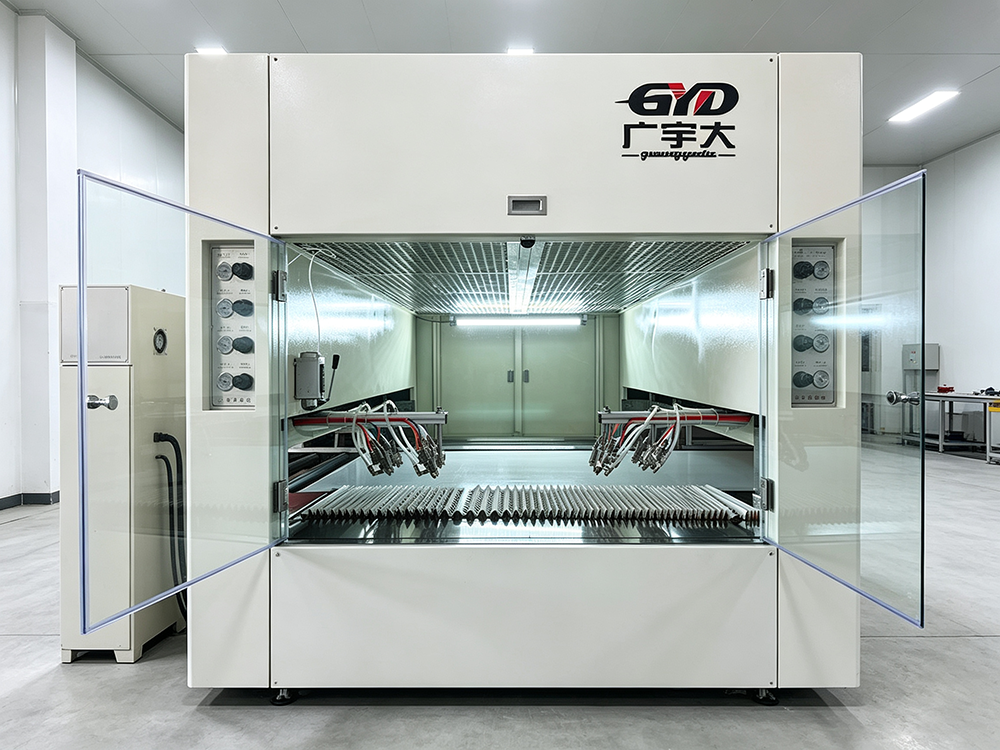
An integrated spray finishing line is a connected production system in which several finishing stages are engineered to operate together.
A complete line may include:
- Automatic loading.
- Conveyorized material handling.
- Dust removal.
- Automatic spray guns.
- Airless or air-assisted airless equipment.
- Reciprocators or robots.
- Flash-off zones.
- Drying and curing tunnels.
- Sanding or denibbing.
- Inspection systems.
- Automatic stacking.
- PLC and recipe management.
The line is designed around a defined product flow and cycle time. Products move from one stage to the next with limited manual intervention.
Higher throughput. Coordinated handling, spraying, and drying reduce waiting between stages.
Consistent coating quality. The system can repeat gun speed, distance, pressure, overlap, film build, and drying conditions.
Lower manual handling. Operators do not need to transfer every product between independent machines.
Reduced work-in-process inventory. Products spend less time waiting between coating stages.
Better material control. Automatic triggering and controlled movement can reduce over-application and overspray.
Integrated drying and curing. Drying capacity is designed as part of the total process rather than added afterward.
Improved traceability. Recipes can store product, coating, spray, and drying parameters.
Better scalability. Additional spray guns, inspection, drying, or stacking modules can be incorporated into a planned line.
Lower cost per accepted product at suitable utilization. The capital cost is spread across higher output when the line runs consistently.
Higher initial investment. The project may require equipment, installation, ventilation, utilities, and building modifications.
Longer engineering and commissioning. Product drawings, coating data, line balance, safety controls, and drying conditions must be validated.
Less flexible for unpredictable products. Automation performs best when product dimensions, orientation, and recipes are repeatable.
Line-wide downtime risk. A failure in one critical stage can affect the complete process.
Requires technical support. Maintenance may involve mechanical, electrical, pneumatic, controls, and coating expertise.
Standalone finishing machines are independent units that perform one primary operation.
Examples include:
- Standalone spray booth.
- Automatic reciprocator.
- Airless spray machine.
- Air-assisted airless machine.
- Flat-panel coater.
- Sanding machine.
- Drying oven.
- Curing tunnel.
- Inspection station.
- Stacking machine.
Operators or material-handling equipment move products between each unit.
Lower initial investment. A factory can purchase only the equipment needed to solve its current bottleneck.
High flexibility. Standalone machines are suitable for different product sizes, coatings, and production sequences.
Fast installation. A single unit is usually easier to install than a complete line.
Good for phased automation. Manufacturers can begin with spraying and add drying, conveying, or inspection later.
Suitable for custom products. Operators can adapt quickly to unusual shapes and short production runs.
Simpler troubleshooting. A problem is often isolated to one machine rather than affecting an entire integrated process.
Practical for uncertain demand. Standalone equipment reduces the risk of overinvesting before production volume is proven.
More manual transfer. Products must be loaded, unloaded, moved, and repositioned.
More labor per product. Manual handling can become expensive at higher volumes.
Greater process variation. Different operators may use different speeds, distances, and settings.
More staging space. Products may wait between machines, increasing work-in-process inventory.
Less synchronized drying. Drying capacity may not match spray output.
Higher integration effort later. Connecting separate equipment may require additional conveyors, controls, and engineering.
Potential bottlenecks. The slowest independent machine can restrict the entire production process.
Integrated lines are generally better for:
- High-volume production.
- Standardized products.
- Multiple shifts.
- Stable demand.
- Continuous spraying and drying.
Standalone machines are generally better for:
- Low- to medium-volume production.
- Custom work.
- Mixed product sizes.
- Short production runs.
- Uncertain demand.
An integrated line controls the relationship between:
- Product position.
- Gun movement.
- Fluid flow.
- Spray timing.
- Conveyor speed.
- Drying residence time.
Standalone machines can also produce high-quality coating, but consistency depends more on operator technique and coordination between process stages.
Standalone equipment usually requires more labor for:
- Loading.
- Spraying.
- Moving.
- Unloading.
- Inspection.
- Stacking.
An integrated line reduces repetitive handling but still requires skilled employees for:
- Line supervision.
- Quality control.
- Cleaning.
- Preventive maintenance.
- Recipe management.
- Safe operation.
An integrated system can reduce coating variation through controlled spray paths, automatic triggering, and stable film thickness.
Standalone machines may consume more material when operators over-apply coating or when transfer between stages causes damage and rework.
Actual savings depend on:
- Spray technology.
- Coating viscosity.
- Product geometry.
- Tip or nozzle selection.
- Booth airflow.
- Film-thickness target.
- Operator or automation settings.
Standalone machines usually offer greater flexibility for changing products.
Integrated lines can support flexibility through:
- Recipe management.
- Adjustable conveyor speed.
- Product detection.
- Programmable spray paths.
- Modular fixtures.
- Automatic color-change systems.
However, flexible automation must be engineered and tested. It should not be assumed from the presence of a PLC alone.
Standalone machines are easier to isolate during maintenance.
Integrated lines may have more complex maintenance, but planned preventive maintenance and spare-parts management can protect uptime.
The right question is not only, "Which machine is easier to repair?" It is also, "Which system produces more acceptable products over a full production week?"
A common mistake is to compare one spray machine with one integrated line. This ignores the surrounding workflow.
Efficiency should include:
- Spray cycle time.
- Loading time.
- Transfer time.
- Drying time.
- Inspection time.
- Cleaning time.
- Color-change time.
- Rework time.
- Waiting time.
- Downtime.
- Accepted production output.
A standalone spray machine may spray quickly but lose time during manual transfer and drying. An integrated line may have a slower spray stage but achieve higher total output because products flow continuously.
The correct benchmark is overall line efficiency, not the rated speed of one machine.
Before investing in an integrated line, identify the actual constraint.
The bottleneck may be:
- Surface preparation.
- Dust removal.
- Spray application.
- Flash-off.
- Drying.
- Curing.
- Inspection.
- Stacking.
- Color change.
- Manual product handling.
If spraying is not the bottleneck, automating the spray machine alone may not increase output.
For example, a factory may install a higher-capacity spray unit but discover that its drying tunnel cannot accept the additional output. A balanced solution may require coordinated improvements in spraying, drying, and material handling.
Use these steps before choosing an integrated line or standalone equipment:
1. Measure current output by product family.
2. Record cycle time at every production stage.
3. Identify the slowest process.
4. Separate standard products from custom products.
5. Measure labor hours per accepted product.
6. Record coating consumption and rework.
7. Document coating viscosity and film thickness.
8. Measure color-change frequency.
9. Evaluate drying and curing requirements.
10. Forecast demand for the next three to five years.
11. Run a controlled coating trial.
12. Compare cost per fully cured, accepted product.
13. Evaluate maintenance and service availability.
14. Choose standalone, modular, integrated, or hybrid equipment.
A credible supplier should evaluate:
- Product drawings.
- Substrate and surface preparation.
- Coating technical data sheet.
- Viscosity and application temperature.
- Spray pressure.
- Tip or nozzle size.
- Gun distance and speed.
- Conveyor or handling cycle.
- Film-thickness distribution.
- Drying and curing conditions.
- Rework and rejection.
- Cleaning and changeover time.
- Final appearance after curing.
Manufacturers should not rely on generic claims such as "up to 30% savings" without testing the actual product and coating. Such figures may be possible in suitable conditions, but they are not universal guarantees.
Integrated lines can combine feeding, dust removal, spray coating, drying, inspection, and stacking for standardized door production.
Standalone machines may be better for custom doors, irregular dimensions, or developing new finishes.
Cabinet doors often have repeatable dimensions and coating recipes, making them suitable for integrated lines.
Custom furniture components may benefit from standalone or robotic equipment because product geometry changes more frequently.
Flooring production can benefit from conveyorized coating, stable application width, controlled line speed, and integrated drying.
Glass coating requires careful handling and contamination control. Integrated handling can reduce contact with wet surfaces, while standalone equipment may be more suitable for mixed formats.
Fibre cement often requires reliable coverage and high-build protection. An integrated line can support continuous production, while standalone airless equipment may be adequate for smaller volumes.
Both integrated spray finishing lines and standalone machines require proper ventilation and safe operating procedures.
OSHA identifies spray operations as presenting physical and health hazards. Relevant requirements address:
- Mechanical ventilation.
- Flammable and combustible materials.
- Ignition sources.
- Electrical equipment.
- Booth construction.
- Exhaust systems.
- Fire protection.
- PPE.
- Maintenance and cleaning. [osha]
Spray rooms and booths should be designed to control mists, vapors, and combustible residues. OSHA guidance also emphasizes ventilation performance and airflow measurement during spray-finishing operations. [dli.mn]
Automatic systems should include:
- Ventilation interlocks.
- Emergency stops.
- Guarding.
- Access-door interlocks.
- Pressure-relief procedures.
- Fire detection or suppression where required.
- Lockout/tagout provisions.
- Safe maintenance access.
Automation can reduce direct operator exposure, but it does not remove the need for training, PPE, ventilation, inspection, and chemical-safety controls.
Add these visual elements:
- System architecture infographic: Show an integrated line versus separate standalone machines.
- Workflow diagram: Display feeding, spraying, drying, inspection, and stacking.
- Efficiency chart: Compare labor, material use, waiting time, rework, and downtime.
- Factory video: Demonstrate a GYD integrated coating line for wooden doors or cabinet doors.
- Bottleneck graphic: Show how drying or inspection can limit overall output.
- Modular-upgrade illustration: Show how standalone machines can evolve into an integrated line.
Photorealistic industrial surface-finishing factory, split-screen comparison between an integrated spray finishing line with conveyor, automatic spray guns, drying tunnel, inspection and stacking versus separate standalone spray, sanding, drying and inspection machines with manual material handling, wooden doors, cabinet panels and fibre cement boards, clean modern machinery, realistic engineering details, professional B2B editorial style, no logos, no text.
Choose an integrated spray finishing line when:
- Production volume is high and stable.
- Product geometry is standardized.
- Coating recipes repeat frequently.
- Manual handling is a major bottleneck.
- Consistent quality is essential.
- Drying, inspection, and stacking should be synchronized.
- Rework and material waste are significant.
- Production traceability is required.
- Future capacity growth is expected.
Choose standalone machines when:
- Production volume is low or uncertain.
- Products are customized.
- Product sizes change frequently.
- Initial investment must be limited.
- The factory is testing a new coating process.
- Fast installation is important.
- A phased automation strategy is preferred.
- Flexibility matters more than continuous flow.
Choose a modular or hybrid system when the factory needs immediate improvement but is not ready for full integration.
For stable, high-volume production, an integrated spray finishing line usually offers better overall efficiency. For flexible or developing production, standalone machines may provide better investment efficiency and lower risk.
Contact GYDFinishing / GYD Machinery with your product drawings, coating data sheets, annual production, target finish, color mix, available floor space, and current bottlenecks. GYD Machinery can recommend standalone machines, modular automation, an integrated spray finishing line, or a complete turnkey solution for wood, glass, fibre cement, furniture, cabinet doors, and flooring.
For stable, high-volume production, generally yes. Integration reduces manual transfer, waiting, process variation, and disconnected drying or inspection steps.
Usually, standalone machines require less initial investment. They may also be more economical for low-volume, custom, or uncertain production.
No. It can improve material control, but actual savings depend on coating chemistry, spray equipment, product geometry, film thickness, and validated operating parameters.
Standardized wooden doors are often suitable for an integrated line. Custom doors and short production runs may be better served by standalone machines or modular equipment.
Integrated lines are effective for repeated cabinet-door sizes and large furniture volumes. Standalone machines offer greater flexibility for custom furniture parts.
Often, yes. Conveyors, product detection, drying equipment, inspection, and automatic stacking can sometimes be added later. The upgrade path should be considered during the original design.
No. It reduces repetitive manual work but still requires trained personnel for supervision, quality control, maintenance, cleaning, recipe management, and safety.
1. [OSHA Technical Manual — Spray Finishing Operations] — Technical guidance on spray-finishing hazards, ventilation, exposure control, and applicable standards.
2. [Minnesota Department of Labor and Industry — Directive: Spray Finishing Operations] — Discusses airflow measurement, ventilation evaluation, vapor dilution, and spray-booth safety.
3. [Purete — How to Choose Industrial Coating Equipment] — Compares integrated and standalone equipment according to process integration, flexibility, capacity, and investment.
4. [Trivec — Automatic Spraying Machine for Wood] — Example of automated wood-product spraying with conveyor handling, consistent coverage, and overspray management.
5. [Graco — Automated Paint Systems] — Discusses paint-line automation, quality, labor, material waste, scrap, and rework.
6. [Graco — Applicator Technology] — Technical overview of industrial liquid-coating application methods.
7. [OSHA — 29 CFR 1910.107 Spray Finishing] — Requirements for ventilation, spray booths, flammable materials, and electrical safety.
8. [ANSI Blog — NFPA 33 Spray Application Requirements] — Overview of NFPA 33 requirements for spray application using flammable or combustible materials.


