
Views: 283 Author: 广宇大 Publish Time: 2026-09-10 Origin: Site


Content Menu
● What Is an Automatic Spray Machine?
>> Advantages of Automatic Spray Machines
>> Limitations of Automatic Spray Machines
>> Limitations of Spray Robots
● Key Differences in Industrial Coating
>> Flexibility
>> Programming
>> Investment
>> Maintenance
>> Throughput
● Which Technology Fits Your Products?
>> Flat Products Favor Automatic Spray Machines
>> Complex Products Favor Spray Robots
>> Profiled Products May Need a Hybrid Solution
● New Expert Insight: Measure Touch-Up Before Choosing
● Material Efficiency and Transfer Efficiency
● Safety and Environmental Requirements
● Practical Selection Checklist
● Visual Content Recommendations
>> Request a Production-Line Assessment
>> 1. Is an automatic spray machine better than a spray robot?
>> 2. Which system offers greater flexibility?
>> 3. Which system is better for cabinet doors?
>> 4. Is robotic paint spraying more expensive?
>> 5. Can an automatic spray machine handle profiled products?
>> 6. Does a robot always use less coating?
>> 7. Can a production line use both technologies?
When manufacturers compare an automatic spray machine vs a spray robot, the difference is not simply "automation versus more automation." The real distinction lies in movement capability, product geometry, flexibility, programming complexity, and total cost per accepted part.
An automatic spray machine typically uses fixed or reciprocating spray guns that move along one or two axes. It is highly effective for flat panels, cabinet doors, furniture components, flooring boards, glass sheets, and fibre cement products with repeatable geometry.
A spray robot uses a multi-axis articulated arm that can change spray angle, approach direction, and gun orientation. This makes it more suitable for complex, curved, recessed, irregular, or frequently changing workpieces.
For industrial coating applications, the correct choice depends on your product geometry, production volume, product mix, coating requirements, labor strategy, and future expansion plans.
GYDFinishing—also known as GYD Machinery—has supplied machinery and surface-finishing solutions since 2007. Drawing on worldwide practical experience and more than two decades of technological heritage, GYD Machinery develops automatic coating equipment ranging from individual machines to complete turnkey production lines.
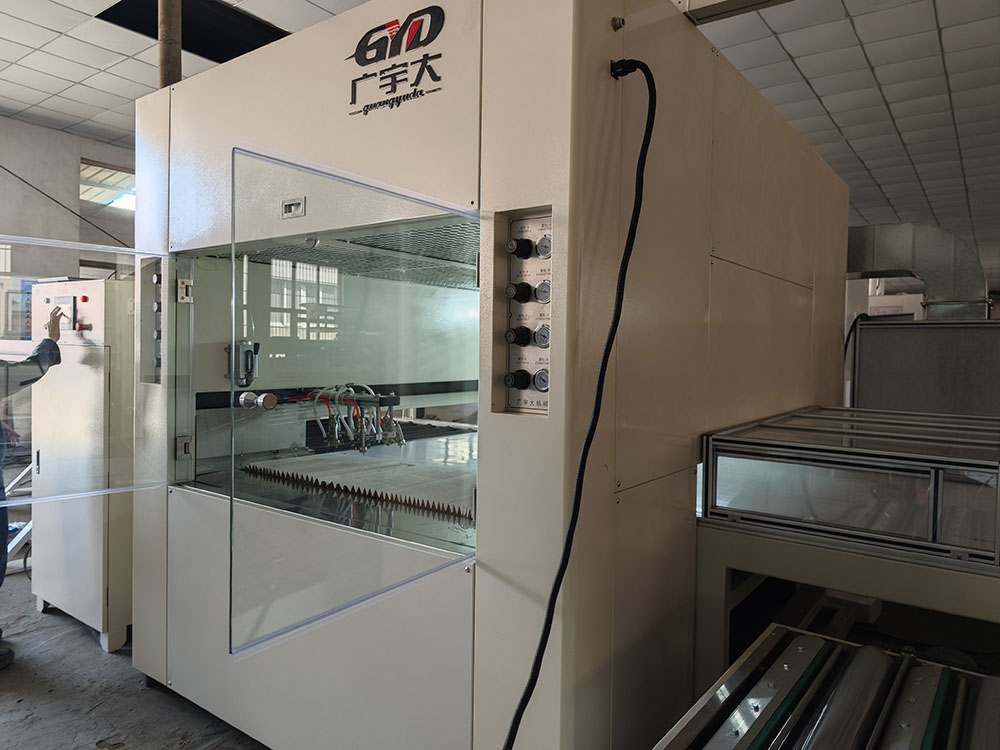
An automatic spray machine is a programmable system that applies coatings through automatic spray guns, reciprocators, conveyors, pumps, sensors, and control systems.
The system may control:
- Gun travel speed.
- Gun-to-part distance.
- Spray-gun activation.
- Coating flow.
- Atomizing pressure.
- Conveyor speed.
- Spray overlap.
- Number of passes.
- Product recipes.
- Gun height and stroke length.
The spray guns typically move vertically or horizontally in a repeatable pattern.
Automatic spray machines are commonly used for:
- Flat cabinet doors.
- Furniture panels.
- Flat wooden doors.
- Flooring boards.
- Glass sheets.
- Fibre cement panels.
- Standardized profiles.
Lower capital cost. Automatic spray machines generally require less investment than a multi-axis robotic cell.
High production speed. Linear movement is efficient for repetitive flat-panel production.
Consistent coating. The machine repeats the same spray pattern on every compatible workpiece.
Simple programming. Operators can manage recipes and operating parameters without advanced robot programming.
Predictable maintenance. Rails, drives, spray guns, pumps, and sensors are usually easier to maintain than multiple robot axes.
Easy line integration. The system can connect with conveyors, sanding, dust removal, drying, inspection, and stacking.
Automatic spray machines may struggle when products have:
- Deep recesses.
- Curved surfaces.
- Multiple surface angles.
- Complex decorative profiles.
- Irregular edges.
- Large variations in product dimensions.
- Three-dimensional workpieces requiring changing spray angles.
A reciprocating system repeats a defined movement. If the workpiece geometry exceeds the design range, edge coverage and recess coverage may become inconsistent.
A spray robot is an industrial robot arm equipped with a spray gun, fluid system, and coating-specific controls.
A robotic spray system may include:
- Six-axis articulated robot.
- Automatic spray gun.
- Fluid pump.
- Color-change valves.
- Positioner or rotary table.
- Product-recognition sensors.
- Safety fencing and interlocks.
- Recipe management.
- Vision or scanning systems.
- Automatic cleaning equipment.
The robot can adjust:
- Spray angle.
- Gun distance.
- Movement direction.
- Path speed.
- Material flow.
- Trigger timing.
- Number of passes.
- Approach direction.
Robotic spray systems are designed to reach complex geometries and hard-to-access areas that are difficult for fixed-path machines.
Spray robots are commonly used for:
- Carved wooden doors.
- Curved furniture.
- Profiled cabinet doors.
- Irregular architectural components.
- Parts with multiple surface angles.
- Mixed product families.
- Products requiring different spray angles.
High flexibility. Robots can handle different sizes, profiles, and surface geometries through programming.
Multi-axis access. The gun can approach edges, corners, curves, and recesses from different directions.
Better complex-surface coverage. A robot can follow three-dimensional workpiece geometry more effectively than a fixed linear path.
Product-mix capability. Recipes can be created for several product families.
Reduced mechanical changeover. New products may require programming rather than extensive machine rebuilding.
Future adaptability. Robotic systems can support product innovation and new designs.
Reduced direct exposure. Workers can remain outside the main spray zone when the cell is correctly enclosed and safeguarded.
Higher initial investment. A robotic cell may require the robot, controller, safety fencing, positioner, sensors, pumps, programming, installation, and commissioning.
More technical maintenance. Calibration, robot axes, cables, controllers, fluid systems, and safety devices require trained personnel.
Longer programming time. New products may require path development, collision checks, trial spraying, and quality validation.
More complicated troubleshooting. Problems may involve software, robot motion, sensors, fluid delivery, or communication systems.
Potential overinvestment. A robot may be unnecessary for a factory coating only flat panels in long, stable production runs.
An automatic spray machine typically moves along one or two axes. A spray robot can move through multiple axes and change orientation continuously.
Automatic spray machines are best for flat or regularly shaped products. Spray robots are better for complex, curved, recessed, irregular, or mixed geometry.
Spray robots offer greater flexibility for mixed product sizes and designs. Automatic spray machines offer strong repeatability within a defined product range.
Automatic spray machines usually require parameter adjustments. Spray robots require path development, coordinate systems, and more advanced programming.
Automatic spray machines generally require less capital. Robots usually require a larger investment in hardware, software, safety, installation, and technical training.
Reciprocating systems are generally simpler to maintain. Robots require more technical expertise and specialized troubleshooting.
For high-volume flat products, automatic spray machines often provide stronger throughput. For complex products, robots may reduce manual touch-up and improve overall finishing efficiency.
An automatic spray machine is usually the better option for:
- Flat cabinet doors.
- Furniture panels.
- Flooring components.
- Standard wooden doors.
- Glass sheets.
- Fibre cement boards.
These products can be positioned consistently on a conveyor. The spray guns can maintain a stable distance and repeat a defined path.
A spray robot is usually more appropriate for:
- Carved wooden doors.
- Curved furniture.
- Deeply recessed panels.
- Irregular architectural products.
- Parts with multiple surface angles.
- Products with wide dimensional variation.
The robot's additional movement can reduce missed areas and manual touch-up.
Profiled products include:
- Routed cabinet doors.
- Shaker-style doors.
- Molded panels.
- Decorative furniture components.
Possible solutions include:
- An automatic spray machine with additional edge guns.
- Multiple spray stations.
- Manual touch-up.
- An automatic machine combined with a small robotic station.
- A robot for only the difficult surfaces.
Many factories compare only spray-machine cycle time. This can produce the wrong conclusion.
An automatic spray machine may coat a panel quickly but leave difficult areas that require manual touch-up. A robot may have a longer programmed cycle but reduce touch-up significantly.
Measure:
- Touch-up minutes per part.
- Percentage of parts requiring touch-up.
- Coating used during touch-up.
- Additional drying time.
- Reinspection time.
- Touch-up staff required.
- Defects caused by missed or over-coated areas.
If touch-up is a major cost, a robot may offer better overall ROI even if its initial purchase price is higher.
Transfer efficiency is the amount of coating solids deposited on the product compared with the total coating solids used.
An automatic spray machine can improve material efficiency through:
- Accurate gun triggering.
- Stable gun distance.
- Controlled spray overlap.
- Repeatable conveyor speed.
- Consistent part spacing.
- Defined spray recipes.
A spray robot can improve material efficiency on complex edges because it may reduce unnecessary overspray and repeated touch-up. However, poor programming may create excessive movement, overlap, or trigger time.
For flat panels, a well-tuned automatic spray machine may be more material-efficient because its spray path is short, direct, and optimized for the product.
Both technologies must be engineered for safe spray finishing.
OSHA identifies spray operations as presenting physical and health hazards. Applicable standards address:
- Mechanical ventilation.
- Flammable and combustible materials.
- Ignition sources.
- Electrical equipment.
- Booth construction.
- Exhaust systems.
- Fire protection.
- PPE.
- Lockout and maintenance procedures.
OSHA's ventilation standard requires spray rooms to be adequately ventilated to protect the operator's breathing zone. [osha]
Robotic cells also require safety fencing, interlocks, emergency stops, access controls, and safe programming procedures. Automation may reduce direct exposure, but it does not remove the need for training and compliant equipment.
Use the following process before choosing a system:
1. Classify products as flat, profiled, recessed, curved, or irregular.
2. Record product dimensions, weight, material, and coating requirements.
3. Measure daily and annual production volume.
4. Document product-mix and changeover frequency.
5. Define film-thickness and appearance standards.
6. Identify the most difficult edges, profiles, and recesses.
7. Test representative workpieces with both technologies where practical.
8. Compare cycle time, coating consumption, touch-up, and rework.
9. Include programming, maintenance, installation, and training costs.
10. Define acceptance criteria before purchasing equipment.
Add these visual elements:
- Geometry-selection infographic: Flat products for automatic machines, complex products for robots.
- Spray-path animation: Show linear reciprocating movement versus multi-axis robotic movement.
- Touch-up cost chart: Compare the manual work remaining after each technology.
- Factory video: Demonstrate an automatic spray machine coating flat panels and a robot coating a carved door.
- Process diagram: Show automatic loading, spraying, drying, inspection, and stacking.
Photorealistic industrial finishing factory, split-screen comparison of an automatic spray machine coating flat cabinet doors on a conveyor and a spray robot coating a curved carved wooden door, visible spray guns, drying tunnel, inspection station, clean modern machinery, realistic engineering details, professional B2B editorial style, no logos, no text.
Choose an automatic spray machine when your production line handles high volumes of flat or regularly shaped products with stable dimensions and repeatable coating recipes.
Choose a spray robot when your products are complex, curved, recessed, irregular, or frequently changing in size and geometry.
An automatic spray machine often provides the best value for standard cabinet doors, furniture panels, flooring, glass, fibre cement boards, and flat wooden doors. A spray robot may provide better value for carved doors, curved furniture, profiled components, and mixed product families.
For a factory with both product types, a hybrid solution may be the strongest strategy:
- Automatic spray machines for flat panels.
- Robots for complex components.
- Manual stations for prototypes and touch-up.
- Shared drying, inspection, and handling systems.
The best choice is not the most advanced technology. It is the technology that matches your product geometry, production volume, quality requirements, workforce, and future expansion plans.
Contact GYDFinishing / GYD Machinery with your product drawings, dimensions, coating materials, annual volume, product mix, and current quality challenges. GYD Machinery can help determine whether your factory needs an automatic spray machine, spray robot, hybrid solution, or complete turnkey coating line.
For high-volume flat or regularly shaped products, an automatic spray machine is often more economical and easier to operate. A spray robot is usually better for complex geometry and product variety.
A spray robot generally offers greater flexibility because the spray path can be programmed for different sizes, shapes, and angles.
An automatic spray machine is usually suitable for flat and standardized cabinet doors. Robotic spraying may be better for deeply profiled, carved, or irregular doors.
Usually, yes. Robots require higher investment in equipment, programming, safety systems, commissioning, and technical support.
It may handle simple and repeatable profiles with suitable spray-gun configurations. Deep recesses and complex geometry may require robotic assistance or manual touch-up.
No. Material efficiency depends on spray technology, product geometry, path design, gun settings, and maintenance. A well-designed automatic spray machine can be highly efficient on flat products.
Yes. A hybrid line can use automatic spray machines for standard panels and robots for profiled or complex workpieces.
1. [RF Finishing — Robotic vs. 5-Axis vs. Reciprocating Spray Painting Machines] — Comparison of spray technologies by workpiece shape, output, flexibility, and cost.
2. [Wood Press Machine — Spray Painting Robot vs. Reciprocating Spray Machine] — Discussion of product geometry, productivity, and investment.
3. [ELASN — Reciprocating Wood Spray Painting Machine vs. Five-Axis Machine] — Comparison of flat products, complex shapes, production speed, and programming.
4. [Taisan — Comparison of Robot Spraying and Automatic Spraying Machines] — Industry discussion of flexibility, material waste, productivity, and application range.
5. [U.S. EPA — Spray Painting Transfer Efficiency] — Definition and measurement principles for coating transfer efficiency.
6. [OSHA — Spray Operations Standards] — Standards relevant to industrial spray-finishing operations.
7. [OSHA — 29 CFR 1910.94: Ventilation] — Ventilation requirements for spray rooms and industrial operations.
8. [eCFR — 29 CFR 1910.107: Spray Finishing Using Flammable and Combustible Materials] — Requirements for spray-finishing areas, ventilation, flammable materials, and electrical safety.
9. [Oregon OSHA — Spray Finishing Operations] — State-level spray-finishing requirements and ventilation standards.


