
Views: 277 Author: 广宇大 Publish Time: 2026-10-13 Origin: Site


Content Menu
>> Sandwich Panel Construction
>> Why Production Quality Matters
● SIP Panels Production Machine Types
>> Manual and Semi-Automatic Production Cells
>> Fully Automatic SIP Panel Production Lines
>> Discontinuous and Continuous Lines
● Core Components of a SIP Production Line
>> Material Feeding and Handling
>> Adhesive Preparation and Application
>> Core Placement and Panel Assembly
>> Pressing and Curing Stations
>> Cutting, Routing, and Stacking
● SIP Panel Manufacturing Process
>> Adhesive Application and Layup
>> Pressing, Cure, and Handling
● Choosing Materials for the Machine
● Quality Control for SIP Production
>> Traceability and Corrective Action
● Factory Planning and Automation
>> Automation Level and Staffing
>> Adhesive and Machine Safety
>> What Does a SIP Panels Production Machine Do?
>> What Materials Can a SIP Production Line Handle?
>> What Adhesive Is Used for SIP Panels?
>> How Long Does a SIP Panel Take to Press?
>> Is a Pneumatic or Hydraulic Press Better?
>> How Is SIP Panel Quality Checked?
>> Can a SIP Production Machine Produce Code-Compliant Panels?
A SIP panels production machine is equipment used to manufacture structural insulated panels by bonding an insulating core between structural facings. In a typical configuration, an expanded polystyrene, polyisocyanurate, polyurethane, extruded polystyrene, or mineral-wool core is laminated between two skins, often oriented strand board. The finished panel may be used in wall, roof, or floor assemblies, subject to applicable engineering, product approvals, and building-code requirements.
Modern SIP panel production machinery ranges from manual glue-and-press stations to automated lines with conveyors, adhesive applicators, gantries, presses, cutting equipment, and stacking systems. The right solution depends on panel design, adhesive chemistry, factory capacity, labor availability, quality-control requirements, and the need for downstream fabrication. This guide explains how SIP production works, what equipment is needed, how to specify a line, and how to achieve reliable panel quality.
A structural insulated panel is a layered, or sandwich, building component. It combines two relatively strong facings with a lower-density insulating core. The facings and core must be bonded so they act together as a single engineered element. Common SIP configurations use OSB facings with EPS, XPS, or urethane-based foam cores; other systems can use metal, PVC, MgO, fibre-cement, particleboard, or other approved skins and can include mineral wool, PIR, or PU cores. [1966][1967]
The production machine does not by itself make a product structural. Structural performance depends on the full panel specification, materials, adhesive, manufacturing controls, test evidence, engineering, and the building system in which the panel is used. A factory must manufacture the exact product configuration covered by its design, evaluation, and quality-control documents.
A SIP relies on adhesion between the facing and core. Poorly distributed adhesive, insufficient pressure, incorrect cure conditions, contaminated surfaces, or mismatched materials can lead to weak bonding or delamination. The manufacturing sequence must therefore control adhesive application, open time, panel alignment, press force, dwell time, and handling after pressing.
Manufacturers commonly use a glue-spreading or direct-application system, assemble a facing-core-facing stack, align it, and apply pressure in a press until the adhesive reaches the required initial cure. Historic SIP manufacturing descriptions also identify pressure and setting time as essential elements of the lamination process. [1967]
A manual cell normally includes an assembly table, adhesive equipment, alignment tools, and a press. Operators load the lower facing, apply adhesive, position the insulation core, apply the top facing, and transfer the panel or panel stack to the press. This configuration can suit low-volume manufacturers, product development, custom panel work, or factories with irregular formats.
Semi-automatic systems add material handling and controlled adhesive application. Roller conveyors, vacuum lifters, scissor tables, gantries, or guided alignment fixtures can reduce manual lifting and improve repeatability. The press may remain a batch process, but the machine sequence is better controlled than in a fully manual operation.
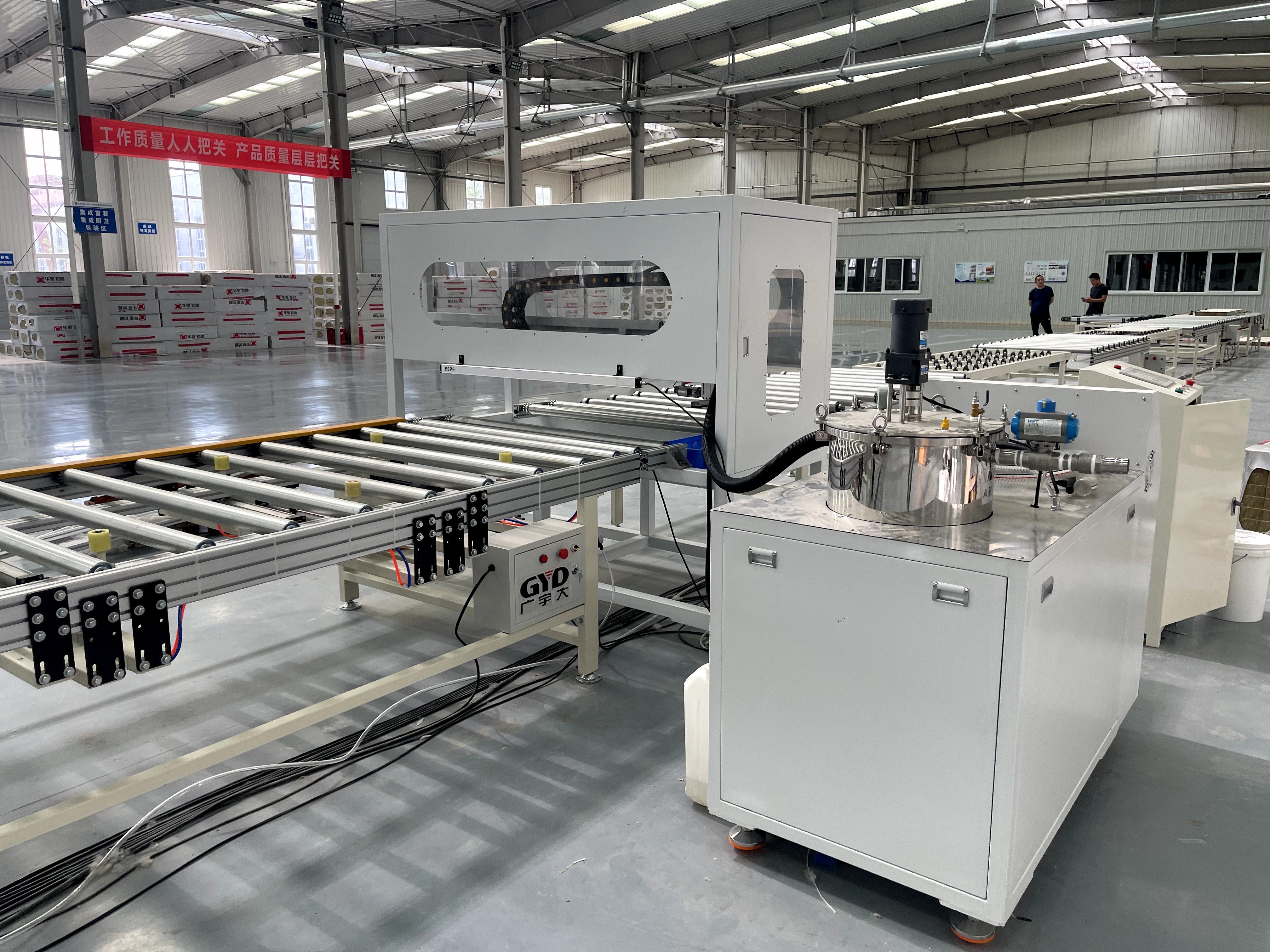
A fully automatic SIP panels production machine integrates material feed conveyors, adhesive application, panel movement, pressing, unloading, and stacking. One commercial system lists feeding conveyors, a manipulation gantry, direct adhesive-application gantry, pneumatic press, and finished-panel manipulator as core units. [1970]
Automation can reduce material handling and improve repeatability, especially when panel dimensions and materials are standardized. However, it does not eliminate the need for operators, maintenance personnel, process technicians, incoming inspection, adhesive management, and final quality checks. A fully automatic line should be evaluated as a complete production system rather than as a single press.
Discontinuous production uses separate, individual cycles. A panel is assembled, pressed for the required time, removed, and then another panel starts the process. Multi-opening or multi-press systems increase throughput by processing several panels or stacks in parallel.
Continuous production moves materials through a lamination process without stopping, usually for highly standardized products and high output. It requires tightly controlled material supply, adhesive application, press settings, and cutting. Continuous equipment can offer high throughput, but it demands reliable upstream logistics and a stable product mix.
The line begins with storage and feeding for skins and cores. OSB sheets, MgO boards, fibre-cement sheets, metal skins, or other facings must arrive flat, clean, dry, and correctly sized. Foam boards or mineral-wool cores must meet thickness, density, flatness, and surface-quality requirements.
Roller conveyors transfer sheets and panels between stations. Gantries, vacuum lifters, or mechanical manipulators can position facings and cores accurately. An automated line may use a distribution platform and motorized roller conveyors to coordinate material movement between adhesive application, pressing, and unloading. [1966]
Adhesive is one of the most important controlled materials in SIP panel production. Systems may use one-component or two-component polyurethane adhesives, depending on the product design and process. A commercial automated line describes cold pressing with one-component PUR adhesive and an open time and pressing time of approximately three to five minutes; actual timing must always follow the adhesive supplier's requirements and the validated factory process. [1970]
Application equipment can include roll coaters, curtain systems, spray systems, bead applicators, or gantry-mounted extrusion heads. Direct-application gantries can apply adhesive in controlled patterns across the facing or core. Precision dosing helps maintain consistent spread rate as adhesive viscosity changes. One supplier describes adhesive jets spaced 8 to 10 millimeters apart and automatic adjustment intended to maintain application consistency. [1966]
The key parameters are application mass per area, pattern, coverage at edges, adhesive temperature, mix ratio where applicable, pot life, open time, and cleanliness. Operators must prevent skipped areas, insufficient edge coverage, over-application, clogged nozzles, and use of adhesive outside its allowable working time.
After adhesive application, the insulating core is placed on the lower facing and the top facing is positioned. Alignment matters because a shifted core can produce uneven panel edges, poor adhesion zones, or incorrect finished dimensions. The assembly must enter the press before the adhesive exceeds its open time.
For some product designs, cores may be pre-cut, joined, edge-treated, or machined before lamination. The factory should define which operations occur before pressing and which occur afterward. For example, pre-cut cores can simplify final panel geometry, while post-lamination CNC machining can produce accurate openings and connection details.
A press applies controlled force across the full panel surface while the adhesive develops sufficient cure. Pneumatic presses are widely used in SIP and sandwich-panel production. Other options include hydraulic presses, vacuum presses, roller presses, or multi-daylight platen systems. [1967][1979]
Press selection depends on panel size, required pressure, adhesive chemistry, cycle time, product mix, and factory layout. The press must provide uniform pressure, avoid damaging fragile cores or skins, and hold the panel for the validated dwell time. Pressure that is too low can leave voids; excessive force can crush a foam core or create adhesive starvation.
After suitable cure, panels may be trimmed, cut to size, routed, grooved, drilled, marked, or machined using saws, CNC routers, hot-wire systems, or specialized panel-processing machines. Cutting after lamination helps create precise project-specific dimensions. SIP manufacturing descriptions commonly include hydraulic pressing followed by cutting and edge grooving for inserts or joining details. [1975]
An automated stacker or manipulator can remove finished panels from the press and arrange them for inspection, storage, or secondary fabrication. Protect panel surfaces during stacking and allow adequate cure time before aggressive handling, machining, or shipment.
Inspect facings for damage, moisture condition, thickness, flatness, grade, and surface contamination. Inspect cores for thickness, density, damage, dimensional stability, and correct material grade. Verify adhesive batch, shelf life, storage conditions, temperature, and any required mixing or conditioning.
Quality begins before the panel reaches the machine. Adhesive cannot reliably bond dusty, oily, wet, warped, or incompatible materials. Establish incoming inspection criteria and quarantine materials that fail them.
Place the lower skin on the line or assembly table. Apply adhesive at the validated spread rate and pattern, then place the core and top skin in the prescribed sequence. Some factories coat the core surfaces; others coat the facings. The chosen method must deliver complete and repeatable bonding without excessive adhesive use.
Monitor elapsed time from application to press closure. Open time is a process limit, not an estimate. If a panel cannot enter the press in time because of a stoppage, follow the validated disposition procedure rather than simply pressing the panel later.
Transfer the aligned layup into the press. Apply validated pressure and hold for the established dwell time. Adhesive cure can depend on temperature, humidity, material temperature, adhesive formulation, and panel construction. Record batch data and press-cycle parameters so the factory can trace each panel or production lot.
After release, allow the panel to reach the required handling or full-cure condition before machining, structural testing, packaging, or shipment. Initial press cure and full property development are not always identical, especially with reactive adhesives.
Fabrication can include cutting panel lengths, shaping rake walls, routing splines, cutting window and door openings, drilling service channels, adding marks, and preparing joints. CAD/CAM data can reduce errors by transferring project drawings to cutting equipment. Advanced SIP facilities use precision fabrication to create panel packages that fit the approved construction drawings. [1974]
Mark every panel clearly with project identification, orientation, assembly location, revision information, and traceability details. Accurate marking reduces field installation errors and supports quality documentation.
OSB is a common structural facing for SIPs, but not every OSB grade or thickness is interchangeable. The selected facing must match the approved panel design. Other skins—including metal, PVC, MgO, fibre-cement, and particleboard—may be used in sandwich panels or specialized SIP products where the design has been validated. [1966]
Different skins affect adhesive wetting, press pressure, cutting method, thermal movement, moisture resistance, and fire performance. If changing a skin, treat it as a product-design change requiring technical and quality approval, not a simple purchasing substitution.
EPS, XPS, PU, PIR, and mineral wool are among the cores used in SIP or sandwich-panel manufacturing. The core determines a large share of the panel's insulation properties, weight, thickness, machining behavior, and fire-related characteristics. [1966][1968]
Core selection must consider the target application, structural design, local building rules, service conditions, adhesive compatibility, and required approvals. A production machine may be mechanically capable of handling several core types, but the factory must validate each resulting panel configuration separately.
PUR adhesives are widely used for bonding SIP and sandwich-panel components. One-component systems can simplify dosing, while two-component systems require controlled mixing. The correct adhesive is selected based on facing material, core material, required performance, cure conditions, and process speed. [1968]
Manage adhesive storage, temperature, moisture exposure, pumping, filtering, mixing, and line flushing according to the supplier's documentation. Purge or protect nozzles during stoppages, particularly for moisture-reactive products. Automated systems may include shutter arrangements that close during extended stops to reduce premature curing within applicator nozzles. [1966]
Monitor skin and core identification, adhesive batch, adhesive temperature, application rate, open time, press pressure, press dwell time, panel thickness, alignment, and ambient conditions. Use machine data where available, but verify critical values independently on a defined schedule.
Visually inspect for gaps, dry adhesive zones, squeeze-out patterns, core damage, surface defects, and dimension errors. Excess adhesive squeeze-out is not proof of a good bond; it can indicate over-application or excessive pressure. Control the process with documented targets, not visual impressions alone.
A quality plan can include panel dimensions, flatness, squareness, facing integrity, bond quality, core condition, surface finish, and label accuracy. Product-specific testing may include bond strength, tensile behavior, shear performance, flexural behavior, moisture conditioning, or other tests required by the governing standard or evaluation report.
The level and frequency of testing should be determined by the panel design, code path, certification program, customer requirements, and risk assessment. For products evaluated under code reports, manufacturing typically occurs under a defined quality-control program and inspection regime. An ICC-ES report for one SIP product family states that facilities listed in the report manufacture panels under a quality-control program with ICC-ES inspections. [1976]
Assign lot numbers to facings, core materials, adhesive batches, and finished panels. Record machine recipe, operator, press cycle, inspection outcomes, rework, and shipment information. Traceability helps isolate affected production if a defect or complaint is found later.
When a panel fails inspection, contain the product, determine the root cause, assess any related panels, correct the process, and document disposition. A robust factory does not rely on final inspection to catch every problem; it uses process data to prevent defects.
Arrange raw-material storage, conditioning, feeding, adhesive preparation, layup, pressing, curing, cutting, inspection, stacking, and shipping in a logical flow. Minimize unnecessary forklift movement and avoid moving panels through dirty or wet areas. Ensure there is enough buffer space to prevent line stoppages from causing adhesive open-time failures.
Production-line suppliers offer systems with conveyors, adhesive gantries, presses, and stackers. One supplier reports 160 to 300 panels per eight-hour shift for certain automatic line configurations, but actual capacity varies with panel size, materials, product mix, staffing, downtime, and process design. [1970]
Automation should solve a real constraint: labor safety, repeatability, throughput, material handling, or data collection. A low-volume custom plant may benefit more from a reliable glue applicator, alignment fixtures, and flexible press than from a complex fully automated line. A high-volume standardized factory may justify conveyors, gantries, automated pressing, and stacking.
Plan for operators, forklift drivers, maintenance technicians, quality staff, production supervisors, and trained personnel who can manage adhesive systems. Even a line marketed as operable by a small team still needs support functions for safe, stable production. [1970]
PLC controls can manage conveyor movement, adhesive application, press timing, alarms, and safety interlocks. Recipe management allows the factory to store approved parameters for different panel types. Connecting production data to a quality system improves traceability and helps identify drifts in adhesive use, cycle time, or press performance.
Do not allow unrestricted editing of validated recipes. Use authorization levels, change records, backups, and verification after software changes. A data-rich line is only useful if the factory reviews the data and acts on trends.
Reactive adhesives may present skin, eye, inhalation, and chemical-handling hazards. Follow the safety data sheet, provide suitable ventilation, use required personal protective equipment, train staff, and prepare spill response procedures. Keep incompatible materials away from adhesive storage and mixing areas.
Presses, saws, routers, gantries, conveyors, and vacuum lifters create crush, cut, pinch, and moving-load hazards. Use guarding, emergency stops, lockout/tagout procedures, interlocked access points, lift plans, and operator training. Never bypass a press or machine safety device to recover lost cycle time.
Maintain pumps, hoses, filters, applicator nozzles, valves, conveyors, rollers, press seals, pneumatic circuits, hydraulic units, sensors, saw blades, CNC spindles, and safety devices. Inspect applicator patterns routinely and clean or replace components before inconsistent glue spread causes defects.
Calibrate measuring equipment and verify press pressure, adhesive flow, panel dimensions, and machine position. Schedule maintenance during planned downtime, retain spare parts for critical items, and document all work performed.
It assembles and bonds the layers of a structural insulated panel. Depending on automation level, the machine feeds skins and cores, applies adhesive, aligns the layup, presses the panel, transfers it, and may support cutting or stacking. [1966][1970]
Many lines can handle OSB, metal, PVC, MgO, fibre-cement, or particleboard skins with EPS, XPS, PU, PIR, or mineral-wool cores. The machine's mechanical capability does not automatically mean every combination is suitable for a structural panel; each product must be technically validated. [1966]
PUR adhesives are commonly used, including one-component and two-component systems. The chosen adhesive must be compatible with the core, facings, process conditions, and required panel performance. [1968]
It depends on adhesive chemistry, temperature, humidity, panel design, and equipment. One automatic cold-press line lists an open time and pressing time of about three to five minutes for its one-component PUR process, but manufacturers must follow the validated specification for their own adhesive and panel. [1970]
Neither is automatically better. Pneumatic presses can be suitable for many sandwich-panel applications, while hydraulic presses may be selected where the product requires different force or control characteristics. Choose based on panel size, required uniform pressure, adhesive system, throughput, and validated results. [1967][1975]
Factories inspect raw materials, verify adhesive application and press parameters, inspect dimensions and surface quality, and perform product-specific bond or structural tests as required. Traceability records help link every panel to materials and process settings.
A machine can support controlled manufacturing, but code compliance depends on the complete panel design, testing, evaluation report or approval path, factory quality program, installation details, and local authority requirements. Consult qualified engineers and local code officials for the intended project. [1976]


