
Views: 294 Author: 广宇大 Publish Time: 2026-11-24 Origin: Site


Content Menu
● What Is Automated Profile Spraying?
>> Define the Required Surfaces
>> Separate Automation from Process Validation
● Why Profiles Are Difficult to Coat Consistently
>> Different Surfaces Need Different Access
>> Product Presentation Changes the Result
>> Appearance Does Not Prove Film Uniformity
● How Automation Improves Coating Consistency
>> Repeatable Distance and Orientation
>> Repeatable Recipe Selection
>> Consistent Material Delivery
● Match the Spray Pattern to the Profile
>> Balance Coverage and Overlap
● Choosing Conventional or Electrostatic Application
>> Match Technology to the Material
>> Check Conductivity Requirements
● How Automated Profile Spraying Reduces Material Waste
>> Improve Transfer to the Product
>> Prevent Unnecessary Film Build
>> Address Material Lost Outside Spraying
● Measure Savings with Comparable Data
>> Check Transfer-Efficiency Test Conditions
>> Track Consumption per Accepted Product
>> Keep Quality Requirements Constant
>> Separate Recoverable Material from Waste
● A Practical Qualification Plan for Profile Coating
>> Stage 1: Qualify the Cross-Section
>> Stage 2: Qualify the Operating Range
>> Stage 3: Test Changeovers and Restarts
>> Stage 4: Verify Routine Production
● Troubleshooting Uneven Coverage and Excess Consumption
>> Thin Recesses with Heavy Edges
>> Rising Material Consumption
● Safety and Environmental Controls Remain Essential
>> Maintain Appropriate Ventilation
>> Separate Particle Collection from VOC Treatment
>> Design for Cleaning and Maintenance
● Discuss Your Profile Spraying Project with GYDFinishing
>> 1. Does automated profile spraying guarantee uniform coating?
>> 2. How does automation reduce paint waste?
>> 3. Is electrostatic spraying always best for profiles?
>> 4. Should manufacturers compare transfer-efficiency percentages directly?
>> 5. What is the most useful material-efficiency measure?
>> 6. Can collected overspray always be reused?
>> 7. What should a supplier demonstrate?
Automated profile spraying can improve coating consistency by controlling how products are presented, how applicators are positioned, and when coating is released. When these controls are validated for the actual profile and formulation, manufacturers can also reduce unnecessary overspray, excessive application, and repeat work.
However, automation does not automatically deliver an even film or lower total consumption. Graco identifies applicator selection, pressure, spray pattern, distance, orientation, and triggering as important influences on transfer efficiency. [2761]
For mouldings, trims, frame components, and other linear products, the objective is not simply a repeatable spray movement. It is repeatable coverage at the required quality.
My recommendation is to evaluate geometry, coating, handling, and inspection as one process.
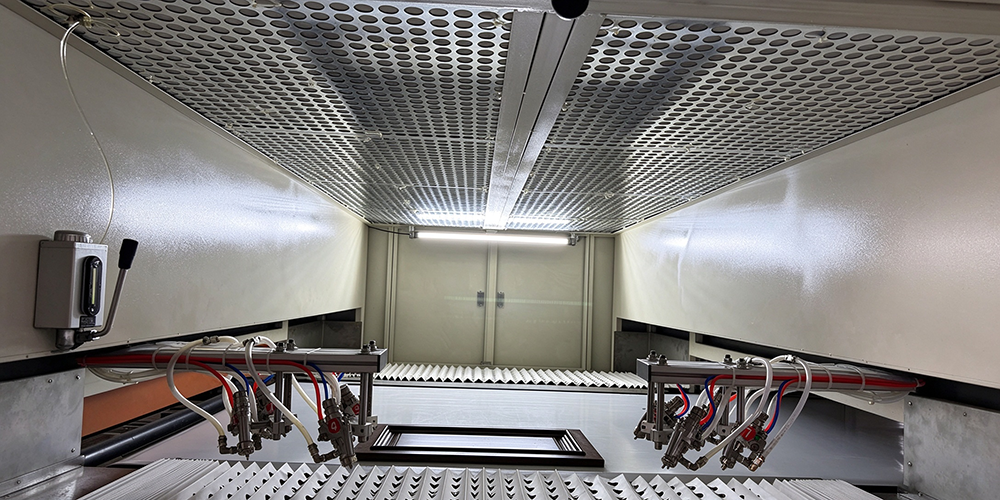
For this guide, automated profile spraying means controlled liquid-coating application to products with a defined cross-section.
Depending on the product, equipment may use fixed applicators, reciprocating movement, or programmed positioning alongside controlled transport.
Identify visible faces, edges, grooves, recesses, undersides, and any areas that must remain uncoated.
Include end treatment where relevant. A system demonstrated on the broad face alone has not necessarily qualified the complete product.
Automation repeats instructions. Validation establishes whether those instructions produce an acceptable finish.
A saved recipe is useful only when the material, product presentation, settings, and downstream treatment remain within approved conditions.
A profile can combine exposed surfaces, narrow edges, corners, and recessed details within one cross-section.
These features should not be treated as equivalent spray targets.
A gun aimed at one face may not provide acceptable coverage elsewhere.
Map the required surfaces before selecting gun positions. Do not assume that adding more coating to the exposed face will resolve a missed recess.
Rotation, lateral movement, support position, or dimensional variation can change the relationship between the applicator and the surface.
Include feeding and guiding in the coating assessment rather than treating them as unrelated handling equipment.
An acceptable-looking surface may still require checks for local film build and coverage.
Define the critical inspection locations across the profile instead of relying on a single convenient measurement.
Graco recommends appropriate gun distance and perpendicular application as important spray practices. It notes that robotic application can repeat technique consistently. [2761]
For profiles, establish which orientation is appropriate for each required surface, then verify it during production.
Coordinating spray release with product position can limit application before arrival, after departure, and through gaps.
Graco identifies correct triggering and de-triggering as relevant to transfer efficiency. [2761]
If sensing or position tracking is proposed, ask how it handles short parts, closely spaced products, and interruptions.
A qualified recipe can document applicator positions, pattern, material settings, transport speed, and associated process conditions.
Control who may edit it. Record changes and require approval before a modified recipe becomes the production standard.
Include coating preparation and delivery in the specification.
Request supplier-approved controls for mixing, filtration, material condition, and usable working time where applicable. Repeating motion cannot compensate for an unsuitable or unstable coating.
Graco explains that a spray pattern larger than the part can produce material blow-by and reduce transfer efficiency. It recommends matching pattern height to the application. [2761]
For narrow profiles, demonstrate the proposed pattern on the actual cross-section.
Where several applicators serve adjacent surfaces, inspect their combined result.
Identify whether overlap produces excess local application or whether a gap remains between coverage zones. Do not evaluate each gun in isolation.
Excessive atomizing air can increase overspray. Excessive fluid pressure can increase bounce-back. [2761]
Establish an acceptable spray pattern without unnecessary pressure. Avoid treating a pressure increase as the universal response to a coverage problem.
Graco identifies several spray technologies, each with advantages and limitations depending on the coating and required finish. [2761]
An automatic profile painting line does not need the most complex applicator to be suitable.
For nonconductive materials such as wood or plastic, Graco notes that a conductive primer may sometimes be needed to optimize electrostatic benefits. Waterborne electrostatic spraying can also require specialized isolation or charging arrangements. [2860]
Confirm the complete system rather than assuming compatibility from a coating label.
Electrostatic application can encounter the Faraday cage effect: charged coating preferentially deposits near accessible edges rather than entering recesses. [2860]
Require trials on difficult corners and grooves. Do not assume wraparound automatically establishes complete coverage.
Transfer efficiency describes how much sprayed coating reaches the intended part rather than being lost elsewhere. [2761]
Better applicator selection and validated settings can reduce the material required for an approved finish.
A process can use excessive coating while still producing an attractive surface.
Specify the required film build and suitable verification method. A consumption reduction is not a valid saving if it creates insufficient coverage.
More stable application may reduce avoidable respraying and associated sanding or handling.
Measure the actual defect categories. Do not assume that every historical repair originated in manual spraying.
Include startup, flushing, residual mixtures, cleaning, and rejected products.
These losses require their own controls. A high applicator-efficiency rating does not automatically establish low total consumption.
Graco explains that different ASTM and EN test arrangements can produce substantially different results for the same applicator. [2761]
Request the test method, coating, target geometry, and operating conditions behind quoted percentages.
Choose a practical unit, such as accepted length for a defined profile family.
Where cross-sections differ substantially, record product family and coated area where practical. Do not treat every linear metre as an identical application task.
Compare the same coverage, appearance, film-build, and performance requirements.
A lower material figure obtained by relaxing the finish specification is not a like-for-like improvement.
If recovery is proposed, document contamination controls, material condition, and supplier-approved reuse requirements.
Do not assume that all collected liquid overspray can return to production.
Use representative production material and inspect critical locations across the profile.
Include faces, edges, grooves, and any underside coverage in the acceptance plan.
Test normal variations in product dimensions, speed, spacing, and coating condition within supplier-approved limits.
The objective is an operating window, not one successful setting.
Include a product change, representative cleaning, a planned interruption, and restarting.
Record how affected products are identified and how first-product approval is performed.
Review accepted output, consumption, defects, operator tasks, and cleaning after commissioning.
Separate initial learning effects from sustained performance before declaring long-term savings.
Review application access, orientation, pattern interaction, and, where applicable, electrostatic behavior.
Avoid increasing total delivery before identifying why coating is not reaching the required area.
Review product tracking, transport, triggering, material delivery, and process records.
Determine whether variation repeats at entry, exit, or another identifiable location.
Compare substrate condition, coating batch, preparation, approved settings, and downstream treatment.
Do not assume the automation program is the only relevant variable.
Check accepted output, product mix, cleaning losses, application settings, component condition, and reject rates.
Investigate the complete consumption record before concluding that the applicator has become less efficient.
For operations within its scope, US OSHA 29 CFR 1910.107 requires adequate mechanical ventilation during spraying and sufficiently afterward to exhaust relevant vapors. [1720]
These are US requirements, not a substitute for local project assessment.
OSHA describes overspray filters as minimizing dust or residues entering exhaust ducts. This does not establish removal of gas-phase volatile organic compounds. [1720]
Specify particulate collection, ventilation, and any required emissions treatment separately.
The same standard addresses cleaning access, combustible residues, grounding, and additional electrostatic-system safeguards. [1720]
Include these requirements in equipment selection, training, and operating procedures.
According to the supplied company background, GYDFinishing was founded in 2007 and provides machinery and surface-finishing solutions for wood, glass, fibre cement, and other materials.
Its stated applications include wooden doors, furniture, cabinet doors, and flooring, with offerings from individual machines to turnkey lines.
For automated profile spraying, ask Guangyutai Machinery to confirm available handling arrangements, applicator configuration, coating compatibility, integration scope, and commissioning support.
Send cross-section drawings, samples, coating documentation, finish standards, current consumption records, and output targets.
Request a representative trial that measures coverage, accepted output, material consumption, changeover, and restart performance. Select equipment around a verified coating process—not a universal savings claim.
No. Geometry, preparation, product presentation, coating condition, application, and downstream treatment still require validation.
It can support repeatable positioning, suitable patterns, and controlled triggering. Actual savings depend on the validated application and total production losses. [2761]
No. Conductivity, formulation, grounding, and recessed geometry affect suitability. Recesses may experience the Faraday cage effect. [2860]
Only when test conditions are comparable. Different measurement arrangements can produce different percentages for the same applicator. [2761]
Consumption per accepted product family is a practical starting point, provided quality requirements and measurement boundaries remain consistent.
Do not assume so. Obtain approval for the actual formulation, collection conditions, contamination controls, and reuse procedure.
Representative profile coverage, approved appearance, application consistency, accepted output, consumption, changeover, safe stopping, and controlled restart.


