
Views: 278 Author: 广宇大 Publish Time: 2026-11-24 Origin: Site


Content Menu
● Define Profile Finishing Capacity Before Comparing Equipment
>> Use a Meaningful Output Unit
>> Include the Complete Product Mix
● Audit the Existing Spray Line First
>> Review Application Performance
● When Upgrading Existing Equipment Makes Sense
>> The Product Range Remains Compatible
>> Supporting Systems Have Capacity
>> The Retrofit Has a Clear Scope
● When a New Profile Spray Painting Line Is Better
>> Requirements Exceed the Existing Architecture
>> Several Systems Need Replacement
>> Support and Recovery Are Unacceptable
>> Separate Capacity Has Strategic Value
● Consider a Third Option: A Hybrid Expansion
>> Upgrade the True Bottleneck
● Compare Coating Efficiency on Equal Terms
>> Validate Applicator Selection
>> Check Transfer-Efficiency Claims
>> Preserve the Finish Specification
● Compare Full-Life Costs, Not Purchase Prices
>> Treat Historical Expenditure Correctly
● Evaluate Installation and Production-Continuity Risk
>> Evaluate Parallel Installation
● Reassess Safety and Environmental Requirements
>> Review the Proposed Operating Conditions
>> Check Ventilation and Maintenance Access
>> Separate Filtration from Emissions Treatment
● Require a Representative Comparison Trial
● Discuss Expansion Options with GYDFinishing
>> 1. Is upgrading existing equipment always cheaper?
>> 2. When should a factory choose a new spray line?
>> 3. Can better spray guns increase profile finishing capacity?
>> 4. Should both options use the same transfer-efficiency percentage?
>> 5. Can the old line remain as backup?
>> 6. What is the most useful decision metric?
>> 7. What should manufacturers send to a supplier?
When comparing a new spray line vs existing equipment, the better choice depends on what limits accepted production today. Upgrading existing equipment is worth considering when the line remains serviceable and a specific constraint can be corrected. A new line deserves consideration when the required product range, output, quality, or supporting infrastructure exceeds a practical retrofit.
Neither option is automatically cheaper over its operating life.
For manufacturers finishing mouldings, trims, frame components, and other linear products, the decision should connect capacity requirements with coating performance, handling, maintenance, and commercial demand.
My recommended approach is to diagnose the existing process first, then compare clearly defined alternatives against the same production and quality requirements.
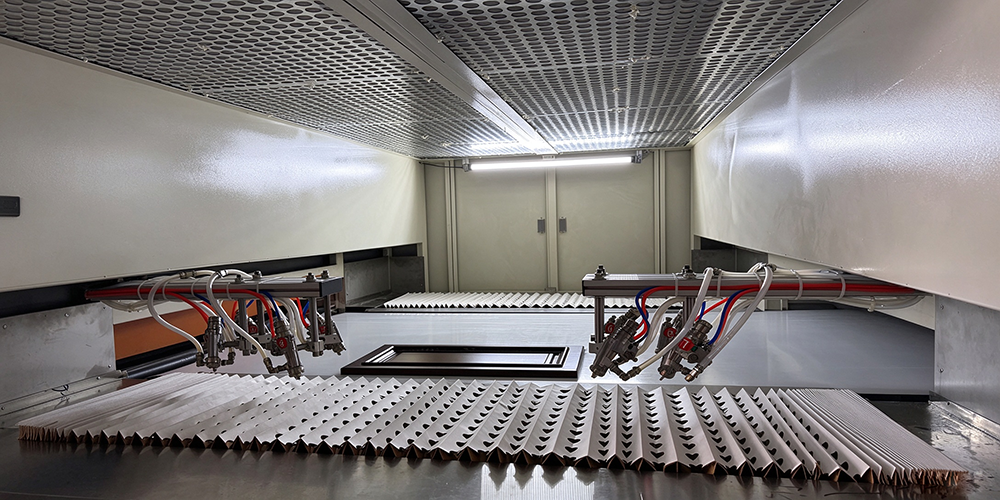
Capacity should mean accepted production under representative operating conditions—not maximum conveyor speed.
Accepted linear metres per shift may suit consistent profiles. However, different cross-sections can require different coated areas, gun positions, passes, and handling.
Group products into meaningful families. Do not treat every linear metre as an identical finishing task.
Document profile dimensions, materials, required coated faces, recesses, end treatment, masking, and appearance standards.
Include short batches, difficult geometries, and frequent colors. A proposal optimized for one easy profile may not serve the actual order book.
Separate recurring demand from a temporary peak.
If the additional capacity is not needed consistently, compare overtime, scheduling changes, selective upgrades, or phased expansion before committing to a complete line.
Do not assume the spray machine is the bottleneck simply because products queue near it.
Record loading, preparation, application, leveling, drying or curing, inspection, and unloading.
Measure waiting time, changeovers, downtime, rework, and work-in-progress. Identify the operation that limits completed, approved output.
Graco identifies applicator selection, air and fluid pressure, spray pattern, gun distance, orientation, and triggering as factors affecting transfer efficiency. [2761]
Poor settings can waste coating without proving that the entire line needs replacement.
Inspect the conveyor, delivery equipment, controls, ventilation, structural condition, and maintenance history.
Request an engineering assessment of remaining capability and component support. Replacing applicators will not resolve every aging-system limitation.
Determine whether drying, cooling, inspection, or unloading can support increased application output.
A faster spray section may simply move the queue downstream.
A retrofit is worth evaluating when a clearly identified issue limits an otherwise suitable line.
Examples to investigate include inconsistent feeding, unsuitable applicators, poor triggering, difficult adjustment, or excessive changeover work.
These are diagnostic possibilities, not promises that a particular upgrade will solve them.
If the factory continues processing similar profiles and coatings, existing handling and downstream equipment may remain useful.
Confirm coverage on every required surface. Do not assume an additional gun automatically reaches a recess or underside.
Verify ventilation, material delivery, utilities, drying, controls, and unloading against the proposed operating conditions.
Obtain written interface requirements rather than relying on unused nameplate capacity alone.
Define the expected output, quality, operating conditions, exclusions, and acceptance method.
A small quotation is not necessarily a low-risk project if integration responsibilities remain unclear.
A new line deserves consideration when required dimensions, presentation, coating access, or production sequence cannot be achieved practically within the existing layout.
Compare the complete engineering solution rather than forcing a fundamentally different process into unsuitable equipment.
If conveying, controls, ventilation, application, and drying all require major work, evaluate their combined retrofit cost.
Include integration effort and uncertainty. Several inexpensive modifications can become a complex project when connected.
Consider spare-part availability, documentation, software access, diagnostic capability, and service support.
A technically functioning line may still carry unacceptable business risk if a single unsupported component can stop production for an extended period.
A second line may allow different products or coatings to run independently.
However, verify whether preparation, utilities, drying, staffing, or packaging remain shared. Two spray machines do not automatically create two independent production systems.
The choice is not always full replacement or no replacement.
Consider assigning stable, familiar products to existing equipment while qualifying a new line for another product family.
Assess utilization and staffing across both lines. Avoid creating an underused asset merely to simplify scheduling.
Compare a targeted feeding, application, drying, or unloading project with a complete line.
Require evidence that the improvement increases finished output rather than only local processing speed.
A phased project can spread investment and qualification work.
Define the final layout and interfaces early. Otherwise, the first stage may require expensive modification when the next stage arrives.
Graco explains that conventional air spray, compliant spray, HVLP, air-assisted, electrostatic, and rotary atomization each have advantages and disadvantages depending on the material and required finish. [2761]
Do not assume a new line must use the most complex technology to outperform existing equipment.
Graco notes that different test arrangements can produce substantially different transfer-efficiency results for the same applicator. [2761]
Ask for the measurement method, target geometry, coating, and operating conditions behind supplier percentages.
Record coating and cleaning-material consumption per accepted product family.
Include startup, flushing, residual material, and rejects. Do not compare a retrofit's factory consumption with a new applicator's isolated laboratory result.
Lower consumption is not a valid saving if required coverage or film build is reduced.
Inspect faces, edges, recesses, and contact areas using agreed criteria.
Include engineering, equipment, installation, utilities, extraction, controls, training, commissioning, and maintenance.
For a retrofit, include modification of retained equipment. For a new line, include removal or relocation of old equipment where applicable.
Consider consumables, service, replacement parts, utilities, software support, cleaning, rework, and disposal.
US Department of Energy guidance describes life-cycle analysis as comparing the present value of acquisition, installation, operation, maintenance, and disposal costs. Its framework is useful for comparing alternatives, although federal financial assumptions should not be copied into a private factory model. [2877]
The existing machine's original purchase price does not, by itself, justify retaining it.
Compare future costs, recoverable value, and required performance. Have finance review the treatment of taxes, financing, and remaining book value.
Use conservative, expected, and higher-demand scenarios.
Vary utilization, product mix, changeover frequency, maintenance, and ramp-up. Identify whether the decision changes when demand falls below forecast.
Establish removal, installation, testing, training, and restart activities.
Include contingency for unexpected conditions in retained equipment. Do not treat the quoted mechanical installation period as the complete production interruption.
If space permits, a new line may be installed while the old line continues operating.
Confirm access, utilities, construction segregation, and commissioning arrangements. Do not assume this approach is feasible without a site review.
Allow time for recipes, fixtures, handling, operator training, and finish approval.
Production capacity becomes commercially useful only after acceptable output is repeatable.
Retaining an existing booth does not remove the need to assess a changed process.
US OSHA 29 CFR 1910.107 addresses ventilation, grounding, ignition sources, cleaning, and related spray-finishing safeguards within its scope. [1720]
Have qualified specialists evaluate the proposed coating, equipment, throughput, and local obligations.
The same standard requires adequate mechanical ventilation and accessible cleaning, alongside other requirements. [1720]
Include these systems in the project scope rather than treating them as unchanged background infrastructure.
OSHA describes overspray filters as minimizing dust or residues entering ducts; that does not establish removal of gas-phase volatile organic compounds. [1720]
Specify particulate collection and any required emissions treatment separately.
Use the same profiles, coatings, appearance standards, and measurement boundaries for both options.
Include difficult geometries, normal loading, a color or product change, an interruption, and restart.
Record accepted output, coverage, consumption, staffing, cleaning time, and defects.
For a retrofit that cannot be fully demonstrated beforehand, identify remaining engineering assumptions and agree on responsibility if performance falls short.
Do not accept a guarantee of "higher capacity" without a defined product mix, operating conditions, and test method.
According to the supplied company background, GYDFinishing was founded in 2007 and provides surface-finishing machinery for wood, glass, fibre cement, and other materials.
Its stated applications include wooden doors, furniture, cabinet doors, and flooring, with offerings from individual machines to turnkey lines.
For a profile-finishing project, ask Guangyutai Machinery to confirm the available configuration, profile-handling capability, retrofit scope, integration responsibilities, and service arrangements.
Send profile drawings, coating documentation, current production records, downtime history, factory layout, and expansion targets.
Request clearly scoped alternatives for retained equipment, targeted upgrading, and a new line where feasible. Choose the option that demonstrates the required accepted output with manageable lifetime cost and implementation risk.
No. Compare installation, integration, retained-component condition, downtime, maintenance, and remaining capability—not the modification quotation alone.
Consider a new line when the required products, capacity, quality, or support needs exceed a practical retrofit, or when several major systems require replacement.
They may improve application performance, but finished output will not necessarily rise if loading, drying, or unloading remains the bottleneck.
Only if the measurement conditions are comparable. Different test arrangements can produce different results for the same applicator. [2761]
Possibly, but verify staffing, maintenance, utilities, qualification, and shared dependencies. Backup capacity must be ready to produce acceptable work.
Compare accepted output, cost per accepted product, full-life cost, and implementation risk against the required product mix.
Provide profile drawings, samples, coating data, quality standards, current output, downtime records, layout, utilities, and demand forecasts.


