
Views: 265 Author: 广宇大 Publish Time: 2026-09-22 Origin: Site


Content Menu
● Understanding Painting Equipment Categories
>> Spray Booths and Paint Stations
>> Automated Spray Coating Lines
>> Powder Coating and UV Curing Systems
● Leading Painting Equipment Manufacturers and Suppliers
>> SK Ensure Machinery Private Limited (India)
>> Tymi Machinery Industry Co. (Taiwan) and Indian Suppliers
>> Resale Marketplaces and Used Equipment Suppliers
● Key Selection Criteria for Painting Equipment
>> Production Volume and Facility Constraints
>> Coating Material Compatibility and Curing Requirements
>> Budget Considerations and Total Cost of Ownership
● Maintenance and Operational Best Practices
>> Daily Cleaning and Preventive Maintenance Protocols
>> Optimizing Application Parameters for Quality and Efficiency
>> What types of painting equipment are commonly available for sale?
>> How much does industrial painting equipment typically cost?
>> Can painting equipment handle both water-based and solvent-borne coatings?
>> What maintenance is required for painting equipment?
>> How long does it take to install and commission painting equipment?
Modern manufacturing demands flawless surface finishes, minimal material waste, and maximum production efficiency to remain competitive in global markets. Finding the right painting equipment for sale has become critical for automotive refinishing shops, furniture manufacturers, metal fabricators, and industrial coating operations seeking to upgrade from manual methods to automated systems or expand existing production capacity. This comprehensive guide explores available painting equipment categories, leading manufacturers, pricing considerations, and selection criteria that transform coating operations from labor-intensive bottlenecks into streamlined competitive advantages.
Spray booths represent the most fundamental painting equipment for sale, providing controlled environments for manual or semi-automated coating application across automotive, aerospace, furniture, and industrial manufacturing sectors. Downdraft spray booths pull air vertically from ceiling to floor, capturing overspray below workpieces for superior finish quality on large assemblies including vehicles, aircraft components, and heavy machinery where contamination must be minimized.
Side draft and semi-downdraft configurations offer cost-effective alternatives for smaller operations with space constraints, pulling air horizontally through rear or side filtration banks while maintaining adequate visibility and access for technicians. Portable spray booths provide flexible solutions for job sites, temporary facilities, and operations requiring occasional coating capacity without permanent infrastructure investment, featuring modular construction that assembles quickly and relocates as business needs evolve.
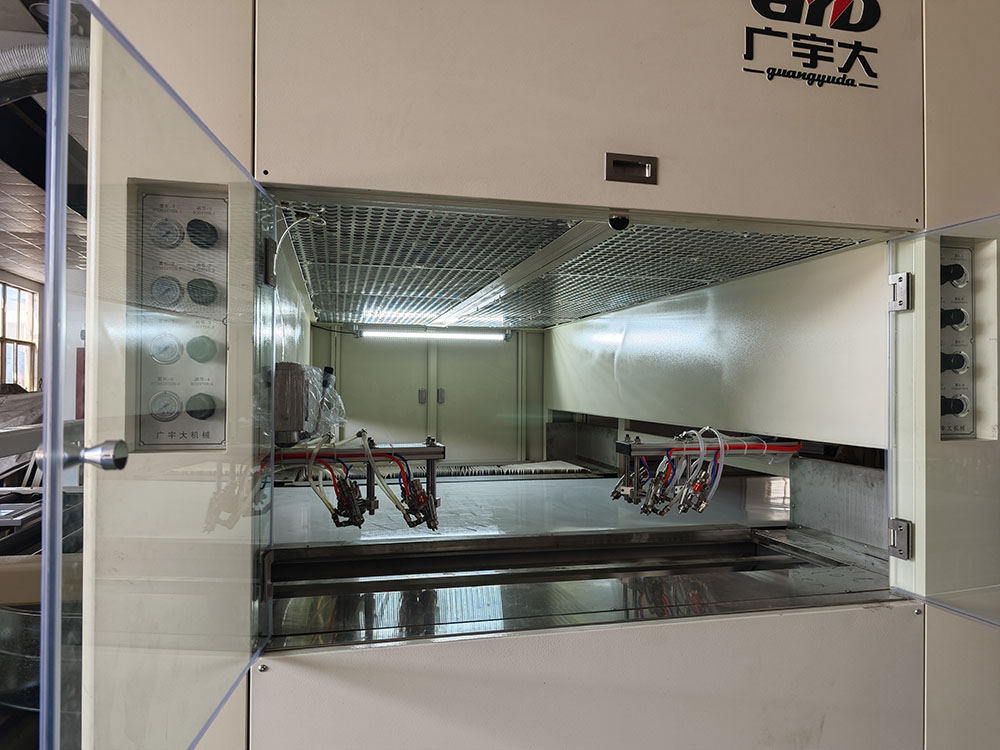
Automated spray coating lines integrate reciprocating spray mechanisms, robotic manipulators, or multi-axis CNC systems with conveyor transport to deliver consistent finish quality at production speeds impossible with manual methods. Reciprocating spray machines mount spray guns on linear tracks that traverse above or beside conveyor paths, applying coatings to flat panels, cabinet doors, and architectural components with overlapping spray patterns that eliminate streaks and ensure uniform film thickness across entire surfaces.
Robotic spray cells employ six-axis articulated arms that navigate complex three-dimensional geometries, maintaining optimal spray angles and standoff distances across curved surfaces, carved details, and assembled structures that challenge conventional reciprocating equipment. Complete turnkey coating lines combine surface preparation, multi-stage spray application, flash-off zones, curing tunnels, and cooling sections in continuous flow that transforms raw substrates into finished, ready-to-assemble components with minimal manual handling between operations.
Powder coating equipment for sale includes electrostatic spray guns, fluidized bed applicators, and complete powder coating lines that apply dry powder coatings cured into durable, environmentally friendly finishes without solvent emissions. Automatic powder coating booths with fast color change systems enable rapid product transitions in high-mix production environments, while polymerization ovens cure powder coatings at controlled temperatures to achieve specified film properties including hardness, flexibility, and chemical resistance.
UV curing systems integrate ultraviolet lamp arrays with spray or roller coating application to instantly polymerize UV-curable coatings, dramatically reducing drying times and floor space requirements compared to conventional air-dry or thermal cure systems. UV roller coaters apply uniform films through precision-ground applicator rollers followed immediately by high-intensity UV lamps that cure coatings in seconds, enabling immediate handling and packaging that accelerates order fulfillment and reduces work-in-progress inventory.
Hinah Technology operates as the largest powder coating equipment supplier and manufacturer in northern China, providing professional powder coating systems, powder coating line equipment, painting equipment, and e-coating line solutions worldwide including industrial powder coating ovens, powder coating booths with fast color change systems, and powder coating conveyor systems. Their fully automatic liquid paint spraying lines suit a very wide range of applications from orbital paint dipping lines to plastic dipping lines, achieving fast spraying rates that maximize equipment utilization in high-volume production environments.
Together with fully automatic paint spraying robots, Hinah systems achieve higher automation effects, reduce pollution, and lower production costs compared to manual or semi-automated alternatives. The company provides professional industrial powder coating systems and powder coating equipment including automatic powder coating booths, powder coating robots, powder coating curing ovens, powder coating conveyors, and electronic control systems worldwide with comprehensive technical support encompassing installation, operator training, and ongoing maintenance services.
SK Ensure Machinery Private Limited, based in New Industrial Township, Faridabad, Haryana, manufactures UV varnish roller coating machines with capacities reaching 2,000 impressions per hour for printing, packaging, and specialty coating applications. Their UV coaters integrate high-speed stream feed sheet feeders, robust roller coater assemblies, driers, and high-pile stackers capable of coating water-based (aqua), UV, and solvent-based formulations across diverse substrates including paper, board, plastics, and metal foils.
The company serves customers across multiple industries and regions with equipment that delivers consistent coating quality at production speeds that justify capital investment over manual or semi-automated methods. Technical support encompasses installation, operator training, and ongoing maintenance services ensuring customers achieve target quality and throughput levels across extended equipment service life.
Tymi Machinery Industry Co., based in New Taipei City, Taiwan, manufactures UV coaters and coating production lines serving printing, packaging, and industrial coating applications across Asia and export markets. Trusted sellers of UV coaters in India include Decent Print Lines, Sigma Industries, and Pearl Print Pack, all based in Faridabad and Ballabgarh manufacturing hubs, offering UV coating machines, roller coaters, and complete coating production lines with comprehensive technical support.
These suppliers serve customers across multiple industries and regions with equipment that delivers consistent coating quality at production speeds that justify capital investment over manual or semi-automated methods. Buyers can source UV coating machines from trusted suppliers including Taniya Machinery Pvt. Ltd., Foto Laminate, Victory Machines & UV Service, MG Micro UV Solutions, and others listed on industry platforms with verified credentials and customer references.
Resale marketplaces such as RESALE.INFO and Machineseeker.co.uk offer extensive inventories of used painting equipment including color coating lines, spray booths, powder coating systems, and complete paint finishing systems at significant discounts compared to new equipment prices. Available listings include automatic powder coating lines with full encapsulation of production processes manufactured by Ecoline, featuring surface preparation tunnels, drying ovens, cooling tunnels, manual cabins for short series, dielectric automatic cabins for quick color change, GEMA applications, cleanrooms maintaining constant operating parameters, polymerization ovens, and automatic mono rotary conveyors.
Used spray booths range from compact portable units priced under 5,000 euros to large industrial installations exceeding 70,000 euros depending on dimensions, filtration capacity, and included features such as bake cycles, downdraft airflow, and explosion-proof electrical systems. Complete paint finishing systems from reputable manufacturers including Wagner, ESB Vöhringer, and OMT Otto Müller offer significant value for operations seeking to expand capacity or upgrade capabilities without new equipment capital expenditures.
Matching painting equipment capacity to actual production volumes and available facility space prevents both underutilization of capital equipment and production bottlenecks that delay order fulfillment and frustrate customers. Low to medium volume operations processing under 500 panels daily benefit from portable spray booths or compact reciprocating spray machines with manual loading and unloading stations positioned at ergonomic heights to reduce worker fatigue during extended shifts.
High-volume manufacturers handling thousands of components daily require robotic spray cells or multi-station coating lines with automated material handling, quick-change nozzle systems, and integrated vision systems that minimize changeover downtime between product styles. Evaluate available floor space, ceiling heights, utility capacity including electrical power, compressed air, and ventilation, along with environmental compliance constraints that vary by region and facility age before committing to equipment purchases that may require expensive facility modifications.
Different coating chemistries demand specific spray gun technologies, fluid delivery pressures, and curing methods to achieve optimal results without sagging, orange peel, or inadequate cure that compromises durability and appearance. Water-based coatings require stainless steel fluid paths, ceramic nozzles, and corrosion-resistant seals to prevent rust contamination during extended production runs, while solvent-borne systems need explosion-proof electrical components and adequate ventilation to meet occupational safety and environmental regulations.
UV-curable coatings necessitate roller coaters or spray guns with specialized nozzles that prevent premature curing inside fluid passages, along with integrated UV lamp arrays positioned immediately after application zones for instant polymerization that enables immediate handling and packaging. Powder coatings require electrostatic spray guns, fluidized bed applicators, or triboguns that charge powder particles for efficient deposition, followed by curing ovens that melt and crosslink powder into durable finishes without solvent emissions.
Painting equipment for sale spans wide price ranges from portable spray booths under 10,000 dollars to complete automated coating lines exceeding 500,000 dollars depending on complexity, automation level, and included features. Initial purchase price represents only a fraction of total cost of ownership that includes installation, commissioning, operator training, preventive maintenance, consumables including filters and nozzles, energy consumption, and eventual decommissioning or replacement costs over equipment service life.
Used equipment offers significant upfront savings but may carry higher maintenance costs, limited warranty coverage, and potential compatibility challenges with modern controls and safety systems. Evaluate supplier reputation, available technical support, spare parts availability, and training resources alongside purchase price to ensure equipment delivers expected return on investment over extended service life without unexpected downtime or performance shortfalls that erode profitability.
Consistent daily cleaning prevents coating buildup in spray guns, fluid lines, filters, and recovery systems that degrades finish quality and increases unplanned downtime that disrupts production schedules. Flush spray guns with appropriate solvents at shift end, removing nozzles, air caps, and fluid needles for thorough cleaning to prevent clogging from dried coating residue that alters spray patterns and creates streaks or dry spots on finished parts.
Inspect conveyor chains, drive motors, photoelectric sensors, reciprocating guides, and roller bearings for wear, contamination, or misalignment that could affect positioning accuracy and coating uniformity across workpiece surfaces. Weekly preventive maintenance should include lubrication of linear guides with manufacturer-specified greases, verification of spray gun alignment using laser tools, calibration of fluid pressure regulators against certified gauges, and inspection of filtration media to ensure adequate airflow through spray booths that prevents overspray accumulation and fire hazards.
Achieving optimal coating quality while minimizing material consumption requires careful balancing of spray gun air pressure, fan width adjustment, fluid flow rate, gun traverse speed, and conveyor velocity to match coating viscosity and workpiece geometry. Start with manufacturer-recommended baseline settings for your specific coating type and substrate, then conduct systematic test applications on sample panels to evaluate coverage uniformity, orange peel severity, and film thickness consistency across faces, edges, and profiles.
Use wet film thickness gauges during setup to verify that applied coatings meet specification requirements before entering flash-off or curing stages, preventing costly rework from under or over-application that wastes material and delays order shipments. Document successful parameter combinations for each coating type and workpiece geometry, creating standardized setup sheets that reduce changeover times and ensure consistent results across shifts, operators, and production facilities that maintain brand quality standards regardless of where products are manufactured.
Common painting equipment for sale includes spray booths (downdraft, side draft, portable), automated spray coating lines (reciprocating, robotic, CNC), powder coating systems (electrostatic spray guns, fluidized beds, curing ovens), UV curing equipment (roller coaters, spray systems, UV lamp arrays), and complete turnkey coating lines integrating surface preparation, multi-stage application, flash-off, curing, and cooling in continuous production flows.
Industrial painting equipment costs vary widely from portable spray booths under 10,000 dollars to complete automated coating lines exceeding 500,000 dollars depending on complexity, automation level, and included features. Used equipment offers significant upfront savings but may carry higher maintenance costs and limited warranty coverage compared to new systems with full manufacturer support and training resources.
Yes, most modern painting equipment accommodates multiple coating types with appropriate component configurations and material selections that resist chemical attack and corrosion. Water-based coatings require stainless steel fluid paths and corrosion-resistant seals, while solvent-borne systems need explosion-proof electrical systems and enhanced ventilation. Many manufacturers offer convertible systems that can be adapted for different coating chemistries with component changes and safety upgrades.
Daily maintenance includes flushing spray guns, cleaning nozzles and air caps, wiping down conveyor systems and roller applicators, and checking fluid levels in pressure pots or supply tanks. Weekly tasks involve lubricating linear guides and reciprocating mechanisms, verifying spray gun alignment and nozzle wear, checking pressure regulator calibration, and inspecting filtration media for clogging. Monthly inspections should cover overspray recovery systems, electrical connections, safety interlocks, conveyor drive components, and UV lamp output to identify wear before failure causes production stoppages.
Installation and commissioning timelines vary by system complexity and site preparation, typically ranging from two to twelve weeks depending on foundation requirements, utility connections, and integration with existing material handling systems. Simple portable spray booths may be operational within days after delivery if utilities and floor space are ready, while complete turnkey coating lines with conveyor integration, multi-stage application, curing systems, and robotic material handling require extended commissioning periods including operator training and production trials.


