
Views: 276 Author: 广宇大 Publish Time: 2026-09-22 Origin: Site


Content Menu
● Understanding Line Spray Machine Technology
>> What Is a Line Spray Machine?
>> Core Components of Linear Spraying Systems
● Types of Line Spray Machine Configurations
>> Single-Head and Double-Head Linear Spray Lines
>> Integrated Automated Spraying Lines
>> UV and Solvent-Based Line Spray Systems
● Leading Line Spray Machine Manufacturers
>> Chengdu Senlian Coating Machinery (China)
>> Foshan Taisan Machinery (China)
>> Qingdao GODN Mechanical Technology (China)
● Key Selection Criteria for Line Spray Machine Systems
>> Production Volume and Profile Geometry
>> Coating Material Compatibility and Curing Requirements
>> Profile Dimensions and Tolerance Requirements
● Maintenance and Operational Best Practices
>> Daily Cleaning and Preventive Maintenance Protocols
>> Optimizing Application Parameters for Quality and Efficiency
>> What is the difference between a line spray machine and a general-purpose spray booth?
>> How much coating material can be saved by using a line spray machine versus manual spraying?
>> Can line spray machines handle both water-based and solvent-borne coatings?
>> What maintenance is required for line spray machines?
>> How long does it take to install and commission a line spray machine?
Modern manufacturing demands flawless surface finishes, minimal material waste, and maximum production efficiency to remain competitive in global markets. A line spray machine has evolved from simple spray guns and manual conveyors into sophisticated automated systems that integrate precision coating application, multi-surface coverage, and intelligent material handling specifically engineered for linear workpieces, narrow profiles, and continuous panel processing. This comprehensive guide explores leading line spray machine technologies, system configurations, and selection criteria that transform coating operations from labor-intensive bottlenecks into streamlined competitive advantages across architectural millwork, furniture, door, window, and exterior wood product manufacturing sectors.
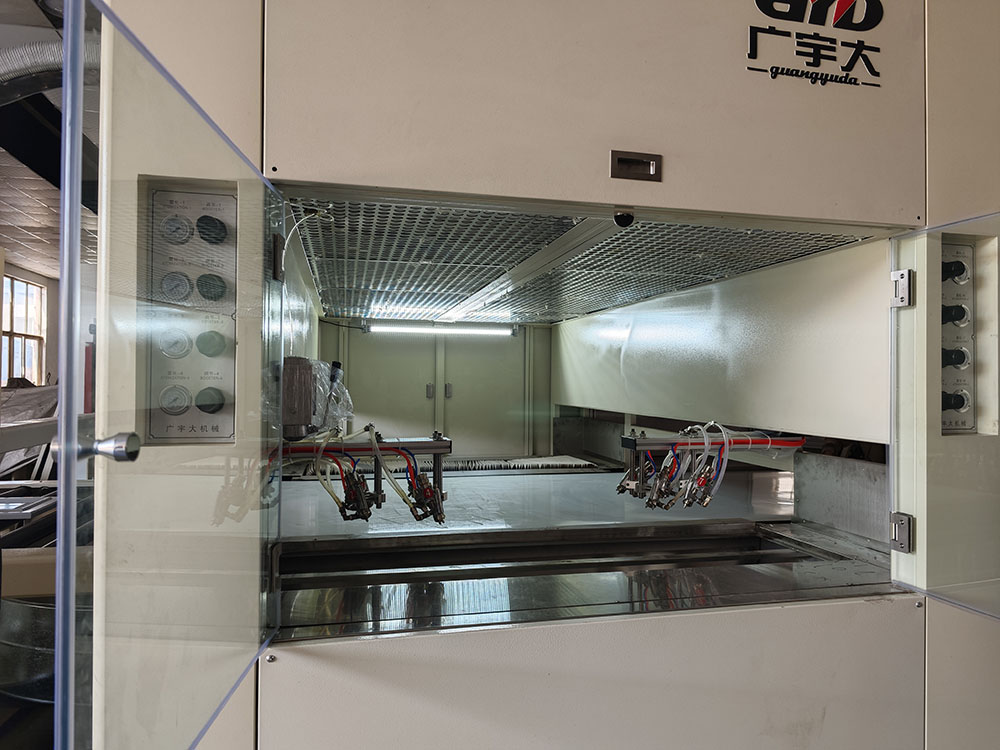
A line spray machine is an industrial coating application system specifically engineered for continuous, multi-surface coating of elongated wooden and composite profiles including door frames, window casings, baseboards, mouldings, and linear furniture components. Unlike general-purpose spray booths designed for varied workpieces, line spray machines incorporate specialized conveying mechanisms, multi-angle spray gun arrays, and optimized spray chamber geometries that deliver uniform coverage on narrow, elongated workpieces where traditional methods struggle with uneven coverage, high material waste, and significant labor costs.
These systems integrate three to eight programmable spray guns positioned at calculated angles that apply coating simultaneously to all visible surfaces as profiles move steadily through spray chambers at controlled speeds ranging from 5 to 50 meters per minute depending on coating requirements and cure times. Advanced line spray machine configurations feature automatic profile detection, adaptive spray pattern adjustment, and integrated dust removal systems that maintain optimal application parameters throughout high-volume production cycles, enabling consistent finish quality across extended production runs.
Industrial line spray machines consist of several integrated subsystems working in concert to achieve reliable high-quality finishes at production speeds optimized for linear workpieces. Conveyor systems employ belt, chain-on-edge, or vacuum transport mechanisms that grip profiles securely while presenting all surfaces to spray guns without shadowing or missed areas that compromise finish quality. Processing widths typically range from 10 to 400 millimeters with thickness capacities from 10 to 100 millimeters, accommodating diverse profile geometries from thin edge banding to substantial door frames and architectural mouldings.
Multi-gun spraying manifolds mount three to eight programmable spray guns at precisely calculated angles that ensure complete coverage of top surfaces and both sides of workpieces in single pass-through operations. Working pressures ranging from 0.5 to 0.8 megapascals atomize coatings into fine mists that penetrate open grain structures uniformly while minimizing overspray losses that create cleanup burdens and hazardous waste disposal costs in conventional spray booths without optimized geometries for linear workpieces.
Single-head linear spray lines represent entry-level configurations suitable for low to medium volume profile finishing operations where capital investment must be minimized while still achieving dramatic improvements over manual methods. These systems feature single spray manifolds with three to four programmable guns positioned to coat top and side surfaces simultaneously, delivering uniform coverage on door frames, baseboards, and simple mouldings at feeding speeds from 0 to 30 meters per minute depending on coating viscosity and desired film thickness.
Double-head linear spray lines double throughput by employing two independent spray manifolds positioned sequentially along conveyor paths, enabling higher line speeds or dual-coat application in single pass-through operations. WoodTech's WTM-SP400 linear spray line exemplifies this configuration with six spraying guns, processing widths from 10 to 400 millimeters, thickness capacities from 10 to 100 millimeters, and feeding speeds reaching 50 meters per minute for maximum throughput in high-volume architectural millwork and furniture component manufacturing where thousands of linear meters flow through finishing lines daily.
Integrated automated spraying lines combine surface preparation, multi-stage spray application, flash-off zones, curing tunnels, and cooling sections in one continuous flow that transforms raw profiles into finished, ready-to-assemble components with minimal manual handling between operations. These complete line spray machine installations suit mass production environments where parts move automatically from dust removal through multi-gun spraying, UV or infrared curing, and final cooling without intermediate storage or re-fixturing that introduces contamination risks and delays order fulfillment.
A typical automated line follows an optimized, closed-loop process beginning with manual or automatic profile loading onto conveyor systems, followed by rotating brushes that thoroughly clean surfaces and grooves to ensure optimal paint adhesion. Multi-gun spraying applies coating simultaneously to all visible surfaces as profiles move steadily through spray chambers, then coated profiles immediately enter drying tunnels where UV or infrared technology quickly sets finishes based on coating chemistry, enabling immediate handling and packaging that accelerates order fulfillment and reduces work-in-progress inventory.
UV line spray machines integrate ultraviolet lamp arrays positioned immediately after spray zones to instantly polymerize UV-curable coatings, dramatically reducing drying times and floor space requirements compared to conventional air-dry or thermal cure systems. These systems achieve line speeds exceeding 30 meters per minute while maintaining coating quality superior to conventional systems, with immediate handling and secondary processing possible within seconds rather than the hours required for air-dry coatings.
Solvent-based and water-based line spray machines employ infrared drying tunnels or forced-air convection ovens that evaporate solvents or water carriers at controlled temperatures to cure coatings without premature skinning or solvent entrapment that creates blisters and finish defects. Flash-off zones between spray manifolds and drying tunnels allow solvents to evaporate gradually before entering high-temperature curing zones, preventing surface defects that compromise appearance and durability in demanding architectural and furniture applications where finish quality directly impacts product value and customer satisfaction.
WoodTech Machinery manufactures automatic profile spraying machines including the WTM-SP400 linear spray line specifically engineered for continuous, multi-surface coating of elongated wooden and composite profiles with six spraying guns, processing widths from 10 to 400 millimeters, and feeding speeds reaching 50 meters per minute. Their linear spray lines feature precision spray manifolds with programmable gun positioning that ensures complete coverage of top surfaces and both sides of workpieces in single pass-through operations, eliminating secondary operations and manual touch-up that slow conventional lines.
The company's equipment serves architectural millwork, furniture parts, cabinet frames, slats, and other linear furniture elements where consistent finish quality and rapid throughput are critical for competitiveness in demanding markets. Technical support encompasses installation, operator training, and ongoing maintenance services across North American markets, ensuring customers achieve target quality and throughput levels that justify capital investment in automated finishing technology rather than continuing with inefficient manual methods that vary with operator skill and fatigue levels throughout shifts.
Chengdu Senlian Coating Machinery operates as a comprehensive coating machine supplier manufacturing UV machines, roller coaters, spray painting machines, UV coating lines, furniture coating machines, furniture painting lines, sanding machines, and curtain coating machines for diverse woodworking applications. Their spray painting machines and UV coating lines serve furniture, doors, cabinets, flooring, and architectural panel manufacturers with equipment that delivers consistent finish quality at production speeds that justify capital investment over manual or semi-automated methods.
The company's product portfolio spans surface preparation through final cure with automatic spraying machines, UV curing tunnels, IR drying systems, and sanding equipment that levels coated surfaces between coats for ultra-smooth finishes required by high-end furniture and architectural millwork specifications. Technical support encompasses installation, operator training, and ongoing maintenance services across global markets, ensuring customers achieve target quality and throughput levels across extended equipment service life.
Foshan Taisan Machinery manufactures comprehensive coating production equipment including UV roller coating production lines, curtain coating production lines, automatic spraying production lines, PUR laminating lines, excimer matting production lines, edge banding printing lines, and protective film laminating machines serving furniture, flooring, cabinet, walling, door, decorative board, and shutter window manufacturers. Their equipment handles diverse materials including wood, MDF, plastic, metal, glass, and calcium silicate boards with working widths up to 1,300 millimeters and operation heights optimized for ergonomic loading and unloading.
The company offers high-quality innovation equipment and solutions to the woodworking industry with delivery times typically ranging from 15 to 25 days and price ranges that reflect equipment complexity, automation level, and included features. Technical support encompasses installation, operator training, and ongoing maintenance services across global markets, ensuring customers achieve target quality and throughput levels that justify capital investment in automated finishing technology.
Qingdao GODN Mechanical Technology operates as one of the outstanding woodworking machinery manufacturers in China, supplying first-class products and services including spraying finishing machines, plane finishing machines, surface coating machines, and basic woodworking machinery for furniture, door, cabinet, and architectural millwork applications. Their Godn UV spraying line machines feature automatic operation with power ratings from 11 to 112 kilowatts depending on configuration, working widths up to 1,300 millimeters, and integrated UV curing systems that enable immediate handling and secondary processing.
The company's leading products include spraying finishing machines and plane finishing machines that deliver consistent finish quality at production speeds that justify capital investment over manual or semi-automated methods. Technical support encompasses installation, operator training, and ongoing maintenance services across global markets, ensuring customers achieve target quality and throughput levels across extended equipment service life.
Matching line spray machine capacity to actual production volumes and profile complexity prevents both underutilization of capital equipment and production bottlenecks that delay order fulfillment and frustrate customers. Low to medium volume operations processing under 1,000 linear meters daily benefit from single-head linear spray lines with manual loading and unloading stations positioned at ergonomic heights to reduce worker fatigue during extended shifts.
High-volume manufacturers handling thousands of linear meters daily require double-head configurations or integrated automated spraying lines with automated material handling, quick-change spray gun nozzles, and integrated vision systems that minimize changeover downtime between profile styles. Evaluate cycle times including loading, dust removal, spray application, flash-off, curing, cooling, and unloading phases to calculate realistic daily throughput under actual operating conditions rather than theoretical maximums that ignore real-world constraints such as material handling delays and quality inspection requirements.
Different coating chemistries demand specific spray gun technologies, fluid delivery pressures, and curing methods to achieve optimal results without sagging, orange peel, or inadequate cure that compromises durability and appearance. Water-based coatings require stainless steel fluid paths, ceramic nozzles, and corrosion-resistant seals to prevent rust contamination during extended production runs, while solvent-borne systems need explosion-proof electrical components and adequate ventilation to meet occupational safety and environmental regulations.
UV-curable coatings necessitate spray guns with specialized nozzles that prevent premature curing inside fluid passages, along with integrated UV lamp arrays positioned immediately after spray zones for instant polymerization that enables immediate handling and packaging. Verify that candidate line spray machines accommodate your specific coating portfolio including primers, stains, sealers, and topcoats without requiring extensive reconfiguration or component replacement when switching materials between production runs.
Architectural mouldings, door frames, window casings, and furniture components vary dramatically in dimensions and complexity, from thin edge banding measuring 10 millimeters wide to substantial door frames exceeding 400 millimeters in width with raised profiles and intricate moulded details. Ensure that candidate line spray machines accommodate maximum profile dimensions with adequate clearance for spray gun travel, overspray containment, and conveyor tracking without edge contact that damages finishes or creates safety hazards for operators loading and unloading profiles.
For shaped components with deep grooves, carved decorative elements, or complex profiles, prioritize line spray machines with programmable spray gun positioning that adjusts angle, standoff distance, and fan width dynamically across varying surface contours. Simple fixed-angle spray manifolds may achieve superior results on flat profiles but struggle with complex geometries, potentially requiring manual touch-up that negates automation benefits and increases labor costs per finished unit.
Consistent daily cleaning prevents coating buildup in spray guns, fluid lines, filters, and recovery systems that degrades finish quality and increases unplanned downtime that disrupts production schedules. Flush spray guns with appropriate solvents at shift end, removing nozzles, air caps, and fluid needles for thorough cleaning to prevent clogging from dried coating residue that alters spray patterns and creates streaks or dry spots on finished profiles.
Inspect conveyor chains, drive motors, photoelectric sensors, spray manifolds, and roller bearings for wear, contamination, or misalignment that could affect positioning accuracy and coating uniformity across profile surfaces. Weekly preventive maintenance should include lubrication of linear guides with manufacturer-specified greases, verification of spray gun alignment using laser tools, calibration of fluid pressure regulators against certified gauges, and inspection of filtration media to ensure adequate airflow through spray chambers that prevents overspray accumulation and fire hazards.
Achieving optimal coating quality while minimizing material consumption requires careful balancing of spray gun air pressure, fan width adjustment, fluid flow rate, conveyor velocity, and gun positioning angles to match coating viscosity and profile geometry. Start with manufacturer-recommended baseline settings for your specific coating type and profile configuration, then conduct systematic test applications on sample profiles to evaluate coverage uniformity, orange peel severity, and film thickness consistency across faces, edges, and profiles.
Use wet film thickness gauges during setup to verify that applied coatings meet specification requirements before entering flash-off or curing stages, preventing costly rework from under or over-application that wastes material and delays order shipments. Document successful parameter combinations for each coating type and profile geometry, creating standardized setup sheets that reduce changeover times and ensure consistent results across shifts, operators, and production facilities that maintain brand quality standards regardless of where products are manufactured.
A line spray machine is specifically engineered for continuous, multi-surface coating of elongated wooden and composite profiles with optimized spray gun positioning and conveyor geometries that ensure complete coverage in single pass-through operations. General-purpose spray booths accommodate varied workpieces but struggle with narrow, elongated profiles where uneven coverage, high material waste, and significant labor costs plague manual or semi-automated methods.
Line spray machines typically reduce coating consumption by 20 to 40 percent compared to manual spraying through precise gun triggering, consistent overlap patterns, and optimized application parameters that minimize overspray and waste. Integrated overspray recovery systems further reduce waste by capturing and filtering excess material for proper disposal or recycling in compliance with environmental regulations.
Yes, most modern line spray machines accommodate multiple coating types with appropriate component configurations and material selections that resist chemical attack and corrosion. Water-based coatings require stainless steel fluid paths and corrosion-resistant seals, while solvent-borne systems need explosion-proof electrical systems and enhanced ventilation. Many manufacturers offer convertible systems that can be adapted for different coating chemistries with component changes and safety upgrades.
Daily maintenance includes flushing spray guns, cleaning nozzles and air caps, wiping down conveyor systems, and checking fluid levels in pressure pots or supply tanks. Weekly tasks involve lubricating linear guides and spray manifolds, verifying spray gun alignment and nozzle wear, checking pressure regulator calibration, and inspecting filtration media for clogging that reduces airflow. Monthly inspections should cover overspray recovery systems, electrical connections, safety interlocks, conveyor drive components, and UV lamp output to identify wear before failure causes production stoppages.
Installation and commissioning timelines vary by system complexity and site preparation, typically ranging from two to eight weeks depending on foundation requirements, utility connections, and integration with existing material handling systems. Simple single-head linear spray lines may be operational within weeks after delivery if utilities and floor space are ready, while complete turnkey line spray systems with conveyor integration, multi-stage application, curing systems, and automated material handling require extended commissioning periods including operator training and production trials.


