
Views: 279 Author: 广宇大 Publish Time: 2026-10-12 Origin: Site


Content Menu
● Main Types of UV Dryer Machines
>> Gallium-Doped and Other Specialty Lamps
>> Conveyor, Flood, and Spot Systems
● How a UV Dryer Machine Works
>> Light Output and Material Response
>> Irradiance, Dose, and Conveyor Speed
>> Cooling and Line Integration
● Applications of UV Dryer Machines
>> Wood, Furniture, and Flooring
>> Printing, Labels, and Packaging
>> Adhesives, Electronics, and Industrial Assembly
● Choosing the Right UV Dryer Machine
>> Start with the Coating and Substrate
>> Specify Throughput and Working Area
>> Compare Total Cost and Support
● Quality Control and Troubleshooting
>> Under-Curing and Surface Tack
>> Uneven Cure Across the Width
>> Heat Damage and Substrate Deformation
>> Routine Care and Output Checks
>> Is a UV Dryer Machine the Same as a Heat Dryer?
>> Which Is Better: Mercury UV or LED?
>> How Do I Know Whether the Coating Is Fully Cured?
>> Can a UV Dryer Cure Dark or Pigmented Coatings?
>> What Does Conveyor Speed Have to Do with Cure?
>> What Maintenance Does a UV Dryer Need?
>> What Safety Measures Are Essential?
A UV dryer machine uses ultraviolet light to cure compatible coatings, inks, adhesives, and other photosensitive materials. Instead of relying on long periods of air drying or heating, it delivers controlled UV energy that initiates a chemical reaction in the material. In suitable applications, this supports rapid handling, continuous production, and consistent finishing.
The phrase "UV dryer" can be misleading: many UV materials do not simply dry by evaporation. They cure through photopolymerization, although a separate flash-off or drying stage may be needed for some formulations. Selecting the right equipment involves matching the light source, wavelength, intensity, exposure time, coating, substrate, and production speed. This guide explains the main machine types, industrial applications, performance factors, safety measures, and buying considerations.
In conventional drying, water or solvent evaporates from a coating. In UV curing, light activates photoinitiators in a compatible formulation and starts a polymerization reaction that converts the wet material into a solid film. This process can cure coatings, inks, and adhesives rapidly, but only when the material is designed to respond to the chosen UV source. [1888]
Some materials combine mechanisms. A waterborne UV coating may first need water removal, followed by UV exposure. A UV-curable adhesive may cure only where light reaches it, unless the chemistry also supports a secondary cure mechanism. A surface that feels dry does not, by itself, prove that the full layer or bond has cured.
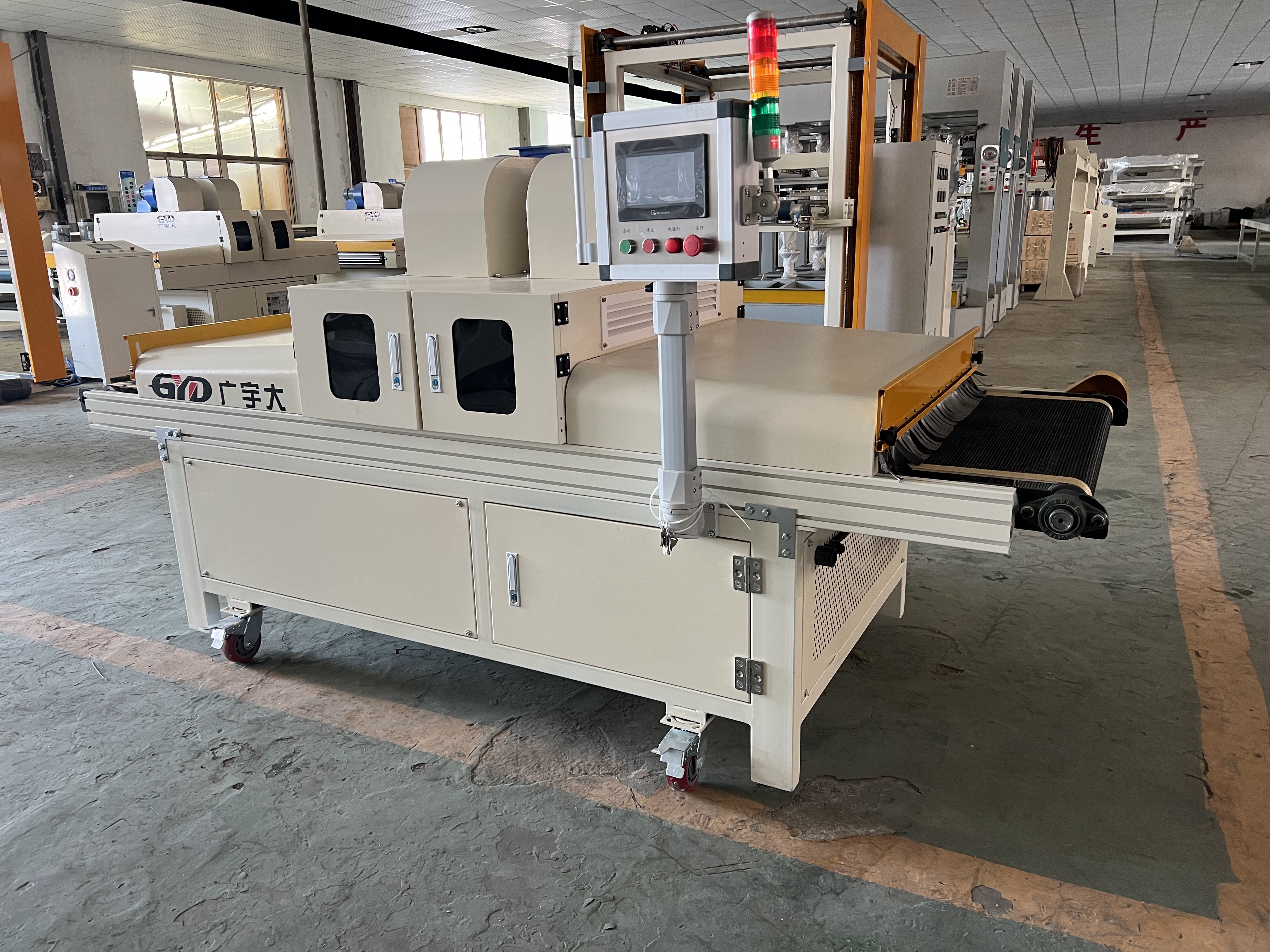
UV dryer machines range from handheld spot-curing units to flood lamps, benchtop conveyors, and wide industrial systems integrated into coating or printing lines. Spot units focus energy on a small area. Flood systems illuminate a larger field. Conveyor machines move products through a controlled exposure zone at a selected speed.
Industrial systems can include one or more lamps, adjustable lamp height, variable power, cooling fans, reflectors, shielding, and controls that coordinate light output with conveyor speed. A wood-finishing dryer, for example, may be configured for coatings on panels and may offer mercury, gallium, or LED options depending on the supplier and process. [1881][1893]
Medium-pressure mercury lamps emit a broad spectrum of UV and visible light. They are established in printing, wood finishing, coatings, and adhesive applications where compatible photoinitiators respond to their spectral output. Industrial conveyor systems may offer one, two, or three lamps, with adjustable power and speed depending on their design. [1888]
Mercury systems can generate substantial heat and typically require cooling. Lamp output changes with operating hours and condition, so process quality should be checked with suitable measurement equipment rather than inferred from the lamp's appearance. Follow the manufacturer's guidance for warm-up, cleaning, replacement, and disposal.
Gallium-doped lamps shift the spectral output toward longer wavelengths compared with standard mercury lamps. They may be used for colored or pigmented coatings when the formulation responds better to that output. Iron-doped lamps and other lamp types are also available for specialized curing needs. The best choice depends on the coating chemistry, pigment, thickness, and cure specification.
A UV dryer supplier should confirm that the proposed lamp spectrum matches the coating supplier's recommendations. For demanding applications, test the actual material on the actual substrate at the target production speed.
UV LED machines emit narrow wavelength bands, commonly including 365, 385, 395, or 405 nanometers. Matching LED wavelength to the photoinitiator is essential because an LED does not provide the same broad spectrum as a mercury lamp. LEDs often provide instant switching, controllable output, and lower heat transfer toward the workpiece, which can be useful for heat-sensitive substrates. [1880]
LED systems still require thermal management. Heat generated within the LED array must be removed to maintain stable output and protect components. Air-cooled and water-cooled designs are available. When comparing machines, consider irradiance at the product, illuminated width, working distance, cooling design, and control interface—not only the electrical rating.
Conveyor UV dryers support repeatable processing of panels, printed parts, and components. Product dimensions, line speed, lamp spacing, and exposure-zone length determine how much energy each part receives. For example, one supplier lists a UV drying tunnel with a working width from 350 to 1,350 millimeters and adjustable conveyor speed; these are product-specific specifications, not universal industry standards. [1893]
Flood systems suit larger areas or batches when the light distribution is sufficiently even. Spot-curing systems provide localized exposure for assembly or repair. A part with recessed areas or shadowed joints may need multiple lamp positions, rotation, or a different curing strategy because UV light cannot reliably cure areas it cannot reach.
When the lamp or LED array illuminates a compatible material, photoinitiators absorb energy and generate reactive species that initiate polymerization. The formulation, wavelength, intensity, exposure duration, coating thickness, pigment, substrate, and oxygen exposure can all influence the result.
The machine must deliver adequate energy across the working area. Distance from the source, reflector condition, protective glass, lamp aging, conveyor speed, and part position can alter the exposure received by the coating. A UV radiometer designed for the relevant wavelength range can help measure output at the work plane. [1880]
Irradiance describes the UV power arriving at a surface at a moment in time. Dose, or energy density, is the total UV energy received over the exposure period. In simplified form, dose equals irradiance multiplied by exposure time. For conveyor systems, the exposure time depends on the active illuminated length and conveyor speed.
This relationship helps explain why simply raising line speed can cause under-curing. If exposure time falls, the formulation may receive less total energy unless the process compensates in a validated way. Conversely, excessive exposure may waste energy or affect sensitive substrates. Establish the required dose and confirm it at operating conditions with measurement and cure testing.
Mercury lamps and LED arrays need thermal management appropriate to their design. Conveyor UV dryers may also include exhaust, guarding, interlocks, sensors, variable-speed drives, and production-line communication. Integration with coating, printing, or assembly equipment helps ensure that the product arrives at the curing station in the intended condition and that the line does not continue when a safety-critical function is unavailable.
Wood-finishing lines use UV dryers to cure compatible primers, sealers, topcoats, fillers, and specialty coatings on furniture, flooring, doors, and decorative panels. Conveyor systems help maintain repeatable exposure for flat products moving continuously through the line. Commercial systems are available with adjustable conveyor speeds and lamp configurations suited to production needs. [1881][1884]
The coating must be matched to the lamp. Pigmented or thick layers may absorb or scatter light, and panel edges or shaped areas can receive a different dose from the main surface. Trials should assess the full coating stack and verify properties such as hardness, adhesion, gloss, and abrasion resistance.
UV inks and coatings can be cured inline after printing, helping products move to subsequent converting steps without long waits. Conveyor UV dryers may serve printed paper, plastics, glass, metal, and laminated materials. Supplier listings describe systems for UV screen inks, adhesives, and printed circuit boards, with working widths, lamp counts, and conveyor speeds varying by model. [1888]
In printing, consistency across the full width matters. Uneven intensity may affect adhesion, rub resistance, gloss, or downstream performance. Check reflectors, optics, lamp condition, and web position, and measure irradiance across the working zone as part of process verification.
UV-curable adhesives are used where light can reach the bonding area and rapid fixation is valuable. Electronics and industrial assembly may use spot or flood systems to secure components or cure protective layers. Opaque parts can block UV, so hidden bondlines require special attention and may need a light-transmitting substrate, secondary cure chemistry, or another joining process.
For high-reliability or regulated products, define a documented process window. Keep records of material lots, lamp output, exposure settings, line speed, and relevant inspection results. A machine's specifications alone do not establish finished-product compliance.
Obtain the coating or adhesive technical data sheet and confirm its required wavelength range, exposure dose, film thickness, and cure test. Identify the substrate's transparency, reflectivity, heat sensitivity, geometry, and surface preparation. If the material supplier has not validated the intended light source, arrange a trial before specifying equipment.
Include worst-case products in the test: darkest pigment, thickest film, fastest line speed, most recessed geometry, and maximum working width. Check whether the cure is complete through the layer or bond, not only at the visible surface.
Define product width, length, height, weight, spacing, required line speed, shift pattern, and expected uptime. For conveyors, ensure that the belt and opening accommodate both the largest product and the required lamp arrangement. A supplier may offer variable speed and lamp adjustment, but verify the usable range under actual process conditions. [1893]
For custom systems, specify whether the product needs top-side exposure only, underside exposure, angled lamps, or multi-sided curing. Some flat panels may require angled lamps to cure coating on edges or sides. [1893]
Compare more than purchase price. Include electrical demand, cooling, lamp or LED replacement, spare parts, installation, shielding, radiometer availability, training, and service response. A system with lower nominal power may deliver inadequate cure at the required speed, while a higher-powered system may be unnecessarily expensive for a low-dose application.
Ask the supplier for a sample trial, a written acceptance protocol, and recommendations for output measurement. Confirm that the proposed safety controls and guarding match the installation and applicable local requirements.
A tacky surface or weak bond can result from insufficient dose, incorrect wavelength, aging lamps, excessive line speed, coating that is too thick, or obstruction of the light path. Pigments and fillers may reduce penetration. Verify lamp output at the product plane, inspect optics, and confirm that the formulation is designed for the installed source.
Do not assume that reducing conveyor speed alone solves every cure issue. It may help, but if the wavelength is incompatible or a shadowed bondline blocks the light, the process still may not cure correctly.
Uneven cure can result from lamp alignment, reflector condition, product tracking, inconsistent coating application, or varying distance from the source. Map UV output across the working width and inspect representative products from the edges and center. Adjustments should be verified with the relevant material test.
Traditional lamps can transfer heat to the product. Heat-sensitive plastics, thin films, and composite substrates may warp or discolor if exposure is excessive. LED systems can reduce heat directed toward the product in many configurations, but they still require validation and good thermal design. [1880]
Direct or reflected UV radiation can injure eyes and skin. Enclose the curing zone where practical, use suitable shielding and interlocks, and prevent access to an energized source. Workers should not look directly at an operating lamp. Appropriate UV-rated eyewear and protective clothing should be selected for the actual source and task. [1879][1880]
Measure stray radiation if exposure outside the enclosure is uncertain, and follow the machine maker's instructions and workplace hazard assessment. UV-curing materials may also emit vapors, so ventilation and local exhaust should be evaluated separately from UV exposure protection. [1879]
Clean lamps, reflectors, protective windows, and cooling filters using approved procedures. Dust or coating deposits can reduce delivered energy. Check fans, water-cooling circuits, belt tracking, guards, interlocks, and electrical connections according to the maintenance schedule.
Track lamp or LED hours and periodically measure output with an appropriate radiometer. If a recipe, material, lamp, distance, or line speed changes, revalidate the process. Keep maintenance and calibration records so output drift can be detected before it creates defects.
No. A heat dryer primarily removes water or solvent through evaporation. A UV dryer cures compatible materials through a light-initiated chemical reaction. Some production lines need both a drying stage and UV curing.
Neither is universally better. Mercury lamps provide broad-spectrum output that suits many established formulations. LEDs offer narrow wavelength bands, instant switching, and often lower heat transfer to the product. The coating chemistry, output needs, cooling, and operating costs determine the choice. [1880]
Use the coating supplier's specified test, which may assess tack, adhesion, hardness, rub resistance, or another property. Measure delivered UV output at the product plane and test at the intended production speed. Visual inspection alone may not establish full cure.
Sometimes, but pigments can absorb or scatter UV and limit penetration. The formulation, lamp spectrum, dose, and film thickness must be validated together. Some finishing systems offer mercury, gallium, or LED configurations for different coating responses. [1881]
Conveyor speed affects how long a product remains under the light source and therefore the UV dose it receives. A faster line may reduce exposure and cause under-curing unless the process is designed and validated for that speed.
Typical maintenance includes cleaning optical surfaces, checking cooling and ventilation, inspecting conveyor tracking and safety interlocks, and monitoring lamp or LED output. Follow the equipment maker's schedule and record output measurements.
Use shielding and interlocks, prevent direct or reflected exposure, provide appropriate UV-rated eye and skin protection, train operators, and assess ventilation for process emissions. Never bypass guards or look directly at an operating UV source. [1879][1880]


