
Views: 294 Author: 广宇大 Publish Time: 2026-11-25 Origin: Site


Content Menu
● What Are You Actually Comparing?
>> Compare the Same Quality Standard
● Where Automation Can Improve Productivity
● Where Manual Finishing Still Makes Sense
>> Complex or Unusual Geometry
● Compare Long-Term Cost, Not Purchase Price
>> Include the Full Cost Stack
>> Beware of Misleading Ratios
● Measure Material Savings Carefully
>> Understand Transfer Efficiency
>> Track Consumption per Accepted Product
● Build the Comparison in Five Steps
>> Step 2: Define Alternatives
>> Step 3: Test Representative Products
>> Step 4: Model Three Scenarios
>> Step 5: Check the Commercial Benefit
● Safety and Compliance Cannot Be an Afterthought
● Discuss Your Comparison with GYDFinishing
>> 1. Is automatic spray finishing always cheaper than manual finishing?
>> 2. Does automation guarantee better coating quality?
>> 3. How much paint will an automatic line save?
>> 4. Should labor savings be counted as cash savings?
>> 5. When does manual finishing remain a sound choice?
>> 6. What should an acceptance trial measure?
Define both options before comparing cost.
An automatic linear spray line moves products through an in-line process. It may include feeding, spraying, leveling, drying or curing, inspection, and unloading. Manual finishing relies on operators to position, spray, inspect, and often correct the work.
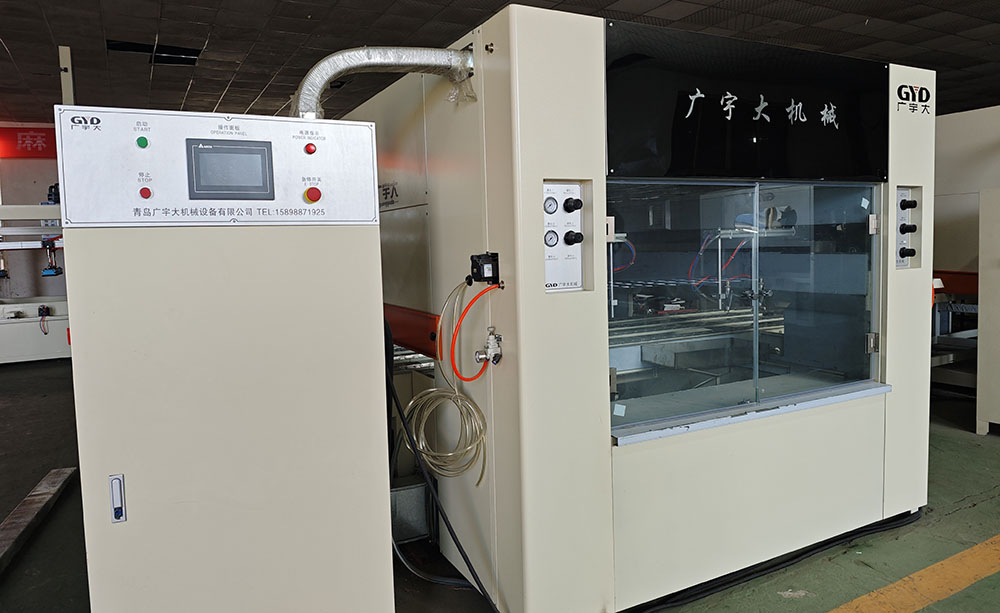
Include the same process boundary on both sides. Manual finishing still needs booth ventilation, material handling, drying, inspection, and rework. An automatic line adds integration and maintenance responsibilities.
Do not compare a complete manual operation with a machine-only quotation.
Use identical finish requirements, including coverage, appearance, film build, and acceptance limits. A cheaper process is not an improvement if it relaxes the specification.
Graco says operator technique can affect transfer efficiency by 10 to 30 percent. It recommends training on spray distance, perpendicular spraying, and correct triggering and de-triggering. It also notes that a paint robot applies the same technique each time. [2761]
That supports a clear point: automation can reduce operator-to-operator variation. It does not remove the need to set the process correctly.
Faster spraying only helps if the rest of the line can keep up. Loading, drying, inspection, and unloading may limit output.
Measure accepted output per shift, not machine speed. Include product spacing, changeovers, interruptions, cleaning, and rejects.
Automation can move people away from repetitive spraying. They may then work on preparation, inspection, maintenance, or material control.
Treat that as released capacity first. It becomes a cash saving only when payroll, overtime, or temporary labor actually falls.
Programming, fixtures, cleaning, and validation take time. If batches are small and products change constantly, a manual or semi-automatic process may deliver better flexibility.
Operators can reach recesses, repair local defects, and adapt to unusual parts. An automatic line must be proven on those same features.
Do not assume that more guns or a programmed path will cover every surface.
If future volume is unclear, the largest investment carries the greatest risk. Compare phased automation, targeted upgrades, and a full line under conservative demand scenarios.
For each option, include:
- Equipment, installation, and commissioning.
- Coating and cleaning materials.
- Direct labor and supervision.
- Energy, extraction, and compressed air.
- Filters and consumables.
- Maintenance and spare parts.
- Rework, rejects, and disposal.
- Training and ramp-up losses.
US DOE guidance describes life-cycle cost analysis as the sum of present values of investment, capital, installation, energy, operating, maintenance, and disposal costs over a project's life. Future costs are discounted to the present, and mutually exclusive options can be compared by lowest life-cycle cost or highest net savings. [2877]
That guidance was written for federal energy and water projects. Use it as a framework, not as a source of discount rates or assumptions for your factory. Ask your finance team to set those.
The same DOE document cautions that savings-to-investment and adjusted internal rate of return metrics may favor less efficient options and should not decide accept-or-reject choices between mutually exclusive projects. [2877] Use them for ranking, not as the final decision rule.
Transfer efficiency compares how much sprayed paint reaches the part with how much passes it and is wasted. [2761] Higher transfer efficiency means less paint must be sprayed for the same finish, which can also cut VOC release and extend filter life. [2761]
Graco explains that ASTM and EN 13699-1 can give very different results. For example, an HVLP gun showed 25 to 32 percent under ASTM and 70 to 78 percent under EN. [2761] Never compare supplier percentages unless they use the same method.
Measure total coating and cleaning-material use against products that meet specification. Include startup, flushing, leftover mixtures, and rejects. Lower consumption from thinner, non-compliant film is not a saving.
Capture current accepted output, labor hours, material use, defects, downtime, and changeover time. Group products by similar geometry and coating.
Compare the existing manual process, an optimized manual process, a semi-automatic option, and an automatic line. Do not compare a polished proposal against a deliberately weak baseline.
Run difficult parts, normal batch sizes, a product change, an interruption, and a restart. Record coverage, finish quality, material use, and cleaning time.
Build conservative, expected, and higher-demand cases. Vary utilization, product mix, maintenance, and ramp-up. Identify which assumptions change the decision.
If automation creates extra capacity, confirm that you can sell and ship the additional output. Value it at contribution after variable costs, not at full sales revenue.
Both manual and automatic spraying need appropriate ventilation, ignition control, and housekeeping.
OSHA's spray finishing standard defines a spray booth as a power-ventilated structure that confines spray, vapor, and residue and directs them to exhaust. It requires mechanical ventilation during spraying and long enough afterward to exhaust vapors from drying articles and residue. [1720] It also requires spraying areas to be kept as free as practical of combustible residue, with cleaning daily if necessary. [1720]
For electrostatic equipment, the standard adds requirements for approved apparatus, safe distances, fail-safe controls, guarding, and ventilation interlocks. [1720]
These are US requirements. Have a qualified specialist assess your local obligations and the actual installation.
According to your company background, GYDFinishing was founded in 2007 and provides machinery and surface-finishing solutions for wood, glass, fibre cement, and other materials. Its stated focus includes automatic coating equipment for wooden doors, furniture, cabinet doors, and flooring, from single machines to turnkey lines.
To get a useful comparison, send Guangyutai Machinery:
- Product drawings and representative samples.
- Coating technical and safety data sheets.
- Current output, labor, material, and defect records.
- Batch sizes, changeover frequency, and appearance standards.
- Factory layout, utilities, and growth targets.
Request alternatives for optimized manual, partial automation, and full line options. Ask for a representative trial with agreed measurement methods before you commit.
No. The result depends on volume, product variety, finish standard, labor cost, maintenance, and utilization. Compare full life-cycle cost per accepted product.
No. It can repeat a validated spray method more consistently, but preparation, coating condition, geometry, drying, and setup still determine the finish. [2761]
There is no universal figure. Transfer-efficiency percentages depend on the test method, applicator, geometry, and setup. Measure consumption per accepted product in a representative trial. [2761]
Only when payroll, overtime, or temporary labor actually falls. Otherwise, treat it as released capacity.
It can suit low volumes, frequent changeovers, difficult geometries, or uncertain demand, provided it meets quality, safety, and cost requirements.
Measure coverage, finish quality, accepted output, material use, cleaning time, changeover, staffing, and restart behavior under representative conditions.
1. Graco. "[Tips for Improving Transfer Efficiency]." Used for transfer-efficiency definition, ASTM and EN 13699-1 differences, operator technique, robotic consistency, and filter-life effects. [2761]
2. US Occupational Safety and Health Administration. "[29 CFR 1910.107 – Spray finishing using flammable and combustible materials]." Used for spray booth definition, ventilation, residue control, and electrostatic safeguards. [1720]
3. US Department of Energy, Federal Energy Management Program. "[Guidance for the Implementation and Follow-up of Identified Energy and Water Efficiency Measures in Covered Facilities]," September 2012. Used for life-cycle cost principles, present-value comparison, and cautions on savings-to-investment ratios. [2877]


