
Views: 259 Author: 广宇大 Publish Time: 2026-11-25 Origin: Site


Content Menu
● What "Integrated" Means in a Spray Finishing Line
● Where Efficiency Gains Come From
>> Less Handling Between Steps
● Where Profit Margin Improvement Comes From
>> 3. Labor
● A Hypothetical Margin Example
● Use Life-Cycle Cost, Not Simple Payback Alone
● Build Safety and Compliance Into the Line
● How to Verify Gains Before and After Purchase
● Questions to Ask Any Supplier
● Discuss Your Finishing Line with GYDFinishing
>> 1. Does an integrated spray line always increase profit margins?
>> 2. Is a faster conveyor the main efficiency benefit?
>> 3. Can I trust a quoted transfer-efficiency percentage?
>> 4. How should I treat labor savings?
>> 5. Which decision metric should I use?
>> 6. What safety systems should an integrated line include?
A standalone sprayer is one machine. An integrated line coordinates several steps so products move through them with little manual transfer.
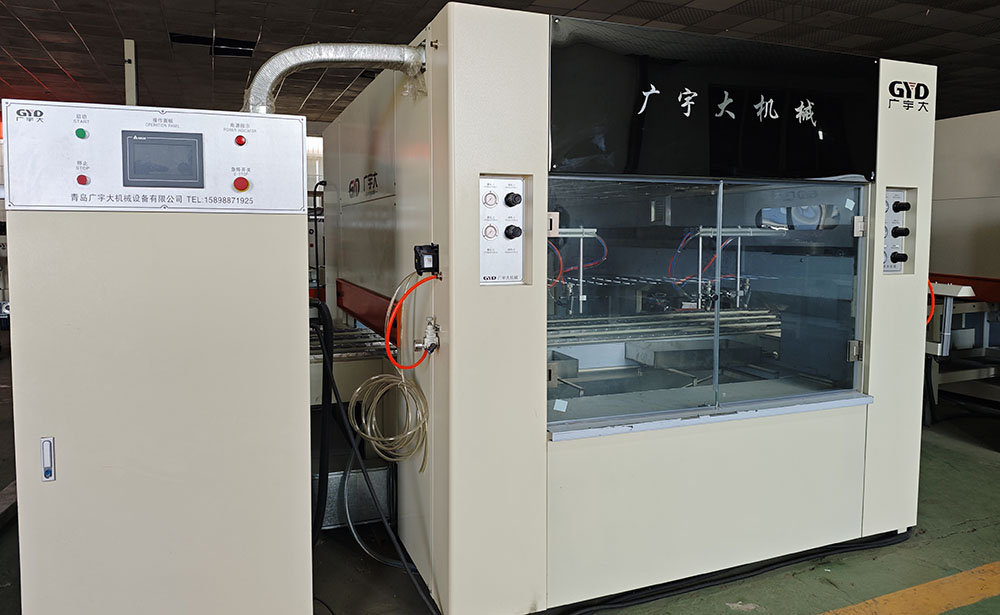
An integrated linear line may include:
- Loading and product positioning.
- Surface cleaning or dust removal.
- Spray application.
- Leveling or flash-off.
- Drying or curing.
- Inspection and unloading.
The exact arrangement depends on the product, coating, and quality standard.
"Integrated" does not tell you what is in the quotation. Ask who supplies extraction, material delivery, controls, curing equipment, installation, and training. Written interfaces matter more than the word turnkey.
Each manual transfer adds waiting, handling risk, and labor. A coordinated line can reduce those transfers. Map your current flow first so you know which handoffs actually cost you time.
Output is set by the slowest stage. If drying or inspection cannot keep pace, a faster spray station only builds a queue. Measure accepted output per shift, not conveyor speed.
Graco says operator technique can change transfer efficiency by 10 to 30 percent. It recommends training on spray distance, perpendicular spraying, and correct triggering and de-triggering, and notes that with a paint robot the spray technique is consistent each time. [2761]
So automation can reduce operator-to-operator variation. It only helps if the programmed technique is correct for your product.
An integrated line can stop, hold, and restart as one system. That helps only if you define how products in the line are identified and released after a stop.
Efficiency becomes margin only when it lowers cost per accepted product or adds sellable output. Look at four sources.
Graco defines transfer efficiency as how much paint spray covers a part compared with how much sprays past it and is wasted. [2761] Spraying less paint to get the same finish reduces VOC release and lengthens booth-filter life. [2761]
Be careful with supplier percentages. Graco explains that the ASTM and EN 13699-1 tests give very different results for the same applicator. For example, an HVLP gun tested to ASTM shows 25 to 32 percent transfer efficiency, while the same gun tested to EN shows 70 to 78 percent. [2761] Ask which method any quoted number used.
Count only defects the line actually removes. Record each defect type and its repair route, such as respraying, sanding, or scrap. Do not assume every historical defect came from manual spraying.
Separate cash savings from released capacity. Cash savings occur when payroll, overtime, or temporary labor falls. Redeployed labor creates capacity, which has value only if it is used productively.
Count additional output only if you can sell and ship it. Value it at contribution margin after variable costs, not at the full sales price.
An integrated line also adds costs:
- Maintenance, spare parts, and consumables.
- Utilities, extraction, and compressed air.
- Programming, software support, and training.
- Cleaning and changeover material.
- Ramp-up scrap and lost production during installation.
Subtract these from your benefits. A model that lists only savings is not a business case.
These numbers are invented to show the method. They are not benchmarks, and they do not describe any GYDFinishing line.
Assume a factory finishes 100,000 accepted units per year at a selling price of 40 currency units each, with a total finishing and other cost that leaves a gross margin of 12 units per unit, or 12 percent of 100...
To keep this clean, use finishing cost only. Assume current finishing cost is 9.00 per accepted unit, or 900,000 per year. After the integrated line, assume coating falls by 0.60 per unit, rework and rejects fall by 0.50 per unit, and cash labor falls by 0.90 per unit. Assume the line adds 0.40 per unit in maintenance, utilities, and consumables.
New finishing cost per unit is 9.00 minus 0.60, minus 0.50, minus 0.90, plus 0.40. That equals 7.40. The saving is 1.60 per unit, or 160,000 per year at 100,000 units.
If the line costs 800,000 installed, simple payback is five years. If the labor saving were released capacity rather than cash, the saving would fall to 0.70 per unit, or 70,000 per year, and payback would stretch to about 11.4 years.
That sensitivity is why you must test each assumption.
US Department of Energy guidance describes life-cycle cost analysis as the sum of the present values of investment, capital, installation, energy, operating, maintenance, and disposal costs over a project's life. Future costs are discounted to the present. [2877]
For mutually exclusive options, DOE recommends comparing lowest life-cycle cost or highest net savings. It warns that savings-to-investment ratio and adjusted internal rate of return may favor less efficient options and must not be used to accept or reject mutually exclusive projects. [2877]
That guidance covers federal energy and water projects. Use its logic, and let your finance team choose the discount rate and evaluation period.
A line that stops for a safety problem cannot protect margin. Include safety in the design review.
OSHA's spray finishing standard requires mechanical ventilation adequate to remove flammable vapors, mists, or powders. It must run at all times during spraying and long enough afterward to exhaust vapors from drying articles and residue. [1720]
In conventional dry booths with overspray filters, the average air velocity over the open face must be at least 100 linear feet per minute. Electrostatic spraying may use at least 60. Visible gauges, audible alarms, or pressure-activated devices must indicate or ensure that velocity is maintained. [1720]
For fixed electrostatic equipment, OSHA requires automatic controls that disconnect power without delay and signal the operator when ventilation fails, the conveyor stops, a ground occurs or is imminent, or required clearance is reduced. [1720]
Spraying areas must be kept as free as practical of combustible residue, with cleaning daily if necessary. [1720] These are US requirements. Have a qualified specialist assess your local obligations and the installed system.
Run a trial on your own products and coating. Include difficult geometry, a product change, an interruption, and a restart. Record accepted output, coating use, cleaning time, and defects under agreed measurement methods.
Track accepted output, consumption, rework, labor, maintenance, and utilities against your baseline. Adjust the baseline only for documented changes such as product mix. Review during ramp-up and again each year.
- What exactly is included in the integrated scope?
- Which stage limits output, and how was that tested?
- What interfaces do I supply, such as extraction, utilities, and curing?
- How are alarms, interlocks, and safe restarts handled?
- What maintenance, spare parts, and training are included?
- Can I trial the line with my coating and products?
According to your supplied company background, GYDFinishing was founded in 2007 and provides machinery and surface-finishing solutions for wood, glass, fibre cement, and other materials. Its stated applications include wooden doors, furniture, cabinet doors, and flooring, from single machines to turnkey lines.
To get a useful proposal, send Guangyutai Machinery:
- Product drawings and samples.
- Coating technical and safety data sheets.
- Current output, rework, labor, and consumption records.
- Factory layout, utilities, and growth targets.
- Finish standards and acceptance criteria.
Ask for a clearly scoped quotation, a trial plan, and a written interface list. Then calculate cost per accepted product with your own data.
No. Margin improves only when cost per accepted product falls or you sell additional output. Results depend on product mix, utilization, quality, and new operating costs.
No. Line output is limited by the slowest stage. Measure accepted output per shift, including drying, inspection, and unloading.
Only if you know the test method. ASTM and EN 13699-1 can produce very different percentages for the same applicator. [2761]
Count them as cash only when payroll, overtime, or temporary labor falls. Otherwise treat them as released capacity.
Use life-cycle cost or net savings to compare mutually exclusive options. Use savings-to-investment ratio or adjusted internal rate of return only to rank projects when funds are limited. [2877]
Expect ventilation interlocks, airflow indication, grounding, and, for electrostatic systems, fail-safe controls. Confirm exact requirements with a qualified specialist and local rules. [1720]
1. Graco. "[Tips for Improving Transfer Efficiency]." Used for the transfer-efficiency definition, ASTM and EN 13699-1 differences and examples, operator technique, robot consistency, and VOC and filter-life effects. [2761]
2. US Occupational Safety and Health Administration. "[29 CFR 1910.107 – Spray finishing using flammable and combustible materials]." Used for ventilation, booth air velocity and indicators, electrostatic fail-safe controls, and housekeeping requirements. [1720]
3. US Department of Energy, Federal Energy Management Program. "[Guidance for the Implementation and Follow-up of Identified Energy and Water Efficiency Measures in Covered Facilities]," September 2012. Used for life-cycle costing, discounting, decision rules, and the limits of savings-to-investment ratio and adjusted internal rate of return. [2877]
The DOE guidance concerns federal projects. This article borrows its economic principles, not its federal parameters.


