
Views: 287 Author: 广宇大 Publish Time: 2026-11-25 Origin: Site


Content Menu
● What Is a Double Roller Color Coating Machine?
>> The Two Rollers and Their Roles
>> How It Differs from Other Roller Coaters
● How the Process Works Step by Step
>> Step 3: Transfer to the Panel
● Key Variables That Control the Result
>> Metering Gap
>> Liquid Viscosity and Surface Tension
>> Roller Surface and Hardness
● Suitable Substrates and Applications
>> Doors and Furniture Components
● Coating Types and Compatibility
>> Check Material Compatibility
● Setting Up the Machine Through Controlled Trials
>> Change One Variable at a Time
>> Measure the Result Consistently
>> Save the Confirmed Settings
● Common Defects and How to Investigate Them
>> Streaks Running With the Panel
>> Uneven Color Across the Width
>> Color Variation Between Panels
>> Marks at the Front or Rear Edge
>> Daily Tasks
>> Spare Parts
● Safety and Environmental Considerations
● How to Choose a Double Roller Color Coating Machine
>> Define the Liquid and Finish
>> Check Working Width and Controls
● A Practical Example of a Trial Record
>> What is a double roller color coating machine used for?
>> How does the gap between rollers affect the coating?
>> Can the machine coat panels with grooves or raised shapes?
>> Which coatings can be applied with a double roller coater?
>> Why does color vary from panel to panel?
>> How often should the rollers be cleaned?
>> Is a double roller color coater the same as a reverse roller coater?
A double roller color coating machine applies a thin, controlled layer of color to flat panels as they travel on a conveyor. Two rollers share the work: one picks up and meters the liquid, and the other transfers it to the panel. This arrangement suits wood-based boards, doors, cabinet panels, flooring, and other flat parts that need an even stain or color layer before further finishing.
This guide explains how the machine works, which variables control the result, how to set it up through controlled trials, and how to troubleshoot common defects. It also covers material compatibility, maintenance, safety, and the questions worth asking before you select equipment. The goal is to give production managers, process engineers, and buyers a practical reference they can use on the factory floor.
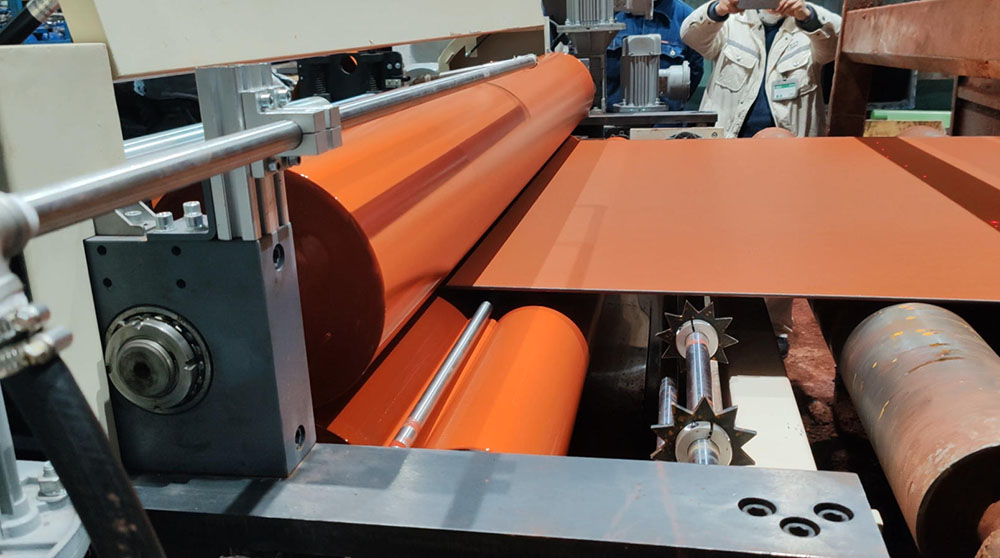
A double roller color coating machine, sometimes called a double roller roll coater, is a surface finishing system built around a pair of rollers and a conveyor. The conveyor carries the panel through the coating head, the rollers transfer color to the surface, and the panel then moves to drying or curing equipment.
In a typical arrangement, one roller is the applicator and the other is the metering roller, also called a doctor roller. The applicator presents the liquid film to the panel. The metering roller controls how much liquid the applicator carries forward.
Manufacturers describe several roller materials. Some machines use a rubber-covered applicator working with a chrome-plated steel metering roller. Others use a high-density sponge roller for color transfer, with the doctor roller spreading the colorant evenly over the sponge surface. The right choice depends on the coating type and the finish you want.
Roller coating equipment comes in several formats. A single roller unit suits simple primer or stain jobs. A reverse roller unit is used where a thin, smooth film is needed. A double roller unit is commonly used for color or for applying two layers in one pass. Edge coaters and bottom-surface coaters cover other surfaces.
Because naming varies between suppliers, ask for a diagram that shows each roller, its rotation direction, and its function. A model name alone does not tell you how the coating is metered.
Understanding the sequence helps you see where problems start.
Color is fed from a pan, reservoir, or pump system to the roller nip. Filtering the liquid before it reaches the rollers removes particles that could leave marks on the film.
The gap between the metering roller and the applicator roller controls the film that forms on the applicator. Roll speeds, rotation direction, and the liquid's flow behavior all influence that film. Technical references on roll coating describe thickness as the combined result of the gap, the roll speeds, and the fluid properties.
The applicator touches the panel surface as the conveyor moves it through. Contact pressure, roller hardness, and surface condition affect how much liquid transfers and how smooth the result looks.
The coated panel moves to the next stage. Depending on the liquid, this may be hot-air drying, infrared heating, or ultraviolet curing. The coating machine applies the color, and the film forms afterward. The drying or curing conditions must therefore match the formulation.
Consistent results depend on several variables working together. Changing one without checking the others often moves the problem rather than solving it.
The gap sets the starting film on the applicator. A smaller gap generally carries less liquid forward, and a larger gap carries more. However, the final wet film also depends on roller deformation, speed, contact, and how much the panel absorbs. The gap display on the machine is a setting, not a measurement of the film on the panel.
The surface-speed relationship between the rollers and the conveyor matters more than a single motor speed. Technical sources on reverse roll coating explain that the ratio of metering speed to applicator speed affects thickness and surface quality. Increasing the ratio can reduce thickness up to a point, after which the liquid's flow behavior can push thickness up again.
For that reason, record roller speeds, conveyor speed, and rotation directions together in the setup sheet. Do not rely on one general speed entry.
A thin color behaves differently from a heavy one. Viscosity changes with temperature, so a reading taken in a cold room may not match production conditions. Surface tension affects wetting and edge behavior. Ask the coating supplier for the working viscosity range and measure at the temperature used in production.
Rubber hardness, surface finish, and wear affect transfer. A worn or damaged roller leaves repeating marks. Sponge rollers can hold more liquid but may need more frequent inspection and replacement.
Moisture content, sanding quality, dust, and surface porosity change how the panel takes color. Wood-based boards can absorb liquid unevenly, so panel preparation is part of the coating process.
Double roller color coaters are built for flat or nearly flat surfaces.
Manufacturers list medium-density fiberboard, plywood, particleboard, and high-density fiberboard among common substrates. These panels are used for furniture, cabinets, wall panels, and flooring.
Flat door skins, drawer fronts, cabinet doors, and shelving can pass through the machine. Parts with deep grooves, raised moldings, or three-dimensional shapes need a separate assessment, because a roller reaches only the surfaces it contacts.
Suppliers also mention fiber cement boards, PVC sheets, glass, metal sheets, and some plastics. Adhesion and wetting differ widely between these materials. Test each one with the intended liquid before committing to production.
Because the film is thin and controlled, the machine can apply stain, tint, or solid color layers under a clear topcoat. Some producers use it to build color before a final protective layer. The visual result still depends on the liquid, the panel, and the drying process.
Several liquid types can be applied by roller. Common examples include water-based paint, UV-curable coatings, polyurethane, and nitrocellulose lacquer. Not every machine suits every liquid.
Confirm that roller covers, seals, pumps, and hoses resist the solvent or water carrier in your liquid. Ask the equipment supplier for written compatibility information. Request the coating's technical data sheet and compare it with the machine's specifications.
Changing color requires cleaning the pan, rollers, and supply lines. The time and material used in a color change affect total cost, especially in short production runs. Ask how the machine is cleaned and how long a typical change takes.
Some machines return excess liquid to the reservoir. Whether the recovered liquid can be reused depends on contamination, evaporation, and the coating supplier's guidance. Do not assume that all collected material can return to production.
A reliable setup comes from structured testing rather than guesswork.
Use production panels and the actual liquid. Record the liquid batch, viscosity and temperature, panel type, moisture condition, roller details, gap setting, roller speeds, directions, conveyor speed, and drying conditions.
Start from a recommended baseline. Adjust the gap, then check the result. Adjust speeds next. If you change several settings together, you will not know which one produced the effect.
Weigh panels before and after coating, or measure the wet film with a suitable gauge. Check appearance under the same lighting each time. Compare results across the panel width and along its length, because variation often appears at edges or at the front and rear ends.
Store the working values in a setup record linked to the product and liquid. Include the roller condition at the time of the test. When the same product returns, you can start from known values.
Run panels at the upper and lower ends of your normal viscosity and temperature range. The goal is a stable operating window, not one successful panel.
The following guide helps organize troubleshooting. It is a starting point, not a substitute for the supplier's instructions.
Machine-direction streaks can come from debris, damaged roller surfaces, or contamination in the liquid. Filter the liquid, inspect the roller surface closely, and check for foreign matter in the pan.
Ribbing appears as evenly spaced ridges. It can occur when the liquid is too thick to level or when the speed is too high for the roller geometry. Check viscosity at operating temperature and review the speed relationship between the rollers.
Uneven color may point to roller misalignment, uneven gap across the roller length, panel thickness variation, or inconsistent absorption. Measure the gap at both ends of the roller and compare panel thickness.
Check liquid mixing, batch differences, temperature changes, and panel moisture. Stir or circulate the liquid as the supplier advises, and keep samples from each batch for comparison.
Edge marks can result from roller contact timing, conveyor support, or liquid pooling. Review how the panel enters and leaves the roller contact area.
Poor adhesion often traces back to panel preparation, contamination, or incompatible layers rather than to the roller. Review sanding, cleaning, and the compatibility of each layer in the finishing system.
Regular care keeps results consistent and extends roller life.
Clean the pan and rollers after each shift or color change. Remove dried residue before it hardens. Inspect rollers for nicks, flat spots, and swelling. Check that the conveyor runs smoothly and that panels do not shift.
Verify gap calibration, roller alignment, and drive condition at scheduled intervals. Inspect bearings, seals, and filters. Keep records so you can see trends rather than isolated events.
Plan for roller recovering or replacement based on wear observed in inspections, not just on elapsed time. Keep spare rollers when production depends on a single machine.
Ask the supplier which parts are consumable and what lead times apply. A short list of critical spares can reduce downtime.
Roller coating avoids spray mist, but it does not remove all hazards.
Rotating rollers create pinch points. Machines should include guards, emergency stops, and clear lockout procedures for cleaning and maintenance. Operators need training on safe cleaning methods, especially around the roller nip.
Read the safety data sheet for every liquid and cleaner. Provide suitable ventilation, storage, and personal protective equipment. Solvent-based liquids may create flammable vapors, so assess ventilation and ignition control for the work area.
If ultraviolet curing follows the coater, protect operators from ultraviolet exposure and heat. Follow the lamp supplier's instructions for shielding and maintenance.
Plan for the disposal of contaminated cleaners, filters, and leftover liquid in line with local rules. Water-based and ultraviolet-curable liquids differ in emissions and waste, so evaluate the actual formulation rather than relying on a label.
Selecting equipment is easier when requirements are clear.
List panel dimensions, thickness range, weight, and surface condition. Include the smallest and largest parts you expect to run.
Provide the coating data sheets and describe the target appearance. Specify whether the machine will apply stain, color, or another layer, and what follows it in the line.
Express capacity as accepted panels per shift, not just conveyor speed. Include loading time, cleaning, color changes, inspection, and rejected panels.
Confirm the maximum working width, gap adjustment method, and how settings are displayed and recorded. Ask whether recipes can be stored and recalled.
Confirm how the machine connects to sanding, dust removal, drying, curing, and unloading. A coating machine works as part of a line, and the slowest stage limits total output.
Ask the supplier to run your panels and your liquid. Compare results against your finish standard and record material use, cleaning time, and defects.
Look beyond the purchase price. Include installation, utilities, maintenance, rollers and other consumables, cleaning materials, training, and rework. A lower price may cost more over time if it increases waste or downtime.
To make the process concrete, consider this hypothetical record. It is an illustration only and does not describe any real installation.
A factory runs a medium-density fiberboard cabinet panel with a water-based color. The team records the liquid viscosity at the working temperature, the panel moisture, the gap, both roller speeds, and the conveyor speed. They run five panels at the baseline setting and weigh each one before and after coating. They then change only the gap and repeat. After three adjustments, they compare appearance under the same lighting and choose the setting that gives consistent weight gain across panels without visible streaks.
They save that setting with the liquid batch and roller condition. When viscosity drifts in the afternoon because the room warms up, they check the record and adjust within the tested window. The value of the exercise lies in the documentation, which lets any operator reproduce the result.
Before purchase, ask these questions:
- Which rollers does the machine use, and what are their materials and diameters?
- How is the gap adjusted, and how accurate is the display?
- How are the rollers cleaned, and how long does a color change take?
- Which liquids has the machine been tested with, and can you share the results?
- What safety guards and emergency stops are fitted?
- What spare parts and service support are available?
- Can you run a trial with my panels and liquid?
It applies a controlled layer of color, stain, or similar liquid to flat panels such as wood-based boards, door skins, cabinet panels, and flooring. The coated panel then moves to drying or curing.
The gap sets the film that forms on the applicator roller before transfer. A smaller gap generally carries less liquid. The final wet film also depends on roll speeds, roller deformation, liquid properties, and panel absorption, so test settings on real panels.
Roller coating suits flat surfaces. A roller reaches only the areas it touches, so deep grooves, moldings, and three-dimensional parts need a separate method or a trial to confirm coverage.
Water-based paint, ultraviolet-curable coatings, polyurethane, and some lacquers are commonly applied by roller. Compatibility depends on the machine's materials and the specific formulation, so check the data sheets and ask the supplier for written confirmation.
Common causes include viscosity or temperature changes, batch differences, uneven panel moisture, worn rollers, and inconsistent settings. Record the conditions for each run and change one variable at a time when investigating.
Clean them at least after each shift and at every color change, or more often if the liquid dries quickly. Inspect rollers regularly for damage and replace them based on wear rather than elapsed time alone.
No. Naming varies, and the two are not interchangeable terms. Ask the supplier for a diagram showing each roller, its direction of rotation, and its function.


